


Best overall: a round diamond with a single halo. Best for an elongated look: an oval diamond with a fine halo. Best for subtle detail: a hidden halo. These are ten halo diamond ring design directions to compare in 2026, not ten verified product listings.
- A round diamond with a single halo is the best overall halo diamond ring design for a classic look.
- Choose an oval with a fine halo for an elongated outline; choose a hidden halo for less face-up detail.
- Balacia offers custom design options, but confirm the exact halo, center stone and setting before ordering.
Why this matters
A halo changes more than the amount of sparkle around a center stone. Its outline affects how you see the diamond’s shape, while its height and placement affect the ring’s side view and how a wedding band sits beside it. If you’re considering a custom ring, start with the custom engagement ring styles guide, then bring a short list of design priorities to the conversation.
Balacia is a useful starting point for couples who want to discuss a custom halo diamond ring rather than assume a preset design has every detail they want. The distinction matters: a ring that looks right from above still needs a side profile you love wearing.
What makes the best halo diamond ring?
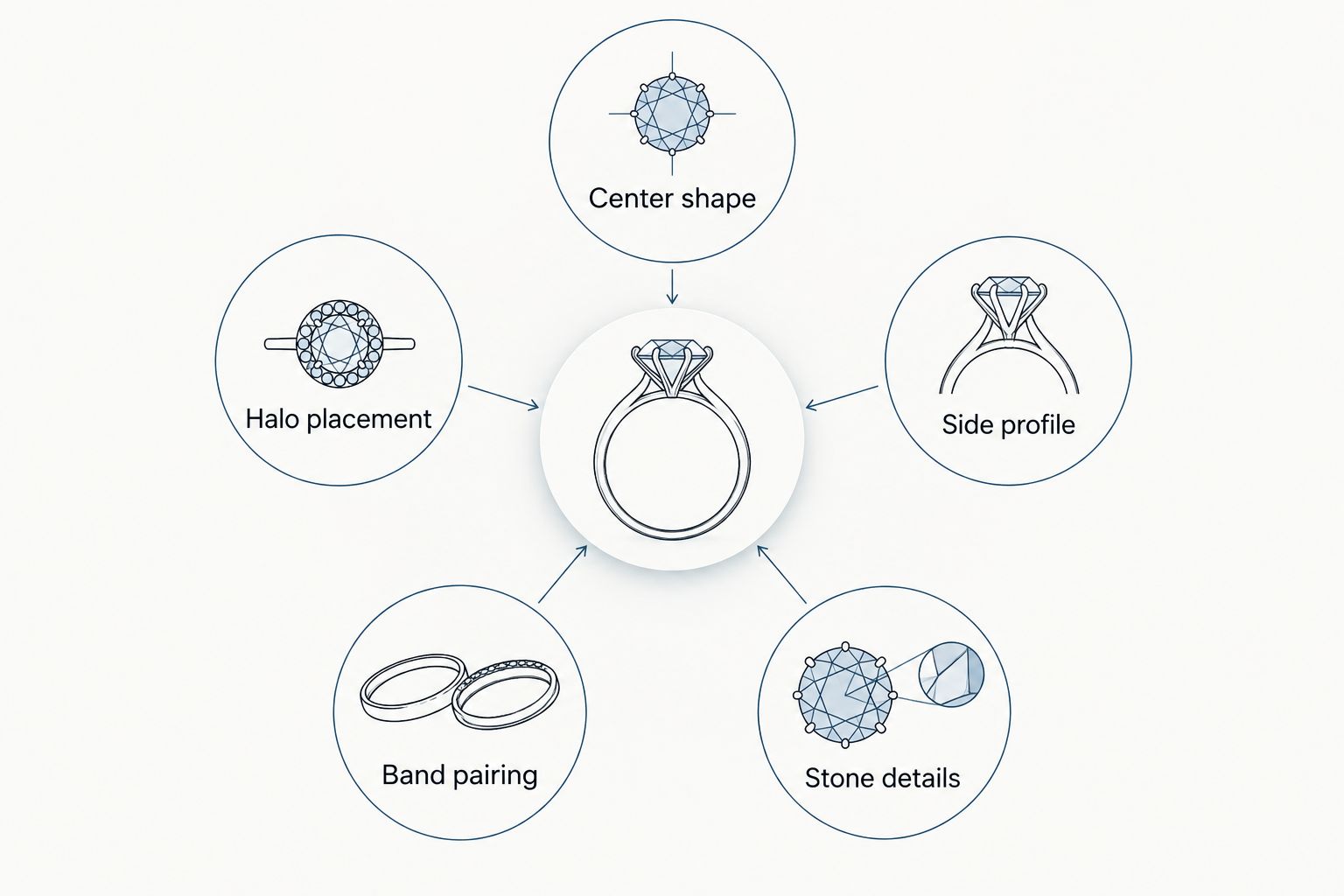
Use these criteria before choosing a favorite photograph. A halo should support the center stone and the way you plan to wear the ring, not simply add more detail.
- Center shape: A round center gives a balanced outline; oval, pear and marquise shapes draw the eye along the finger. Choose the shape you want to see first, then decide how closely the halo should follow it.
- Halo placement: A face-up halo frames the center stone when you look down at your hand. A hidden halo sits below the center stone and is more apparent from the side.
- Side profile: Look at the setting from eye level. A raised halo creates a different silhouette from a lower-set design, even when their top views look similar.
- Band pairing: Decide whether a flush-fitting wedding band matters to you. The setting and halo can affect how closely another ring sits against it.
- Stone details: Ask which stones are diamonds, whether the center is lab-grown or natural, and what documentation applies to the exact stone. Do not treat a certification claim for one stone as a claim about every stone in the ring.
A useful comparison has both a top view and a side view. The top view tells you whether the outline feels right; the side view helps you judge height, visible halo placement and band fit before you commit to a design.
The best halo diamond ring styles at a glance
| Rank and design | Best for | Standout feature | Key limitation |
|---|---|---|---|
| 1. Round single halo | A classic face-up look | Balanced circular outline | Halo competes with a delicate solitaire look |
| 2. Oval fine halo | An elongated outline | Follows the oval center | Proportions need a close top-view check |
| 3. Cushion halo | A soft square outline | Rounded corners | Can look broad beside a narrow band |
| 4. Pear halo | A distinctive point | Tapered silhouette | The tip needs attention during design review |
| 5. Emerald-cut halo | Clean geometric lines | Contrast around a step-cut center | Busy halos can distract from the center |
| 6. Radiant-cut halo | Defined corners with lively facets | Strong rectangular outline | Shape can feel crowded with a wide halo |
| 7. Marquise halo | A long, pointed silhouette | Follows both tapered ends | Tip and spacing details matter |
| 8. Double halo | Maximum face-up detail | Two surrounding rows | Less restrained than a single halo |
| 9. Hidden halo | Subtle side-view detail | Detail below the center | Limited face-up halo effect |
| 10. Floral halo | A vintage-inspired outline | Petal-like framing | Less suited to a clean geometric look |
These ranks compare design concepts, not verified Balacia halo ring listings. Use the table to choose a direction, then confirm which details are possible for the exact ring you want.
1. Round single halo: best halo diamond ring for a classic look
A single halo follows the round center stone, so the ring reads as one circular composition from above. It is the clearest starting point if you like traditional diamond rings but want a more detailed outline than a solitaire.
Round single halo pros:
- Easy to assess from both top and side views.
- Keeps the center shape visually familiar.
- Works as a reference point when comparing other halo styles.
Round single halo cons:
- It will not satisfy someone who wants an uninterrupted solitaire outline.
- A prominent halo can draw attention away from the center stone.
Best for: Someone who wants a recognizable halo without committing to an unusual center shape. Ask to compare a delicate halo with a more pronounced one before settling on the proportions.
Verdict: Buy this design direction if your first reaction to a classic round engagement ring is that it needs a little more framing.
2. Oval fine halo: best for an elongated outline
An oval center and a close-fitting halo carry the eye along the length of the stone. Keep the halo proportionate: if the surrounding detail becomes the first thing you notice, you may lose the oval silhouette you chose in the first place.
Oval fine halo pros:
- Emphasizes the oval’s length.
- Gives you a softer outline than pointed shapes.
- Offers a clear contrast with the round single halo.
Oval fine halo cons:
- A thick halo can make the overall outline look wider than intended.
- Top-view appeal does not tell you how high the setting sits.
Best for: Someone who wants an elongated shape without pointed ends. Compare the oval’s outline with the proposed halo outline, not just a close-up of its center stone.
Verdict: Buy the oval direction if length and a soft perimeter are both priorities.
3. Cushion halo: best for a soft square outline
A cushion center has rounded corners, giving a halo a shape between round and square. This style suits you if you want a defined outline without the sharp geometry of an emerald or radiant cut.
Cushion halo pros:
- Rounded corners soften the overall shape.
- The halo can echo the cushion outline.
- Easy to compare against a round halo for shape preference.
Cushion halo cons:
- A broad outer outline can feel heavy beside a slim band.
- Corner proportions change the look substantially.
Best for: Someone who likes a square-leaning ring with a gentler perimeter. Check whether the proposed halo follows the center closely or changes its outline.
Verdict: Hold until you have seen the cushion and halo together from above and on the hand.
4. Pear halo: best for a distinctive tapered point
A pear center has a rounded end and a pointed end. A halo can reinforce that contrast, making orientation and spacing particularly important to the final look.
Pear halo pros:
- Has a recognizable silhouette.
- Combines a curved end with a tapered end.
- Gives you a clear alternative to an oval.
Pear halo cons:
- The point makes the outline less visually symmetrical.
- An uneven-looking gap around the tip is hard to ignore.
Best for: Someone who wants an elongated ring with more character than an oval. Look closely at how the halo follows the tip, and decide which direction you prefer the point to face when worn.
Verdict: Buy the pear concept if you love its asymmetry; skip it if you want a balanced outline from every angle.
5. Emerald-cut halo: best for clean geometric lines
An emerald-cut center has a rectangular outline and step-cut facets. A restrained halo can frame those straight edges without asking the ring to look like a round brilliant design.
Emerald-cut halo pros:
- Makes the center’s geometry the starting point.
- Offers a clear rectangular alternative to cushion shapes.
- Lets you compare spare and detailed design approaches.
Emerald-cut halo cons:
- A visually busy halo can compete with the center’s clean lines.
- Corner treatment needs a deliberate decision.
Best for: Someone who wants a structured shape but still likes the idea of surrounding detail. Review the center and halo together at normal viewing distance; extreme close-ups can obscure the overall balance.
Verdict: Hold if the halo overwhelms the rectangular center; choose a quieter frame instead.
6. Radiant-cut halo: best for a defined rectangular outline
A radiant-cut center gives you a rectangular or square-leaning outline with a different facet appearance from an emerald cut. Adding a halo makes the outer shape even more prominent, so decide whether you want the corners softened or emphasized.
Radiant-cut halo pros:
- Keeps a strong geometric outline.
- Distinguishes itself from a step-cut emerald center.
- Gives you room to prioritize either center or surrounding detail.
Radiant-cut halo cons:
- A wide halo can make the top view feel crowded.
- A photograph alone will not settle height or wedding-band fit.
Best for: Someone drawn to straight-edged shapes who does not want the quieter look of an emerald cut. Compare versions with similar outer proportions before judging the center shape.
Verdict: Buy the radiant direction if its center remains distinct inside the halo.
7. Marquise halo: best for a long, pointed silhouette
A marquise center tapers at both ends. A closely shaped halo emphasizes that long outline, making it a strong choice when the shape itself is the reason you love the ring.
Marquise halo pros:
- Presents an unmistakable outline.
- Draws attention along the center stone.
- Offers a pointed alternative to the oval.
Marquise halo cons:
- Both tips demand close attention in the design.
- A heavy halo can change the slender look you wanted.
Best for: Someone who wants a pronounced elongated shape rather than a softer oval. Inspect both ends in the top view and ask how the setting supports the center stone.
Verdict: Hold until the halo preserves the marquise outline instead of making it look broad.
8. Double halo: best for maximum face-up detail
A double halo places another surrounding row outside the first. Choose it because you enjoy a richly detailed ring, not because you assume more surrounding stones automatically make a better design.
Double halo pros:
- Makes the halo a major part of the look.
- Creates a clear contrast with understated settings.
- Gives you a deliberate choice about how much detail to show from above.
Double halo cons:
- Can visually compete with the center stone.
- Leaves less room for a restrained, minimal look.
Best for: Someone who consistently prefers elaborate settings when comparing rings side by side. View the complete ring at normal scale; a magnified image can make the detail easier to inspect but harder to judge as a whole.
Verdict: Buy only if you love the full composition, not just the close-up.
9. Hidden halo: best for subtle side-view detail
A hidden halo sits below the center stone rather than tracing its face-up outline. From above, the center remains the focus; from the side, the additional detail becomes part of the setting.
Hidden halo pros:
- Keeps the top view quieter than a face-up halo.
- Rewards attention to the ring’s side profile.
- Provides a useful middle ground between solitaire and visible halo styles.
Hidden halo cons:
- Does not deliver the framed top view many halo shoppers expect.
- Its effect depends on how the finished setting appears from the side.
Best for: Someone who wants a personal detail without making it the main event. Ask for a side view before deciding, and check how the setting meets a wedding band.
Verdict: Buy if subtlety is the goal; skip it if you want the halo visible every time you look down at your hand.
10. Floral halo: best for a vintage-inspired outline
A floral halo uses a petal-like arrangement rather than a simple continuous frame. It can make the setting feel decorative and romantic, especially when the center shape still reads clearly within the design.
Floral halo pros:
- Gives the ring a distinctive outer silhouette.
- Makes surrounding detail central to the design.
- Suits someone who prefers ornament over strict symmetry.
Floral halo cons:
- Not the right direction for a clean geometric look.
- Decorative details need careful review at normal viewing size.
Best for: Someone whose favorite rings feel expressive rather than minimal. Check that you love the entire outline, including the spaces between its petal-like elements.
Verdict: Buy if the decorative silhouette feels personal; skip it if you keep wishing the outline were simpler.
How these styles were ranked
The order favors a clear center shape, an understandable halo outline and a practical starting point for comparing top and side views. It does not rank named products by diamond grade, price or wear testing. Those judgments require details for the exact ring and center stone you choose.
For a 2026 design shortlist, pick one classic, one shape-led and one subtle option. Comparing three genuinely different looks tells you more about your taste than comparing minor changes to the same setting.
Which halo diamond ring should you choose?
Choose the round single halo if you are undecided. It gives you a straightforward reference for judging every other 2026 design: decide whether you want a longer shape, more surrounding detail or less visible halo. If the top view feels too decorated, move to a hidden halo. If it feels too familiar, compare oval, pear and marquise outlines.
Balacia offers custom design options, so bring your preferred center shape, halo placement and wedding-band priorities into the discussion. Confirm the exact stone details and setting rather than assuming a design concept describes a finished ring.
FAQ
What is the best halo diamond ring style in 2026?
A round diamond with a single halo is the best starting point for a classic look. Compare its top and side views with an oval halo and a hidden halo before deciding.
Is a hidden halo better than a regular halo?
A hidden halo is better when you want subtle side-view detail. Choose a face-up halo when you want the surrounding frame visible from above.
Does a halo change how an engagement ring looks from the side?
Yes, halo placement and setting height affect the side profile. Review a side view of the exact proposed design rather than relying on a top-view image.
Which halo works best with an oval diamond?
A fine halo that follows the oval is a clear choice when you want to preserve its elongated outline. Check that the outer frame does not make the design wider than you want.
Can a halo engagement ring sit flush with a wedding band?
Band fit depends on the exact setting and halo placement. Ask to see the proposed engagement ring and wedding band together before choosing either design.
Are all diamonds in a halo ring certified?
Do not assume every stone has the same documentation. Ask what documentation applies to the exact center stone and whether any claims extend to the surrounding stones.
Should I choose a double halo or a single halo?
Choose a single halo for a simpler frame and a double halo when you want surrounding detail to play a larger visual role. Compare both at normal viewing size, not only in close-up photos.
One last thing
Before you approve a 2026 halo diamond ring design, look at it beside the wedding band you intend to wear. A favorite top view is only part of the decision; the pair should look right together from the side, too.