


Radiant cut wedding rings pair rectangular or square outlines with trimmed corners and brilliant-style faceting, and the best one in 2026 depends on whether the setting actually protects those corners or leaves them exposed to chip.
- Radiant cut wedding ring styles range from bezel-set solitaires to hidden halo builds, and no two suit the same hand.
- The Radiant Cut Diamond Engagement Ring with Radiant Cut Side Diamonds is the best overall shape-matched pick for 2026.
- Bezel settings protect the four corners better than open prongs, the weak point on any radiant cut wedding ring.
- Radiant cut carries 70 facets, giving it more fire than a step cut like emerald or asscher at the same carat weight.
- Lab-grown radiant cut diamonds let you size up the center stone without changing the setting.
Why this matters
Radiant cut sits between a round brilliant and an emerald cut: a rectangular or square outline with trimmed corners over brilliant-style faceting. That combination hides warmer color grades better than a step cut and throws more fire than an emerald cut at the same carat weight, which is why it keeps showing up in 2026 wedding and engagement ring searches. See how Balacia frames radiant cut center stones across its ring styles before you settle on a setting.
The catch is the four corners. Left under a thin, open prong, they chip first and chip fastest during daily wear like gardening or gym sessions. Every pick below is ranked on how well the setting protects those corners, not just how the stone photographs.
The verdict
Best overall: the Radiant Cut Diamond Engagement Ring with Radiant Cut Side Diamonds, which matches a rectangular center stone to graduating radiant cut side diamonds so the whole hand reads as one cut. Best for everyday durability: a bezel-set radiant cut wedding ring, which tucks the four corners under a metal rim instead of leaving them open. Best for maximizing perceived size: a halo radiant cut ring, which frames the center stone in a ring of smaller diamonds. Best budget-minded build: a solitaire radiant cut wedding ring, which puts the least metal and labor between you and the diamond.
What makes the best radiant cut wedding ring
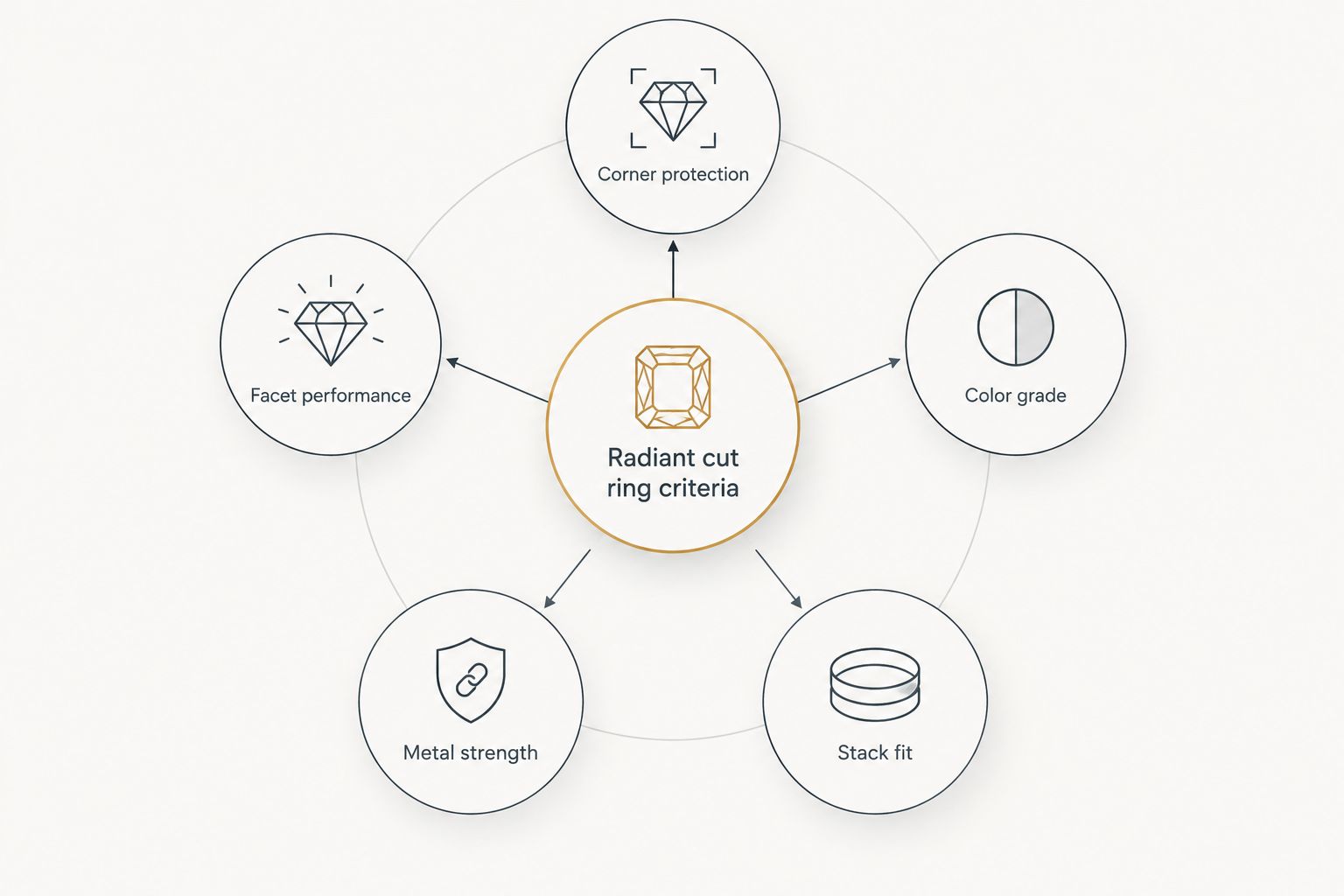
- Corner protection — prong or bezel coverage at the four corners, the cut's most vulnerable point
- Facet performance — brilliant-style faceting (70 facets) that keeps step-cut lines but round-cut fire
- Color grade forgiveness — radiant cut hides warmer color better than a step cut like emerald or asscher
- Metal and setting strength — platinum or 14k white gold prongs hold up better than soft yellow gold alone
- Stack compatibility — how cleanly the wedding band sits against an engagement ring of the same or a different cut
- Diamond origin — lab-grown versus natural changes how large the center stone can run for the same visual weight
Radiant cut wedding rings at a glance
| Style | Best for | Standout feature | Key limitation |
|---|---|---|---|
| Radiant Cut with Radiant Cut Side Diamonds | Shape-matched look | Graduating side stones echo the center shape | Side stones add more surfaces that need cleaning |
| Bezel-set radiant cut | Everyday durability | Full metal rim covers all four corners | Bezel can mute light return slightly |
| Halo radiant cut | Maximizing perceived size | Ring of accent stones widens the visual footprint | More prongs to inspect over time |
| Hidden halo radiant cut | Extra sparkle, same silhouette | Accent stones sit under the center, invisible from the top | Harder to clean underneath the halo |
| Three-stone radiant cut | Symbolic milestone rings | Two side stones flank the center for a past-present-future read | Wider profile can catch on gloves |
| Split-shank radiant cut | A modern hand | Band divides into two rows near the center | Thinner shanks need occasional resizing checks |
| Tapered baguette side stones | Art Deco style | Elongated baguettes extend the rectangular line | Baguettes chip more easily than round accents |
| Vintage milgrain radiant cut | Heirloom detail | Beaded metal edging along the band | Milgrain wears smoother with decades of use |
| Two-tone radiant cut | Mixed-metal wearers | Combines white and yellow or rose gold in one band | Harder to match to a single-metal engagement ring |
| Solitaire radiant cut | Budget-minded builds | Least metal work, all focus on the center stone | Least corner protection of any style here |
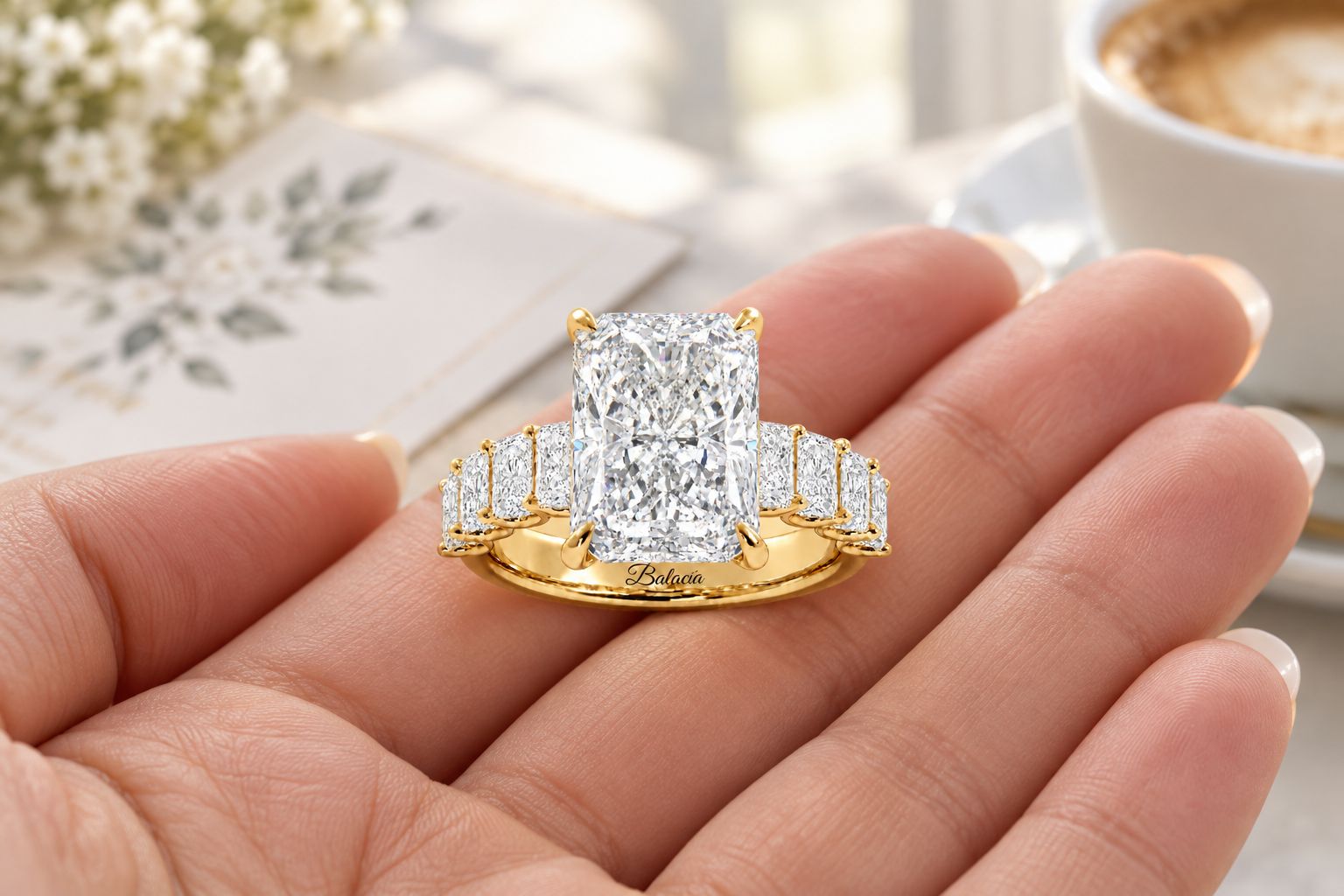
1. Radiant Cut Diamond Engagement Ring with Radiant Cut Side Diamonds: best radiant cut wedding ring for a shape-matched look
This ring centers a radiant cut diamond and flanks it with graduating radiant cut side stones, so the rectangular line carries across the whole band instead of stopping at the center. It's built in 14k gold with a sparkling hidden detail beneath the center stone.
Pros:
- Side stones repeat the center cut, so the ring reads as one shape from across the room
- 14k gold construction holds the side-stone prongs firmly over years of wear
- Works as both an engagement ring and a stand-in for a matched wedding set
Cons:
- More facets and prongs mean more surfaces that trap lotion and need cleaning
- A rectangular side-stone row is less forgiving of a crooked resize than a plain band
Best for: shoppers who want the wedding band and center stone to visually match. Verdict: Buy.
2. Bezel-set radiant cut: best radiant cut wedding ring for everyday durability
A bezel wraps a thin rim of metal fully around the diamond, covering all four corners instead of leaving them exposed between prongs.
Pros:
- Corners are the weakest point on a radiant cut, and a bezel covers every one of them
- Lower profile catches less on gloves, pockets, and gym equipment
- Cleaner lines read modern rather than traditional
Cons:
- Metal rim blocks some light entry from the side, slightly muting fire
- Resizing a full bezel takes more work than resizing an open-prong band
Best for: hands-on jobs, gyms, and anyone who's chipped a stone before. Verdict: Buy.
3. Halo radiant cut: best radiant cut wedding ring for maximizing perceived size
A ring of smaller diamonds surrounds the center stone, widening the visual footprint without changing the carat weight of the center itself.
Pros:
- Extra diamonds around the center boost overall sparkle from every angle
- Makes a smaller center stone look larger on the hand
- Pairs well with a plain wedding band underneath
Cons:
- More prongs across the halo means more points to check for wear
- Halo can catch lint and debris more than a solitaire
Best for: buyers who want size without upgrading the center diamond. Verdict: Buy.
4. Hidden halo radiant cut: best radiant cut wedding ring for sparkle without a bigger silhouette
Accent stones sit underneath the center diamond, invisible from a direct top-down view but visible in profile and in motion.
Pros:
- Adds fire without widening the ring's footprint
- Keeps a classic solitaire look from the front
- A subtle detail that reads as intentional, not flashy
Cons:
- Cleaning underneath the halo takes more care than a simple solitaire
- The detail is easy to miss unless the hand tilts in light
Best for: shoppers who want a classic look with a hidden upgrade. Verdict: Buy.
5. Three-stone radiant cut: best radiant cut wedding ring for milestone symbolism
Two side stones flank the center, a layout often read as past, present, and future.
Pros:
- Symbolic layout appeals to couples who want meaning built into the design
- Side stones add visible carat weight across the hand
- Works well with matching radiant cut studs for a coordinated set
Cons:
- Wider profile than a solitaire can catch on tight gloves
- Three center-weight stones raise the bar for consistent color matching
Best for: couples who want a milestone story in the setting. Verdict: Hold if you're deciding between this and a plain band; revisit once you've tried both on.
6. Split-shank radiant cut: best radiant cut wedding ring for a modern hand
The band splits into two rows as it approaches the center stone, opening up light and adding visual width without more diamond weight.
Pros:
- Reads more contemporary than a single continuous band
- Extra metal surface near the center adds perceived presence
- Two rows create additional light play at the shoulders
Cons:
- Thinner split shanks need more careful resizing checks over time
- Less metal per row means slightly less corner reinforcement
Best for: a modern silhouette that still centers the diamond. Verdict: Buy.
7. Tapered baguette side stones: best radiant cut wedding ring for Art Deco style
Elongated baguette-cut diamonds run alongside the center stone, extending its rectangular line in a straight, architectural way.
Pros:
- Baguettes visually stretch the rectangular shape further down the finger
- Reads distinctly Art Deco, a strong point of difference from round-cut halos
- Straight lines pair cleanly with geometric wedding bands
Cons:
- Baguettes chip more easily than round or bezel-set accents
- Straight step cuts show inclusions more readily than brilliant-faceted stones
Best for: vintage-leaning buyers who want a defined architectural line. Verdict: Buy.
8. Vintage milgrain radiant cut: best radiant cut wedding ring for heirloom detail
Beaded milgrain edging runs along the band, a detail borrowed from early-1900s jewelry construction.
Pros:
- Milgrain adds texture and shadow without extra diamonds
- Reads as an heirloom piece from the day it's purchased
- Pairs naturally with a vintage-style engagement ring
Cons:
- Fine beading wears smoother with decades of daily use
- Detail is harder to appreciate in a casual glance than a halo
Best for: buyers who want period detail over extra sparkle. Verdict: Buy.
9. Two-tone radiant cut: best radiant cut wedding ring for mixed-metal wearers
The band combines white gold with yellow or rose gold, usually splitting the shank or trimming the setting in a second tone.
Pros:
- Matches jewelry collections that already mix metal tones
- Two-tone bands don't require replacing existing mixed-metal pieces
- Adds visual contrast without adding diamonds
Cons:
- Harder to match precisely to a single-metal engagement ring
- Two metal tones can wear at different rates over years
Best for: hands that already wear mixed-metal jewelry daily. Verdict: Hold, and check it against your existing engagement ring's metal first.
10. Solitaire radiant cut: best radiant cut wedding ring for a budget-minded build
A single radiant cut diamond sits in a simple prong or bezel setting, with no side stones or halo to add labor or maintenance.
Pros:
- Least metal work of any setting on this list, which keeps focus on the diamond alone
- Simplest setting to clean and inspect
- Timeless shape that won't look dated in a decade
Cons:
- Open prongs on a solitaire offer the least corner protection here
- No secondary sparkle from accent stones
Best for: buyers who want the diamond to do all the talking. Verdict: Buy, paired with a bezel or six-prong setting for corner protection.
How we ranked
Each style above is scored against the same six criteria: corner protection, facet performance, color forgiveness, metal strength, stack compatibility, and diamond origin flexibility. A bezel or six-prong setting outranks an open four-prong build every time on corner protection alone, since the four corners are where a radiant cut chips first.
Which radiant cut wedding ring should you choose?
If you're not sure, start with a bezel-set radiant cut wedding ring — it solves the cut's one real weakness, the exposed corners, without giving up the fire that makes radiant cut worth choosing over a step cut in 2026. Buyers chasing the biggest visual impact should look at a halo build; buyers who've already chipped a stone once should not consider anything without a bezel or a full six-prong head.
FAQ
What is a radiant cut wedding ring?
A radiant cut wedding ring uses a rectangular or square diamond with trimmed corners and brilliant-style faceting, typically around 70 facets. It combines the outline of an emerald cut with the fire of a round brilliant.
Is a radiant cut wedding ring more prone to chipping than round cut?
Yes, the four trimmed corners on a radiant cut are more exposed than the rounded edge of a round brilliant. A bezel or six-prong setting protects those corners far better than an open four-prong setting.
Does radiant cut hide diamond color better than other cuts?
Radiant cut hides warmer color grades better than step cuts like emerald or asscher because its brilliant-style faceting scatters light and masks tint. It doesn't hide color as well as a round brilliant, but it beats most step cuts.
What metal works best for a radiant cut wedding ring?
Platinum or 14k white gold prongs hold the corners more securely than softer yellow gold alone. A bezel setting in either metal adds even more protection at the corners.
How is radiant cut different from emerald cut?
Emerald cut is a true step cut with fewer, larger facets and more visible flashes of light. Radiant cut layers brilliant-style faceting under a similar rectangular outline, producing more overall fire.
Can a radiant cut wedding ring pair with a plain wedding band?
Yes, a plain band pairs cleanly with a radiant cut center stone and lets the diamond's shape carry the design. A shaped or contoured band works better when the engagement ring already has a halo or side stones.
Is a lab-grown radiant cut diamond a good choice for a wedding ring?
Lab-grown radiant cut diamonds have the same optical and physical properties as natural ones, since they're chemically identical carbon. Choosing lab-grown typically lets buyers size up the center stone within the same budget.
When was the radiant cut invented?
The radiant cut was patented in 1977 by Henry Grossbard, making it one of the newer standard diamond cuts compared to the round brilliant or emerald cut.
One last thing
The detail most buyers miss: a radiant cut's length-to-width ratio changes its whole look, not just its size. A square radiant sits closer to a 1-to-1 ratio, while a rectangular radiant stretches longer down the finger — same 70-facet cut, same corner-protection rules, completely different silhouette on the hand. Try both ratios in person before locking in a setting for 2026.