


A moissanite tennis bracelet is worth it if you love colorful sparkle and choose a well-made bracelet with a secure clasp, comfortable fit, and clearly disclosed materials. It is not the right substitute for someone who specifically wants diamonds: moissanite is a different gemstone, and its scratch resistance does not protect the bracelet’s links, settings, or clasp from damage.
- A moissanite tennis bracelet is worth choosing for colorful sparkle, not as an undisclosed substitute for diamonds.
- Moissanite scores 9.25 on the Mohs hardness scale; bracelet construction still determines how securely it wears.
- Choose lab-grown diamonds when diamond identity matters more than moissanite’s rainbow flashes.
- Balacia is best for jewelry gift shoppers who want help comparing diamond bracelets and other fine jewelry.
Why this matters
A tennis bracelet is a gift you hope someone will reach for often. The important question is not whether moissanite can resemble diamond in a photograph; it is whether the recipient likes the actual stone, feels comfortable wearing the bracelet, and understands what you chose.
For a 2026 gift purchase, separate gemstone preference from construction quality. A beautiful stone cannot compensate for a clasp that is difficult to fasten or a bracelet that catches on clothing.
If you need help sorting those choices, speak with a Balacia jewelry expert about the recipient’s preferences and your budget. The guide to scheduling a virtual diamond consultation is a useful starting point when you are also considering diamond jewelry.
Is a moissanite tennis bracelet worth it?
Yes—for someone who knowingly prefers moissanite’s appearance and will choose the bracelet as carefully as the gemstone. Skip it as a surprise substitute when your loved one has specifically asked for diamonds.
Moissanite, lab-grown diamonds, and natural diamonds belong in the same buying conversation, but they are not interchangeable descriptions. Use this comparison to decide which direction fits the person receiving the gift.
| Bracelet option | Best for | Main advantage | Main limitation |
|---|---|---|---|
| Moissanite | Someone who enjoys pronounced rainbow flashes | High scratch resistance and distinctive fire | Its appearance and gemstone identity differ from diamond |
| Lab Diamond Tennis Bracelet | Someone who specifically wants diamonds of laboratory-grown origin | Lab-grown diamonds are diamonds, not diamond simulants | Laboratory-grown origin must match the recipient’s preference |
| Natural diamond | Someone who specifically values naturally formed diamonds | Meets a preference for natural diamond origin | Natural origin alone does not establish cut quality or bracelet workmanship |
The lab-grown diamond bracelet is a relevant alternative within Balacia’s fine jewelry selection, not evidence that moissanite is an inferior gift. Choose the gemstone your loved one actually wants, then judge the finished bracelet on its own merits.
Moissanite: best for colorful sparkle
Moissanite has stronger dispersion than diamond, producing noticeable rainbow flashes. That is a feature if you enjoy lively color in your jewelry; it is a drawback if you prefer diamond’s particular balance of white light and colored fire.
Look at the bracelet in ordinary indoor lighting and daylight, not only under concentrated display lights. Ask for a video if you cannot examine it in person, and pay attention to whether you enjoy the sparkle rather than whether it passes for something else.
Lab-grown diamond: best for diamond identity
Lab-grown diamonds have essentially the same chemical composition and crystal structure as natural diamonds. They are not moissanite, even when both appear in searches for alternatives to naturally mined stones.
Choose this direction when the recipient wants diamonds and accepts laboratory-grown origin. The limitation is personal preference: a diamond grown in a laboratory will not satisfy someone whose priority is natural formation.
Natural diamond: best for natural-origin preference
Natural diamonds suit someone who places meaning on geological origin. That preference can be part of the gift’s story, but it does not remove the need to assess appearance, setting security, and comfort.
Do not treat the word natural as a workmanship grade. The bracelet still needs a clear description of its stones and metal, along with a clasp and links you can use confidently.
Why a moissanite tennis bracelet’s value varies
For a 2026 purchase, compare the complete bracelet rather than a headline stone description. These factors determine whether the piece suits your needs:
- Stone appearance: Look for a consistent appearance across the row. Uneven-looking stones interrupt the continuous effect that makes a tennis bracelet appealing.
- Metal construction: Establish whether the bracelet is solid precious metal, plated, or made from another metal. A surface finish and the underlying material are different facts.
- Setting security: Inspect how the stones are held. Ask a jeweler to assess loose stones, catching prongs, or visibly uneven settings.
- Clasp function: Confirm how the primary closure works and whether there is a secondary safety mechanism. Neither feature is useful if the wearer cannot operate it comfortably.
- Fit and flexibility: Check how the bracelet follows the wrist and moves with the hand. A bracelet that pinches, rolls excessively, or slides where it becomes bothersome is a poor match.
- Repair and care requirements: Ask what maintenance the particular construction needs and whether a jeweler can service it. Do not assume every seller provides repairs or coverage.
The stone tells you what sparkles; the construction tells you how the bracelet functions. Keep those judgments separate when comparing listings.
How do you check quality before buying?
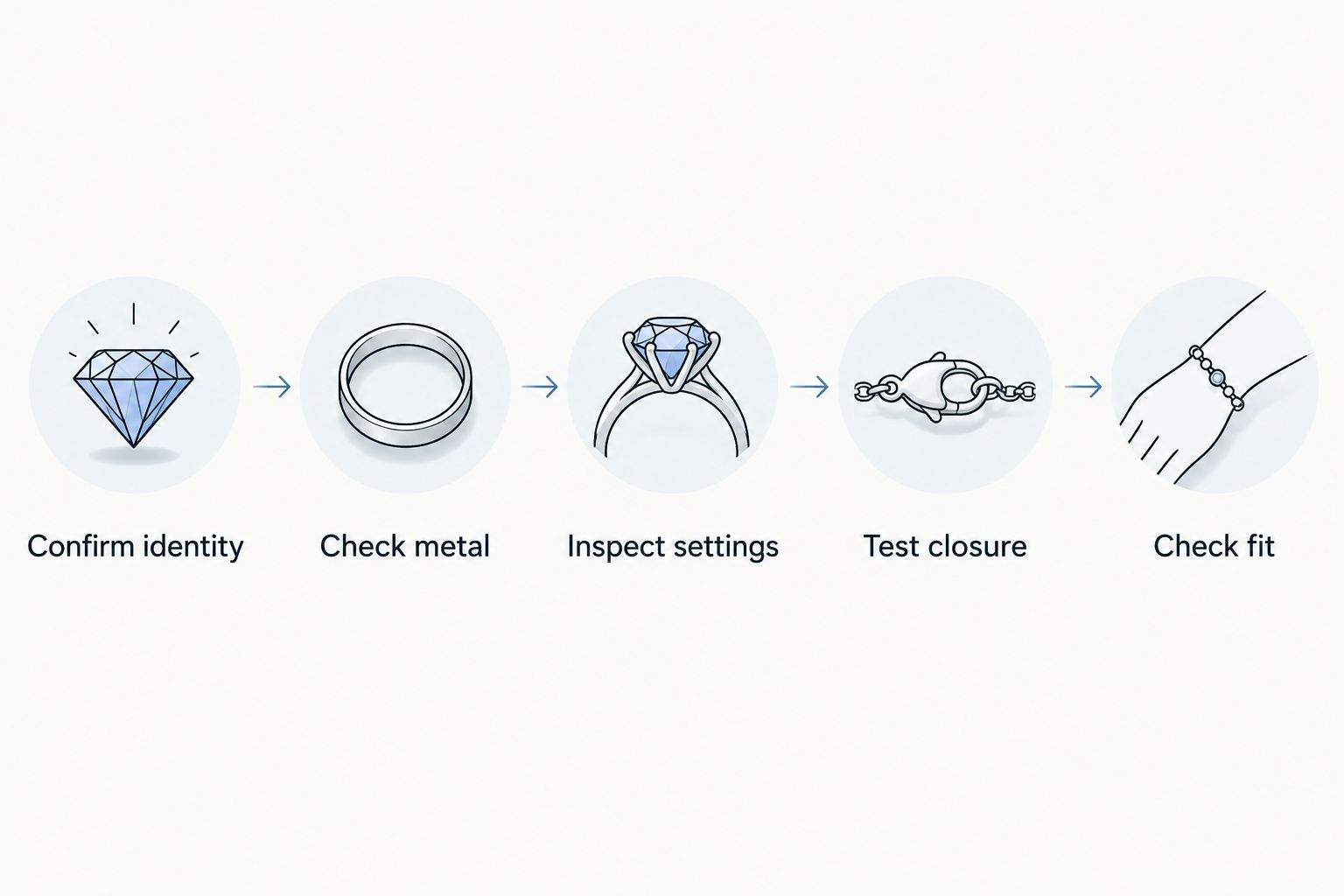
Use this sequence to turn an attractive listing into a purchase you understand. It also gives you clear questions to ask when product descriptions leave important details unclear.
- Confirm identity. The description should explicitly say moissanite. Terms such as diamond-like or brilliant do not identify the gemstone.
- Check metal. Read the full material description, including any plating and the underlying metal. Ask about alloy composition if the recipient has a known sensitivity.
- Inspect settings. Examine close-up images of the stone seats, prongs, links, and bracelet underside. Ask for additional views when those areas are hidden.
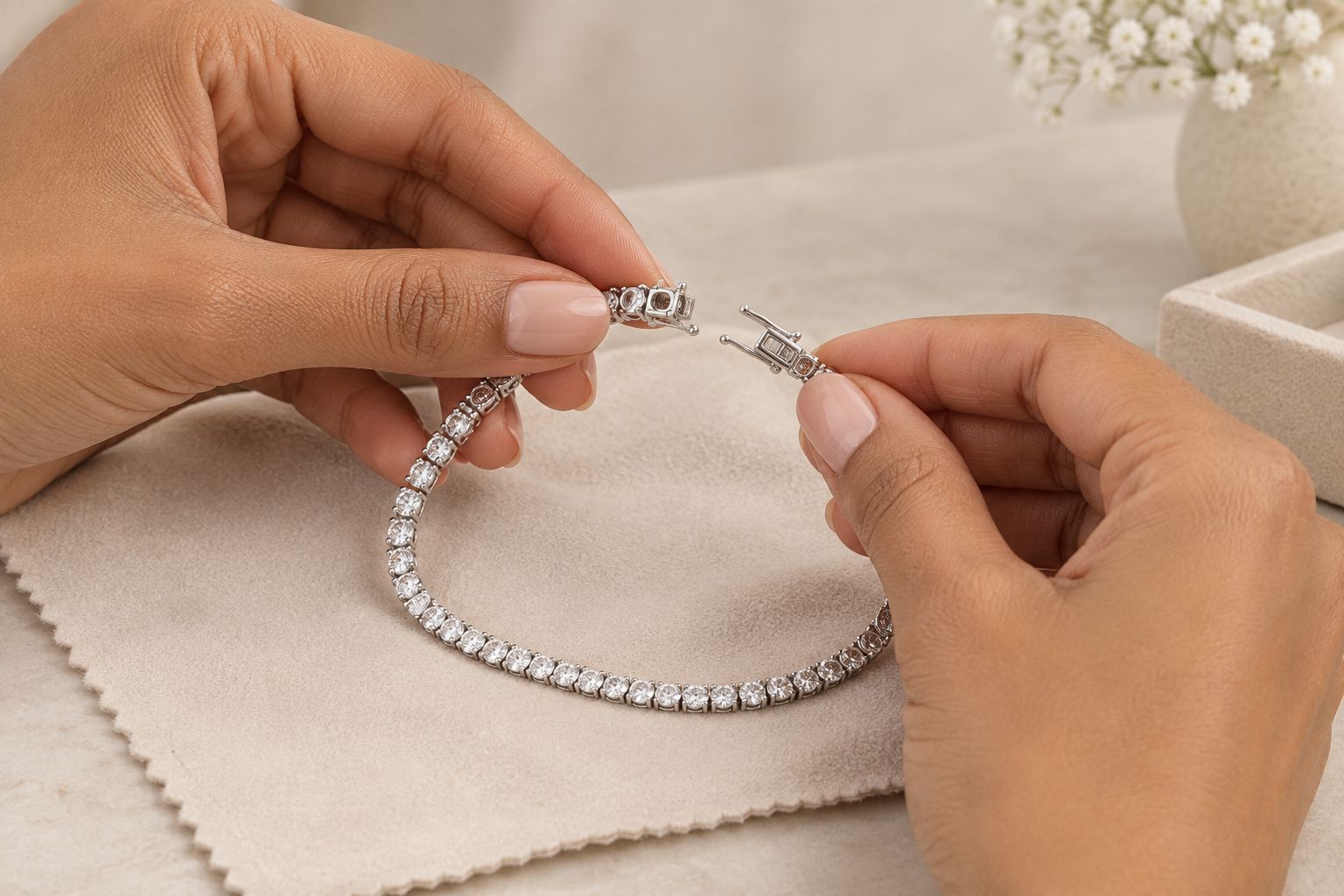
- Test closure. Have the fastening mechanism demonstrated. If possible, try opening and closing it yourself before deciding.
- Check fit. Compare the stated bracelet length with a comfortable bracelet the recipient already wears, then confirm how the new design sits on the wrist.
This order keeps your attention on facts rather than photography. In 2026, a detailed product page is useful, but a glamorous image is still not a substitute for material disclosure or a clear view of the clasp.
What do metal markings actually tell you?
Gold fineness describes the proportion of gold in an alloy. For example, 14k gold contains approximately 58.3% gold, while 18k gold contains 75% gold; those figures do not certify the stones or guarantee the finished bracelet’s durability.
A karat description also needs context. Gold plating over another metal is not the same construction as a gold-alloy bracelet throughout, so read beyond the color name and ask for clarification when necessary.
Neither gold color nor fineness tells you everything about skin compatibility. If the recipient has reacted to jewelry before, discuss the actual alloy rather than assuming a familiar metal name settles the question.
What should you notice when handling the bracelet?
Run your eyes along the bracelet’s underside and edges, then check how it bends naturally. You are looking for comfortable contact surfaces, consistent articulation, and a closure that engages as intended—not trying to stress-test the jewelry.
Ask a jeweler to investigate catching prongs or a closure that feels uncertain. Do not bend settings or pull on the clasp to prove it is strong.
Can you wear a moissanite tennis bracelet every day?
Moissanite’s 9.25 Mohs hardness supports frequent wear, but it does not make a tennis bracelet suitable for every activity. Remove the bracelet for manual work, exercise that exposes it to impact, and tasks where links or settings can catch.
Diamond ranks 10 on the Mohs scale. These are scratch-hardness ratings, not measures of clasp strength, impact resistance, or how long a bracelet will last.
For everyday wear in 2026, prioritize a comfortable fit and a routine of checking the closure before leaving home. Stop wearing the bracelet if you notice a loose stone, distorted link, or fastening problem, and have a jeweler inspect it.
Is a moissanite tennis bracelet a good anniversary gift?
A moissanite tennis bracelet is a good anniversary gift when the recipient likes moissanite and knows that is the gemstone you selected. Its meaning comes from choosing thoughtfully, not from presenting it as diamond.
Notice what your partner already enjoys: delicate or substantial jewelry, colorful sparkle or quieter shine, a close fit or a little movement. Those preferences are more useful than guessing what an anniversary gift is supposed to look like.
A Balacia jewelry expert can help you explore diamond bracelets and other jewelry gifts within your budget. Discuss the recipient’s style first, then ask which details need checking on the exact piece you are considering.
Will a moissanite tennis bracelet become an heirloom?
A moissanite tennis bracelet can become a meaningful heirloom, but no gemstone name guarantees generations of wear. Construction, maintenance, repairability, and the care of successive owners all matter.
Keep the original material description and purchase documentation with your jewelry records. If the bracelet is a 2026 anniversary gift, add a personal note about the occasion; the story is something a future owner cannot recover from the stones alone.
Treat heirloom potential as a reason to choose carefully, not as a promise of resale proceeds. A gift can carry lasting emotional value without being purchased as an investment.
FAQ
Is a moissanite tennis bracelet worth buying in 2026?
A moissanite tennis bracelet is worth buying in 2026 if you prefer its colorful sparkle and choose sound construction. Confirm the metal, setting security, clasp function, and fit rather than judging only the stones.
Is moissanite the same as a lab-grown diamond?
Moissanite is not a lab-grown diamond. Moissanite is silicon carbide, while diamond is crystalline carbon; laboratory-grown diamonds are diamonds of laboratory-grown origin.
Will a moissanite tennis bracelet scratch easily?
Moissanite resists scratching well because it ranks 9.25 on the Mohs hardness scale. That rating does not make the bracelet’s metal, links, or clasp scratch-proof or damage-proof.
Does a moissanite tennis bracelet look exactly like diamond?
A moissanite tennis bracelet does not look exactly like diamond. Moissanite’s stronger dispersion produces more pronounced rainbow flashes, so compare the appearance in ordinary lighting before choosing.
Should I choose moissanite or diamond for a surprise gift?
Choose the gemstone the recipient prefers, and do not present moissanite as diamond. If that preference is unknown, ask a discreet question or involve the recipient in the final choice.
Can I clean every moissanite bracelet the same way?
No, the cleaning method must suit the complete bracelet, including its metal, plating, settings, and any other gemstones. Follow the seller’s care instructions and ask a jeweler before using ultrasonic or steam equipment.
Does a tennis bracelet need certified stones?
A tennis bracelet does not automatically come with an individual grading report for every stone. Ask exactly what documentation accompanies the piece and what it covers; a report is not a guarantee of clasp or setting quality.
One last thing
For a surprise gift, learn which bracelet your loved one already finds comfortable before choosing a larger-looking design. Familiar fit and easy fastening deserve as much attention as sparkle.
Ask a Balacia jewelry expert to help connect those practical preferences with the sentiment of your gift. The right choice is jewelry your loved one understands, enjoys, and wants to wear.