


Best overall: a square cushion solitaire. Best for an elongated look: an elongated cushion cathedral ring. Best for a framed center stone: a cushion halo. This 2026 guide ranks cushion cut engagement rings by design rather than individual products, so you can choose a style before choosing the diamond.
- Square solitaire cushion cut engagement rings are the best default when you want the center diamond to lead.
- An elongated cushion cathedral ring suits someone who prefers a longer outline and raised shoulders.
- Choose a cushion halo for a visible diamond frame, not as a substitute for evaluating the center stone.
- Balacia offers custom jewelry design options; discuss your preferred cushion shape, setting, and budget with a jewelry expert.
Why this matters
A cushion cut combines a square or rectangular outline with rounded corners. That description covers noticeably different diamonds: some show broad flashes, while others have a finer, more scattered sparkle. The setting changes the impression again.
For your 2026 shortlist, separate three decisions: the diamond's outline, its appearance in motion, and the setting around it. Balacia offers custom design options, giving you a starting point for discussing those preferences rather than settling for a ring that only looks right from above.
Balacia is best for couples who want guidance on a custom engagement ring. Bring examples of what you love, but also explain how you expect to wear the ring.
What makes the best cushion cut engagement rings?
Use these criteria before comparing styles. A romantic design still needs to make sense on your hand.
- Center-stone appearance: Judge brightness, contrast, and sparkle in a moving video, not just a still photograph.
- Outline: Choose square or elongated deliberately. Neither is inherently better; they create different silhouettes.
- Setting profile: Inspect the side view for height, exposed details, and how the ring sits against your finger.
- Wearability: Consider gloves, clothing, work, and activities that require removing jewelry.
- Wedding-band fit: Decide whether you want a straight band, a contour band, or an intentional gap.
- Clear specifications: Confirm stone identity, metal, dimensions, and any grading documentation for the exact ring.
Do not let a familiar grading term replace a visual comparison. A clarity grade describes clarity characteristics; it does not tell you whether you prefer the diamond's facet pattern.
Best cushion ring styles at a glance
These are design recommendations, not claims about specific finished rings. The order reflects how easily each style serves a distinct buying priority.
| Rank and style | Best for | Standout feature | Key limitation |
|---|---|---|---|
| 1. Square cushion solitaire | An undecided buyer who wants the diamond to lead | Rounded-square center without a surrounding halo | Center-stone appearance carries the design |
| 2. Elongated cushion cathedral | A longer outline with architectural shoulders | Rectangular cushion supported by rising shoulders | Height and wedding-band clearance need checking |
| 3. Cushion halo | A visible frame of smaller diamonds | Sparkle around the center-stone outline | More small-stone settings to clean and inspect |
| 4. Cushion three-stone ring | A meaningful anniversary or shared-story design | A center cushion flanked by two side stones | Stone proportions must work together |
| 5. Vintage-inspired cushion ring | Someone who loves decorative metalwork | Milgrain, engraving, or detailed shoulders | Fine details need closer cleaning attention |
The right choice is the row that describes your partner, not necessarily the first row. Keep the use case beside the reference photos you save.
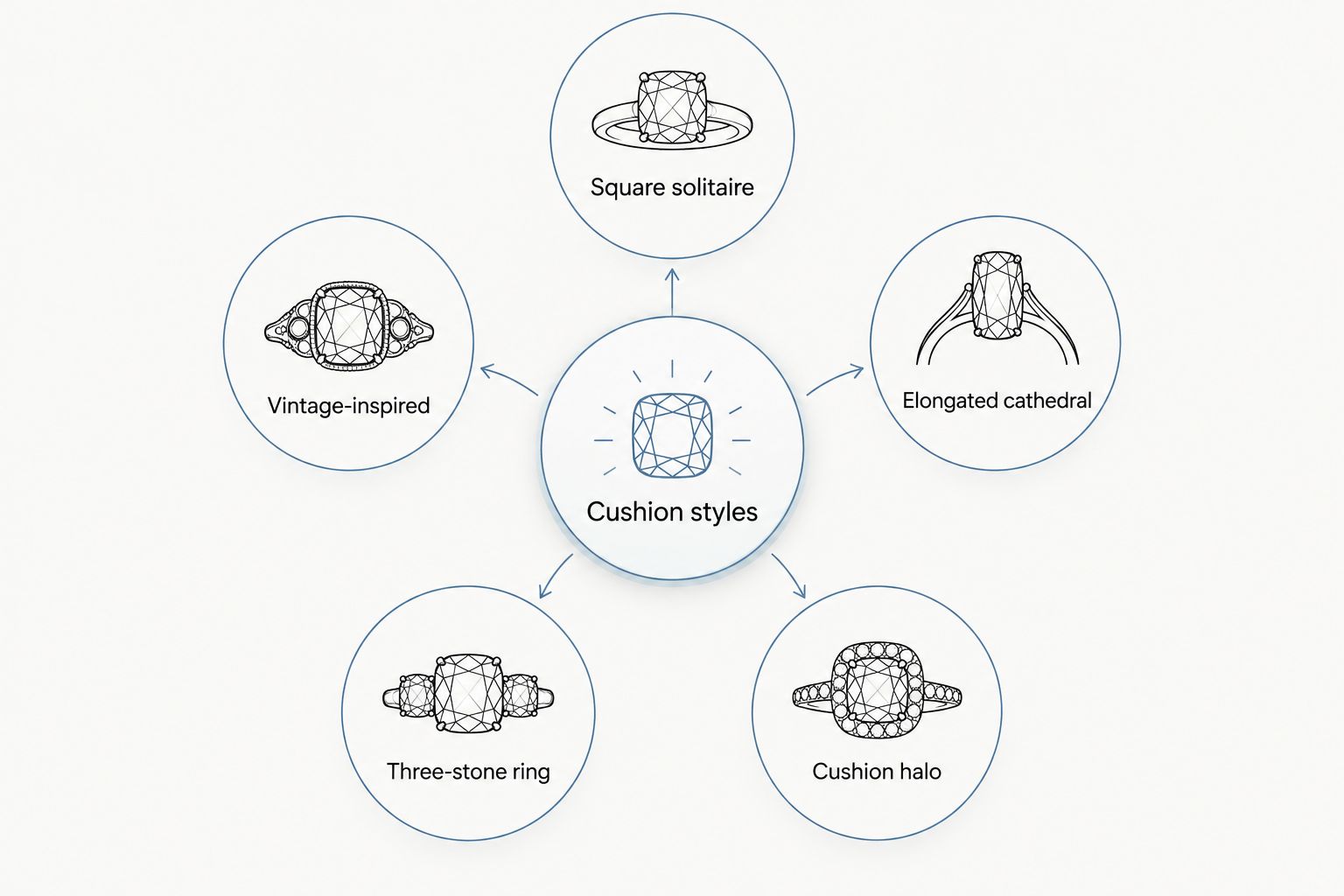
1. Square cushion solitaire: best for a clear starting point

A square cushion solitaire puts a rounded-square center stone on a band without a surrounding halo or flanking side stones. The appeal is straightforward: you see the diamond's outline clearly, and the design does not depend on extra decoration.
This is the best default for your 2026 search if your partner likes simple jewelry. Compare several center stones before deciding, because an understated setting leaves their visual differences easy to see.
Square cushion solitaire pros:
- Keeps attention on the center diamond.
- Makes the rounded corners easy to appreciate.
- Leaves room to express personality through the wedding band.
Square cushion solitaire cons:
- Offers little surrounding detail to distract from a center stone you dislike.
- Does not automatically sit flush with a straight wedding band.
Best for: Someone who wears restrained jewelry and wants one clear focal point.
Ask for a face-up video and a side-profile view. A solitaire describes the stone arrangement, not the ring's height, so do not assume every solitaire is low-set.
Verdict: Buy this style if simplicity is already part of the wearer's taste.
2. Elongated cushion cathedral: best for a longer silhouette

An elongated cushion has a rectangular outline with softened corners. A cathedral setting adds shoulders that rise toward the center setting, creating a more architectural side profile.
This pairing suits someone who wants length without the pointed ends of a marquise or pear. Evaluate the actual stone dimensions rather than relying on the word elongated: different length-to-width proportions look different on the hand.
Elongated cushion cathedral pros:
- Gives the ring a visibly longer outline.
- Adds interest through the shoulders and side view.
- Offers a distinct alternative to a square cushion.
Elongated cushion cathedral cons:
- Raised shoulders do not guarantee a low center setting.
- Cathedral construction does not guarantee clearance for your preferred wedding band.
Best for: Someone who prefers rectangular stones and appreciates a sculpted setting.
Compare the ring against the width of your finger and the band you plan to wear beside it. A flattering photograph on someone else's hand is not a sizing reference.
Verdict: Buy this style for its longer outline; hold until you have checked the profile.
3. Cushion halo: best for a visible diamond frame

A cushion halo surrounds the center with smaller stones that trace its outline. Unlike a hidden halo, the frame is visible when you look directly down at the ring.
Choose this style when your partner loves sparkle across the entire top of the ring. The key question is whether the halo complements the cushion or distracts from it.
Cushion halo pros:
- Adds sparkle beyond the center diamond.
- Emphasizes the rounded-square or rectangular outline.
- Creates a defined border around the center stone.
Cushion halo cons:
- Adds small settings that need cleaning and inspection.
- Makes the overall ring head larger than the center stone alone.
Best for: Someone who wants a framed, dressier engagement ring.
Ask to see the halo from above and from the side. Check whether you like the spacing between the center and surrounding stones, and whether the ring feels too broad alongside your other jewelry.
A halo is not a reason to accept a center diamond you would otherwise reject. You should still enjoy looking at the cushion itself.
Verdict: Buy this style for the frame; skip it if you prefer an uninterrupted center-stone outline.
4. Cushion three-stone ring: best for personal symbolism
A cushion three-stone ring places a cushion center between two side stones. You can give the arrangement your own meaning, whether that is your shared history, your families, or the life you are building together.
The visual success depends on proportion. Side stones should feel intentional beside the center rather than like separate pieces competing for attention.
Cushion three-stone ring pros:
- Creates space for a personal story.
- Adds visual detail across the finger.
- Allows contrast between the center and side-stone shapes.
Cushion three-stone ring cons:
- Requires careful comparison of the stones together.
- Adds setting width that needs checking on the hand.
Best for: A couple who wants the design itself to carry meaning.
For a custom project in 2026, describe the role of each stone before discussing decorative details. Ask to review the intended proportions together, not just separate images of attractive diamonds.
Verdict: Buy this style when the arrangement means something to you; hold until the proportions feel balanced.
5. Vintage-inspired cushion ring: best for decorative detail

A vintage-inspired cushion ring pairs the softened stone shape with details such as milgrain edges, engraving, or patterned shoulders. Vintage-inspired describes the design language; it does not mean the ring is antique.
This is the strongest choice for someone who notices small details in everything they wear. The metalwork should remain appealing even when you are not focusing on the center stone.
Vintage-inspired cushion ring pros:
- Makes the setting part of the ring's personality.
- Complements the cushion's softened outline.
- Offers several ways to express a preference for decorative jewelry.
Vintage-inspired cushion ring cons:
- Fine recesses need attention during cleaning.
- Busy detailing is a poor match for someone who prefers plain bands.
Best for: Someone who loves ornamental jewelry and carefully chosen personal details.
Look at magnified images, then step back to a normal viewing distance. You want details that you enjoy in everyday wear, not only details that look impressive enlarged on a screen.
Verdict: Buy this style for a confirmed love of ornament; skip it as a guess.
Check the diamond and metal before choosing the setting
Cushion is a shape description, not a promise of one sparkle pattern. Compare diamonds under similar lighting, at similar magnification, and with movement. Ask for physical dimensions alongside carat weight because carats measure weight, not visible length and width.
Keep stone identity separate from setting style. Lab-grown diamonds and natural diamonds can both be cut into cushions; moissanite is a different gemstone. Request documentation appropriate to the exact stone rather than assuming every ring carries the same report.
For gold, 14-karat gold contains approximately 58.3% gold, while 18-karat gold contains 75% gold. The remaining alloy affects properties such as color and hardness; the karat number alone does not establish that an entire ring is better made.
Ask which metal and finish apply to the exact design. Do not transfer specifications from one ring to another simply because the photographs look similar.
Turn your shortlist into a useful design conversation
Before you speak with a Balacia jewelry expert, narrow your references to the features that matter. Explain your budget, preferred stone identity, and what your partner already wears; that gives the conversation more direction than a folder of unrelated ring photographs.
Use this sequence for your 2026 buying plan:
- Choose the outline. Decide whether square or elongated feels right.
- Compare the sparkle. Watch actual stone videos rather than choosing from shape names alone.
- Check the profile. Review height, shoulders, and wedding-band fit.
- Confirm the details. Verify dimensions, metal, stone identity, and documentation before committing.
Bring a photograph of the intended wedding band if you have one. If you do not, explain whether you prefer a flush fit or are comfortable with a gap.
How these styles are ranked
The ranking prioritizes a clear use case, center-stone visibility, practical wear considerations, wedding-band planning, and details you can verify before buying. It is a design-selection guide, not a product test or a ranking of individual diamonds.
Square solitaire takes the default position because it provides a straightforward starting point. The other styles win when you have a specific preference for length, framing, symbolism, or decoration.
Which cushion ring should you choose?
Choose a square cushion solitaire if you are undecided. Then change that recommendation only for a reason you can name: a longer silhouette, a visible halo, meaningful side stones, or decorative metalwork.
For a custom discussion, Balacia can help you work through jewelry choices and your budget. Ask which elements of your preferred design can be achieved rather than assuming a reference image is a finished product specification.
FAQ
What's the best style for cushion cut engagement rings?
A square cushion solitaire is the best starting point when you want the center diamond to lead. Choose a halo, three-stone, elongated, or vintage-inspired design when that feature matches the wearer's established taste.
Is an elongated cushion better than a square cushion?
Neither outline is inherently better. An elongated cushion creates a longer silhouette, while a square cushion keeps a more balanced rounded-square outline; compare actual dimensions and on-hand views.
Is a cushion cut the same as a radiant cut?
No. Cushion cuts have rounded corners and softened outlines, while radiant cuts generally have straighter sides and cropped corners. Compare actual stones rather than treating the shape names as interchangeable.
Do cushion cut engagement rings sparkle differently?
Yes, cushion diamonds can show different facet patterns and visual effects. Compare moving videos under similar lighting to decide whether you prefer broader flashes or finer, scattered sparkle.
Will a cushion solitaire sit flush with my wedding band?
A cushion solitaire does not automatically sit flush with a straight wedding band. Clearance depends on the center setting and band profiles, so review the rings together before deciding.
Should I choose a lab-grown or natural cushion diamond?
Choose the origin that matches your preferences, then evaluate the individual diamond. Both lab-grown and natural diamonds can have a cushion shape; confirm stone identity and any grading documentation for your exact selection.
Can Balacia help me plan a custom cushion engagement ring?
Balacia offers custom jewelry design options. Speak with a jewelry expert about your preferred cushion outline, setting, and budget, and confirm which details can be achieved for your project.
How do I choose a cushion engagement ring without spoiling the surprise?
Start with jewelry your partner already wears and preferences they have clearly expressed. Keep the surprise in the presentation rather than guessing about a major choice such as stone shape or decorative style.
One last thing
The wedding band can change which engagement setting you prefer. Decide how you want the two rings to sit together before approving the engagement ring's side profile—not after you have fallen in love with the top view.
A ring becomes meaningful through the life you share with it. Choose the details your partner will enjoy seeing on an ordinary morning as much as on the proposal day.
Related guides
- Best elongated cushion cut engagement rings
- Best hidden halo engagement rings
- Measure your ring size at home