

Best overall: an emerald-cut solitaire. Best for extra sparkle: an emerald-cut halo. Best for a design with personal meaning: an emerald-cut three-stone ring. These are the strongest emerald cut engagement ring styles to compare in 2026, whether you choose a finished ring or discuss a custom design with Balacia.
- An emerald-cut solitaire is the best overall choice for emerald cut engagement rings in 2026 because nothing distracts from the center stone.
- An emerald-cut halo adds sparkle; a three-stone setting gives couples more room to express a personal story.
- Balacia offers custom design options, but these ranked styles are design directions, not a list of verified emerald-cut products.
- Inspect any emerald-cut diamond face-up: its broad facets make inclusions and uneven light patterns easier to notice.
Why this matters
An emerald cut has a different kind of beauty from a brilliant-cut diamond. Its long, stepped facets create broad flashes of light rather than the dense sparkle you see in a round or radiant cut. The setting changes how clearly you see those steps, how much attention goes to the center stone, and how the ring feels beside a wedding band.
Balacia sells engagement rings and offers custom design options. That makes a style comparison useful, but it does not establish that every setting below is a currently listed Balacia product. Treat this 2026 guide as a shortlist for choosing a design and questions to ask before committing to a specific stone and setting.
What makes the best emerald cut engagement ring?
- A center stone you like in person or on video. Look through the table of the diamond, not just at its outline. Broad facets can make an inclusion or an uneven light pattern more noticeable.
- A setting that matches the intended look. A solitaire keeps the geometry quiet. A halo adds detail around the stone. Side stones change the ring’s overall silhouette.
- Protected corners. Emerald cuts have trimmed corners, but the setting still needs to hold the stone securely. Ask how each corner is covered and have the proposed design reviewed before ordering.
- A comfortable profile. Check the height of the center stone and where a wedding band will sit. A ring that looks balanced alone can leave a gap beside a straight band.
- Clear stone information. The 4 Cs describe carat weight, color, clarity, and cut. For an emerald cut, do not use a grade as a substitute for inspecting the actual stone.
- A design that fits the wearer. The best ring is the one they will want to wear, whether that means a restrained solitaire or a more detailed setting. An heirloom gift begins with knowing their taste.
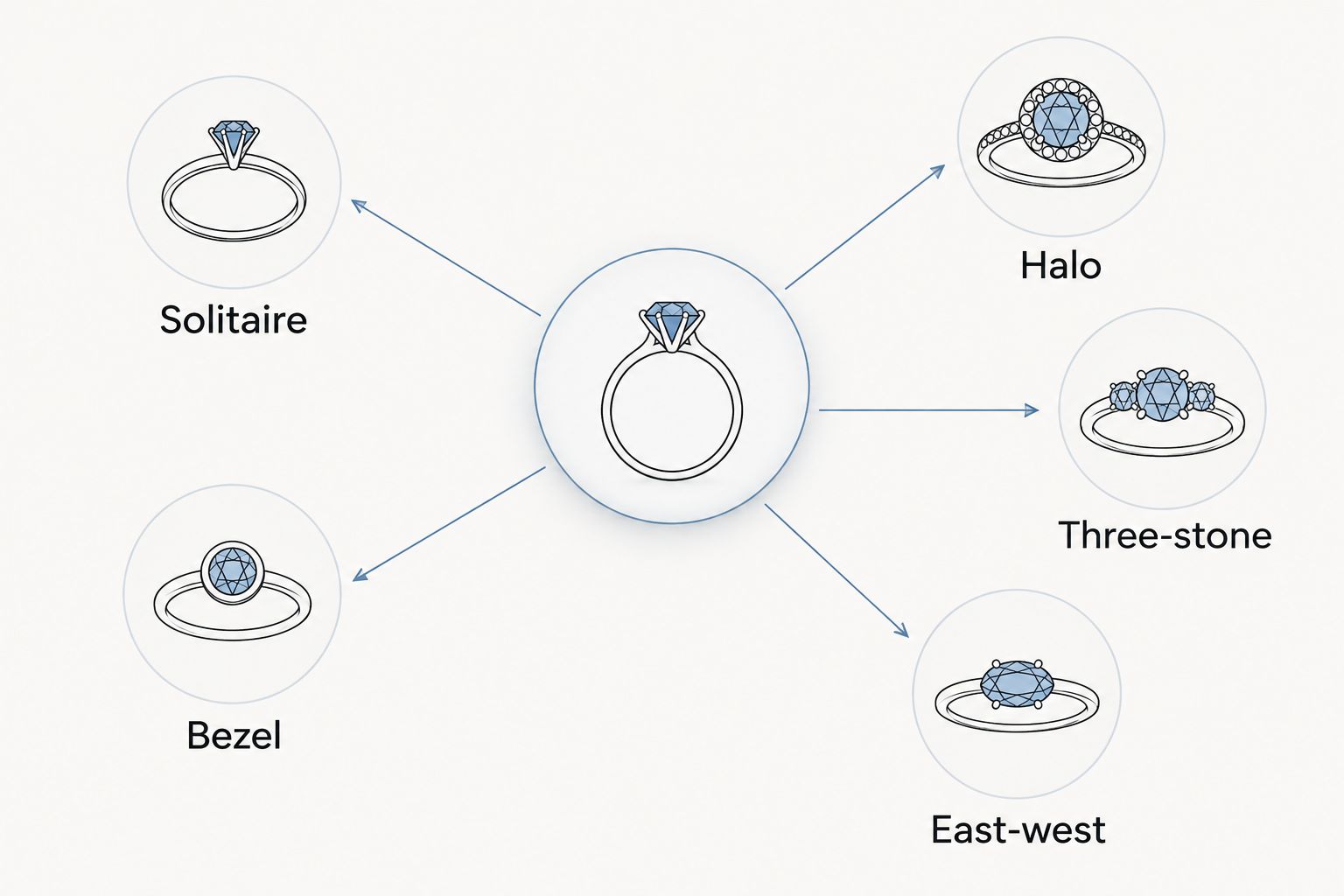
Emerald cut engagement rings at a glance
| Style | Best for | Standout feature | Key limitation |
|---|---|---|---|
| Emerald-cut solitaire | Letting the center stone lead | Uninterrupted view of the step-cut facets | Gives the stone nowhere to hide |
| Emerald-cut halo | Adding visible sparkle | Smaller surrounding stones frame the center | Can soften the clean outline |
| Emerald-cut three-stone ring | A story expressed through design | Side stones share the attention | More proportions to balance |
| Emerald-cut bezel setting | A smooth, defined outline | Metal frames the stone’s edge | Covers more of the stone’s perimeter |
| East-west emerald-cut ring | A less conventional silhouette | Stone sits across the finger | Changes the classic elongated look |
The first decision is not which style looks most elaborate. It is whether you want the emerald cut’s straight lines to stand alone or share attention with other details. If you love a brighter facet pattern, compare an emerald cut with a radiant-cut engagement ring with princess-cut side diamonds before choosing a setting; radiant and emerald are different cuts.
1. Emerald-cut solitaire: best for a clean, enduring design
An emerald-cut solitaire puts one center stone at the heart of the ring. With no halo or side stones competing for attention, you can see the cut’s long facets and rectangular outline clearly. It is the best overall emerald cut engagement ring style for someone who loves the stone itself.
Emerald-cut solitaire pros:
- Keeps attention on the center stone and its step-cut pattern.
- Works with restrained or more detailed wedding-band choices.
- Makes it easier to judge whether you genuinely love the diamond rather than its surrounding setting.
Emerald-cut solitaire cons:
- A visible inclusion or distracting light pattern has less surrounding detail to draw attention away.
- The setting’s height and prong placement matter to both appearance and wedding-band fit.
Best for: Someone who prefers clean lines and wants the emerald cut to remain the focal point. When comparing stones, ask to see each candidate face-up in ordinary lighting as well as close-up. Turn it slowly. Decide whether the pattern looks calm and even to your eye, then inspect where the prongs will meet the corners.
If you are planning a custom design, start with the stone you want to look at every day. Discuss the band and setting around it rather than choosing the most detailed mounting first. Verdict: Buy the solitaire design when the actual center stone earns your attention without help from accent stones.
2. Emerald-cut halo: best for added sparkle around the center
An emerald-cut halo surrounds the center stone with smaller stones. That border brings a brighter, more detailed look to a cut known for broad flashes. The important choice is how closely the halo follows the emerald cut’s trimmed corners; its shape determines whether the center still reads as crisp and geometric.
Emerald-cut halo pros:
- Adds sparkle without changing the center stone’s cut.
- Gives a wearer who likes decorative rings more detail to enjoy.
- Can make the center and surrounding stones feel like a single, intentional design.
Emerald-cut halo cons:
- Surrounding sparkle can draw attention away from the emerald cut’s step pattern.
- Additional stones and setting details create more places to inspect during routine jewelry care.
Best for: Someone who loves the outline of an emerald cut but wants a livelier ring. Look at the design from above, then from the side. A top view tells you whether the halo frames the center neatly; a side view shows how the added detail affects the ring’s profile and its fit beside a band.
Do not choose a halo simply to make a center stone seem different from what it is. Choose it because the wearer likes the contrast between quiet, broad facets and a sparkling border. Verdict: Buy when the halo adds the detail you want without obscuring the center stone’s character.
3. Emerald-cut three-stone ring: best for a personal design story
A three-stone ring pairs an emerald-cut center with a stone on either side. Couples often give that arrangement personal meaning, but the design should work visually even without an explanation. The center needs to remain recognizable as the lead stone, while the side stones should feel deliberately chosen rather than crowded into the setting.
Emerald-cut three-stone ring pros:
- Offers room to express a personal meaning through the design.
- Lets side-stone shape influence the finished silhouette.
- Gives a wearer who likes more visual presence an alternative to a halo.
Emerald-cut three-stone ring cons:
- Poorly balanced side stones can compete with the emerald-cut center.
- More stones mean more placement and proportion decisions before the design is final.
Best for: A couple who wants the ring to mark a shared story and prefers side stones to a border of small stones. Ask for a face-up view showing the actual proportions under consideration. Compare the full outline on a hand, not just an isolated image of the center diamond.
A three-stone ring is not automatically more meaningful than a solitaire. The meaning comes from the choice you make together. Verdict: Buy when the side stones support the center stone and the wearer genuinely likes the wider composition.
4. Emerald-cut bezel setting: best for a defined metal frame
A bezel uses metal to frame the edge of the stone instead of leaving the perimeter exposed between prongs. On an emerald cut, that frame can emphasize straight sides and trimmed corners. It also changes how much of the stone’s outline is visible, so the details of the proposed setting matter more than the word bezel alone.
Emerald-cut bezel pros:
- Creates a clear outline around the center stone.
- Gives metal a visible role in the design rather than using it only to support the stone.
- Offers a distinct alternative to a prong-set solitaire.
Emerald-cut bezel cons:
- Metal covers more of the stone’s edge than an open prong setting.
- A heavy-looking frame can overwhelm a center stone if the proportions are not right.
Best for: Someone who likes a strong geometric outline and wants to see how metal and stone work together. Ask for both face-up and side views of the proposed ring. Check how the bezel meets the trimmed corners and whether the profile works with the wedding band you have in mind.
Do not treat every bezel as interchangeable: the width of the metal frame changes the result. Verdict: Hold until you have seen the proposed bezel around a stone of the intended shape and can judge the full outline.
5. East-west emerald-cut ring: best for an unexpected silhouette
An east-west setting places the emerald cut’s longer sides across the finger rather than along it. The diamond remains an emerald cut, but its orientation changes the ring’s first impression. It is a direct way to make a familiar shape feel personal without adding a halo or side stones.
East-west emerald-cut ring pros:
- Gives the emerald cut a distinctive orientation.
- Keeps the design visually simple if the setting has few added details.
- Makes the stone’s width across the finger part of the design.
East-west emerald-cut ring cons:
- Does not create the classic lengthwise emerald-cut look.
- The full width and wedding-band pairing need careful review on a hand.
Best for: Someone who already knows they like emerald cuts but does not want the traditional orientation. Compare east-west and lengthwise views of a stone with similar proportions. A close-up of either ring by itself will not show how the silhouette feels once worn.
This is a choice of taste, not an upgrade over the solitaire. Verdict: Buy when the wearer prefers the across-the-finger shape after seeing both orientations on a hand.
Check the stone and setting before deciding
A style shortlist narrows the search; it cannot tell you whether a particular diamond looks right. Use this sequence when comparing finished rings or discussing a custom design in 2026:
- See the actual center stone. Request clear face-up imagery or video of the stone being considered. Look for a facet pattern you enjoy and any inclusions you notice without magnification.
- Read the grading information. A grading report describes the stone; it does not replace your visual judgment. Diamond clarity grading uses 10× magnification, while you will usually enjoy the ring without it.
- Confirm the material for that ring. Ask whether the center stone is lab-grown or natural and which metal is specified. Do not assume that a detail shown on another ring applies to yours.
- Check the corners and side view. Ask how the stone is held and examine the ring’s height. This matters for comfort, appearance, and the wedding band you plan to wear with it.
- Review the design as a pair. If you want a straight band to sit close to the engagement ring, check the proposed pairing before finalizing the setting.
The difference between 14-karat and 18-karat gold is the proportion of gold in the alloy, not a verdict on which finished ring you will prefer. Check the exact metal specified for any design you consider. The same rule applies to grading reports and stone details: verify them for the particular diamond, not for a similar-looking ring.
How these styles were ranked
The ranking starts with how clearly a setting shows an emerald cut, then considers how well it serves a distinct wearer’s preference. A solitaire comes first because it makes the center stone easiest to assess and remains a clear starting point for design decisions. Halo, three-stone, bezel, and east-west styles follow because each answers a different request: more sparkle, personal symbolism, a metal-framed outline, or a changed orientation.
This is a ranking of design choices, not a claim that specific emerald-cut rings were tested or that each configuration is in stock. The right 2026 shortlist is the one you can discuss using an actual stone, a proposed setting, and the intended wedding band.
Which emerald cut engagement ring should you choose?
Choose an emerald-cut solitaire if you are undecided. It lets you make the central decision first: do you love the stone’s outline and step-cut flashes? If the answer is yes but the ring still feels too quiet, compare a halo for sparkle or a three-stone design for a broader, more personal composition.
Choose a bezel when the metal frame is part of what attracts you. Choose east-west only when the changed orientation looks better to the wearer than the traditional one. Balacia’s custom design option gives you a way to discuss those preferences, but confirm the exact stone, materials, setting, and finished design before ordering.
FAQ
What is the best emerald cut engagement ring style in 2026?
An emerald-cut solitaire is the best default in 2026 because it keeps attention on the center stone and its step-cut pattern. Choose a halo or three-stone design when the wearer wants more detail.
Are emerald cut diamonds as sparkly as radiant cut diamonds?
No. Emerald cuts show broad flashes from step-cut facets, while radiant cuts have a more glittering facet pattern. Compare the two shapes in motion before choosing.
Is a halo better than a solitaire for an emerald cut?
A halo is better for someone who wants extra surrounding sparkle; a solitaire is better for someone who wants an unobstructed view of the center stone. Neither setting fixes a center stone you do not like.
What should I check when choosing an emerald cut diamond?
Inspect the actual stone face-up for a pleasing facet pattern and visible inclusions, then review its grading information. Check how the proposed setting holds its corners.
Can an emerald cut engagement ring have a custom setting?
Yes. Balacia offers custom design options for engagement rings. Confirm which stone, metal, setting details, and wedding-band pairing are included in the proposed design.
Does a bezel change how an emerald cut looks?
Yes. A bezel places a visible metal frame around the stone’s edge, changing its outline compared with an open prong setting. Review face-up and side views of the specific design.
What does east-west mean for an emerald cut ring?
East-west means the stone’s longer sides run across the finger rather than along it. The cut stays the same; its orientation and overall silhouette change.
One last thing
Before choosing a ring from its close-up image, picture the moment it becomes part of everyday life: the hand it will sit on and the wedding band that may sit beside it. In 2026, the most useful final comparison is a view of the proposed design on a hand. It can settle a choice between two styles faster than another round of isolated stone photos.