


Yes—lab grown birthstone jewelry can use genuine laboratory-grown gems, including diamonds, rubies, sapphires, emeralds, and alexandrites. For a 2026 birthday gift, confirm the exact gem identity: a lab-grown birthstone is not the same thing as a look-alike simulant, and a birthstone label alone does not tell you how the stone was made.
- Lab grown birthstone jewelry uses genuine laboratory-grown gems, not merely stones that resemble a birthstone.
- Lab-grown diamonds suit April gifts; lab-grown alexandrites suit June gifts when clearly identified.
- Balacia offers lab-grown diamond and alexandrite jewelry; verify the stone origin on each individual piece.
- Choose birthstone gifts by gem identity, the recipient's preferences, setting, and care requirements.
Why this matters
A birthstone gift connects a piece of jewelry to someone you love. But the month, color, and gemstone name do not explain whether its stone formed underground, grew in a laboratory, or simply resembles another gem.
Balacia is best for birthstone jewelry shoppers who want help choosing between lab-grown and natural gemstones. Speak with a Balacia jewelry expert about the recipient's favorite styles, your budget, and the stone identities you are considering. Ask for guidance on the exact piece rather than assuming that every item shares the same materials or documentation.
For your 2026 gift search, separate two decisions: which birthstone carries the meaning you want, and which origin the recipient prefers. Neither decision needs to be a surprise after the box opens.
Can birthstone jewelry be made with lab-grown stones?
Yes. A laboratory-grown gemstone can represent a birth month when it is the same gem material associated with that month. Lab-grown ruby, for example, is ruby; red glass is not ruby simply because its color looks similar.
Laboratory-grown gems have essentially the same chemical composition, crystal structure, and optical and physical properties as their natural counterparts. Their growth environment differs. A simulant is a different material used to imitate a gem's appearance.
| Stone category | What you are choosing | Best for | Main advantage | Main limitation |
|---|---|---|---|---|
| Lab-grown gemstone | A gem grown in a laboratory rather than formed naturally | Someone comfortable with laboratory origin | Preserves the gemstone's material identity | Does not offer natural geological origin |
| Natural gemstone | A gem formed through natural processes | Someone who specifically values natural origin | Meets that preference for formation history | Natural origin alone does not establish quality or absence of treatment |
| Simulant | A different material resembling another gemstone | Someone choosing a color or look rather than the actual gem | Offers a visual alternative | Does not have the identity or necessarily the properties of the gem it resembles |
The distinction matters most when a listing emphasizes appearance. Words such as birthstone, blue, or diamond-like are not substitutes for a material description. Look for the actual gem name and an explicit origin disclosure.
April: lab-grown diamond birthstone jewelry
Diamond is April's birthstone, and a lab-grown diamond is diamond—not cubic zirconia or moissanite. Choose it when the recipient wants diamond jewelry and is comfortable with laboratory origin.
Best for: an April birthday recipient who wants a diamond without requiring natural origin. A pendant or pair of studs lets you make the birthstone connection without choosing a ring size. The limitation is preference: laboratory origin will not satisfy someone who specifically wants a naturally formed diamond.
Do not treat scratch resistance as permission to wear jewelry through every activity. Diamonds can chip, and settings need attention regardless of how their stones grew. The guide to how long lab-grown diamonds last addresses that separate question.
June: lab-grown alexandrite birthstone jewelry
Alexandrite is one of June's birthstones, alongside pearl and moonstone. Lab-grown alexandrite offers that gem identity with laboratory origin; a color-changing imitation made from another material does not become alexandrite.
Best for: a June birthday recipient who enjoys color-changing gemstones. Ask to understand how the exact stones appear under different lighting rather than relying on one photograph. The limitation is that appearance varies with illumination, so a single image cannot communicate every wearing condition.
Check the full description carefully. A listing should identify alexandrite itself, not merely describe a stone as alexandrite-colored or color-changing.
May, July, and September: lab-grown colored birthstones
Emerald represents May, ruby represents July, and sapphire represents September. Each can be laboratory-grown, but that category fact does not establish the origin of a particular necklace, ring, or pair of earrings.
| Birth month and gem | Best for | Reason to consider a lab-grown version | What to confirm |
|---|---|---|---|
| May: emerald | Someone who loves green gemstones | Emerald identity with laboratory origin | Treatments and care instructions for the exact stone |
| July: ruby | Someone drawn to red birthstone jewelry | Ruby identity rather than a red look-alike | Explicit lab-grown disclosure, not color alone |
| September: sapphire | Someone who wants sapphire birthstone jewelry | Sapphire identity with laboratory origin | Exact color, treatments, and stone origin |
Choose the gem first, then assess the individual piece. Laboratory growth does not make emerald, ruby, and sapphire interchangeable in wear or care. Nor does it establish a particular grade, treatment status, or certificate.
For a 2026 purchase, read the description attached to the exact selection you intend to order. A retailer selling laboratory-grown diamonds can also sell natural colored gemstones; one product's origin tells you nothing about another's.
Why lab-grown birthstone jewelry varies
Two pieces described as lab-grown birthstone jewelry can suit very different people. These details explain the differences that matter when choosing a gift:
- Gem identity: Diamond, alexandrite, emerald, ruby, and sapphire are different materials. Choose the intended birthstone rather than a matching color alone.
- Stone origin: Natural and laboratory-grown describe formation. Confirm that the recipient welcomes the origin you select.
- Treatments: Growth origin and treatment are separate questions. Request any treatment disclosures and the corresponding care instructions.
- Size and proportions: Carat weight describes mass, not the complete face-up appearance. Ask for dimensions when the visual size matters.
- Metal and setting: Confirm the exact metal and how the stones are held. Do not transfer specifications from a similar-looking piece.
- Jewelry format: Earrings, pendants, bracelets, and rings involve different fit questions. Consider pierced ears, chain length, wrist fit, or ring size before choosing.
A sentimental choice still deserves practical checks. The piece should feel like the recipient's jewelry—not simply a technically correct birthstone.
How do I choose a lab-grown birthstone gift?
Start with what your loved one already wears. A favorite metal color, a preference for studs over dangling earrings, or a habit of wearing one necklace gives you more useful direction than choosing the largest stone.
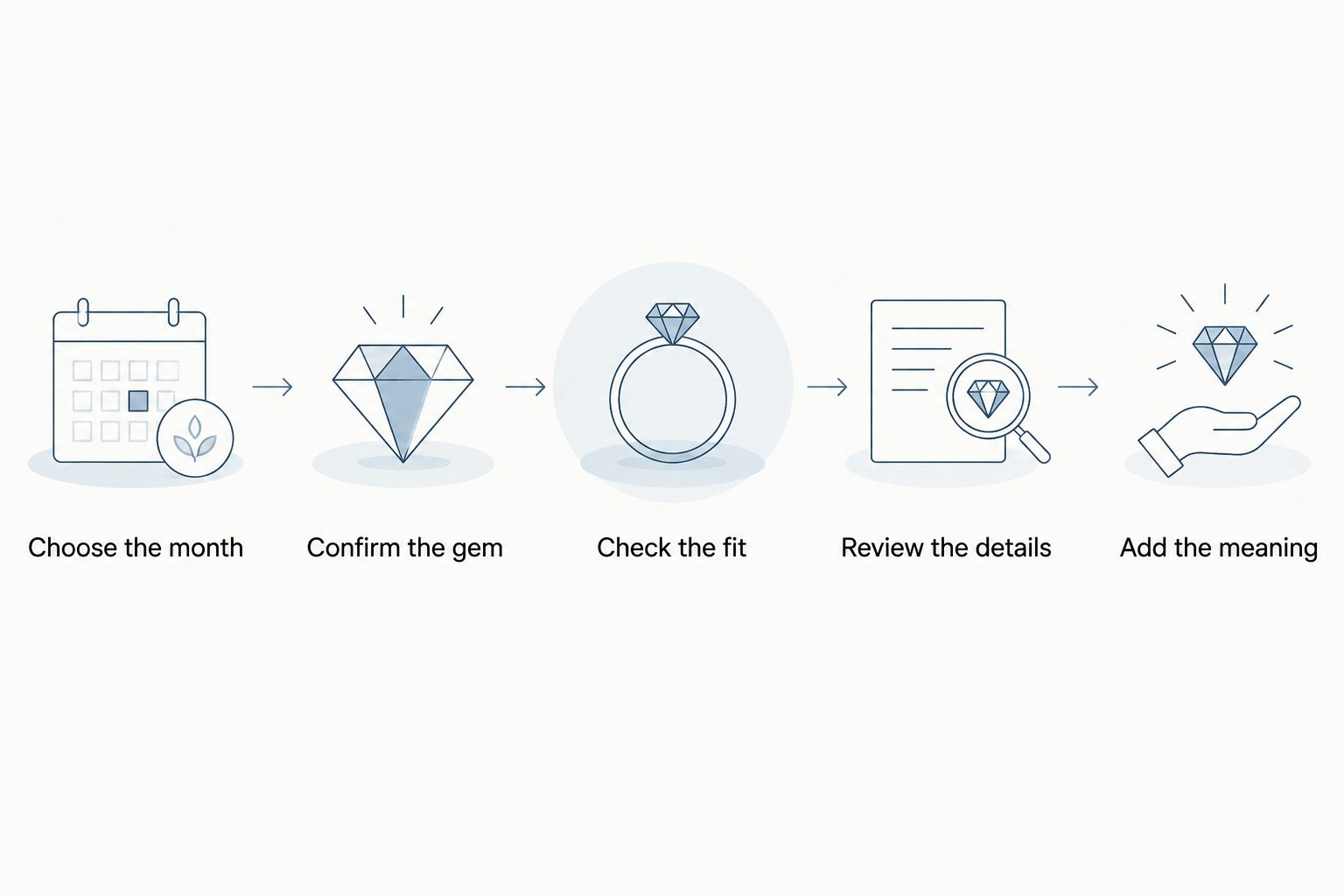
- Choose the month. Confirm the birthday month and which associated gemstone you want. For months with multiple birthstones, let personal taste guide the choice.
- Confirm the gem. Read the actual material name and its origin disclosure. Separate laboratory-grown gemstones from simulants before comparing designs.
- Check the fit. Confirm dimensions, chain length, earring fastening, or ring size as applicable. Use a well-loved existing piece as a reference when possible.
- Review the details. Ask about treatments, setting construction, documentation, and care. Keep the answers tied to the exact item.
- Add the meaning. Include a note explaining why you chose the birthstone. The personal connection does not depend on natural origin.
For your 2026 shortlist, keep a simple record of the exact product title and the questions you still need answered. That prevents a detail from one piece—such as metal type or stone origin—from accidentally influencing your assessment of another.
Two examples with explicitly identified lab-grown stones
Balacia's lab-grown birthstone jewelry includes the following diamond and alexandrite examples. These are different gift formats, not interchangeable versions of the same design.
| Piece | Best for | Verified details | What to check before choosing |
|---|---|---|---|
| Lab Alexandrite Stud Earrings | A June birthday recipient who prefers studs | Round lab-grown alexandrite; 14k or 18k solid white, rose, or yellow gold | Selected metal, total carat weight, dimensions, and fastening |
| 1/6 ctw Lab Diamond 14k White Gold Pendant | An April birthday recipient who prefers a necklace | Lab diamond; 14k white gold; 1/6 ctw; adjustable 16–18-inch chain | Whether that chain length and pendant scale suit the recipient |
The Lab Alexandrite Stud Earrings suit a stud-earring wearer; the 1/6 ctw Lab Diamond 14k White Gold Pendant suits a necklace wearer. The earrings require pierced ears, while the pendant's stated chain adjustment does not establish where it will sit on every person. Let the recipient's habits settle the choice.


Is lab-grown birthstone jewelry real gemstone jewelry?
Lab-grown birthstone jewelry is real gemstone jewelry when the stones are the laboratory-grown counterparts of the named gems. Laboratory-grown ruby is ruby; a red simulant remains its own material, even when used in a July-themed gift.
Does lab-grown birthstone jewelry need a certificate?
Lab-grown birthstone jewelry does not automatically include a grading or identification report. Ask what documentation accompanies the exact piece and what it covers; a report for one stone does not certify every stone or the entire item.
Can lab-grown birthstone jewelry become an heirloom?
Lab-grown birthstone jewelry can become an heirloom through its personal history, thoughtful construction, and care. Laboratory origin does not prevent sentimental meaning, but neither origin nor the word heirloom guarantees future resale value or freedom from repairs.
What should I ask before buying?
Before ordering, ask the seller to confirm the gemstone name, laboratory or natural origin, and any treatments. Then ask about the metal, dimensions, fastening, and care instructions for that specific piece. You are checking identity and suitability, not looking for the longest list of technical terms.
For a 2026 gift, keep those answers with your purchase records. If documentation accompanies the piece, retain it too. Clear records help the recipient understand what they own and give a jeweler useful information when discussing care or repairs.
Avoid assuming that laboratory-grown means untreated, certified, environmentally preferable in every case, or guaranteed to retain value. Those are separate claims requiring their own evidence. Choose the piece for its disclosed materials, suitability, and meaning—not promises attached to the category.
FAQ
Can birthstone jewelry be made with lab-grown stones?
Yes, birthstone jewelry can use laboratory-grown gems such as diamond, ruby, sapphire, emerald, and alexandrite. Confirm the actual gem identity and origin on the individual piece.
Is lab-grown birthstone jewelry fake?
Lab-grown birthstone jewelry is not fake when it contains accurately identified laboratory-grown gemstones. A simulant is a different material that resembles another gem and should be described accordingly.
Can I give a lab-grown diamond for an April birthday?
Yes, a lab-grown diamond can represent April's diamond birthstone. Choose it when the recipient is comfortable with laboratory origin rather than specifically wanting a natural diamond.
Is lab-grown alexandrite suitable for a June birthday?
Yes, lab-grown alexandrite is suitable for a June birthday because alexandrite is one of June's birthstones. Confirm that the stone is alexandrite rather than a color-changing imitation made from another material.
Does every birthstone necklace contain a lab-grown gem?
No, a birthstone necklace can contain natural, laboratory-grown, or imitation material depending on the piece. The birthstone label alone does not disclose origin.
Does lab-grown mean that a gemstone is certified?
No, laboratory-grown origin does not mean a gemstone has a grading or identification report. Ask which documents accompany the exact stone or piece and what those documents establish.
How do I choose a birthstone gift within my budget?
Choose the birthstone, jewelry format, and preferred metal before comparing individual pieces. A Balacia jewelry expert can help you understand the materials and discover gifts suited to your loved one and your budget.
One last thing
The most useful detail to put in the gift box is the gemstone's actual name and origin. A short note can say why you chose that birthstone, while the product information explains what it is. Keeping both gives your loved one the story and the practical details together.
An heirloom begins with a relationship, not a geological requirement. Choose jewelry your loved one wants to wear, explain its meaning honestly, and help them care for it.