


Athletes choose mens wedding bands for comfort, style, and safe removal. The best approach for 2026 is to choose for life outside training. Do not treat any ring as protective equipment.
TL;DR
- Choose mens wedding bands for athletes around removal habits, everyday comfort, and the demands of your sport.
- Balacia offers wedding bands for everyday wear; no jewelry purchase replaces a sport-specific safety decision.
- Tungsten resists scratching but can fracture; gold can scratch and deform. Neither belongs under heavy gripping pressure.
- Silicone wedding rings are flexible, not a guarantee against injury. Follow your sport’s jewelry rules.
Why wedding-band choice matters for athletes
A wedding ring carries a promise. It sits where you grip a bar, catch a ball, or hold a rope. Choose the ring you love, then establish when it comes off.
For athletes shopping in 2026, the important distinction is everyday wear versus training wear. A comfortable ring at your desk can become uncomfortable when your fingers swell during exercise. A hard surface that resists scratches does not protect your finger from pressure or a snag.
Balacia sells wedding bands and offers custom design options. Consider a meaningful ring to wear outside training. Your sport’s rules determine if jewelry belongs in the session.
Couples choosing a gift should discuss this together. Removing a wedding band for a workout protects both the wearer and a piece chosen to mark your commitment. It does not diminish what the ring means.
How to choose mens wedding bands for an active lifestyle
Check your sport’s rules and contact risks
Start with the rulebook, coach, or facility instructions—not a metal comparison. Jewelry restrictions take priority over a ring’s advertised durability. Contact sports, climbing, and activities involving machinery or loaded gripping require particular attention to catching and compression hazards.
A ring caught on equipment can seriously injure a finger. Flexible materials do not make every activity safe. Taping over a ring does not remove snag risk. When a session creates a ring hazard, remove the ring. Do not try to make it workout-ready.
Build this decision into your preparation. Do so alongside checking shoes and other equipment. Know where the ring goes before the session begins. Do not decide beside a loaded bar or entering the field.
- Check rules: Read the jewelry policy for your sport and facility.
- Assess contact: Identify collisions, tackling, and hand-to-hand contact.
- Assess grip: Notice bars, handles, ropes, and tools pressing against the ring.
- Remove jewelry: Take the ring off before a prohibited or hazardous activity.
The decision follows a simple sequence. First, check permission. Then, assess the activity. Finally, remove jewelry where rules or hazards require it.
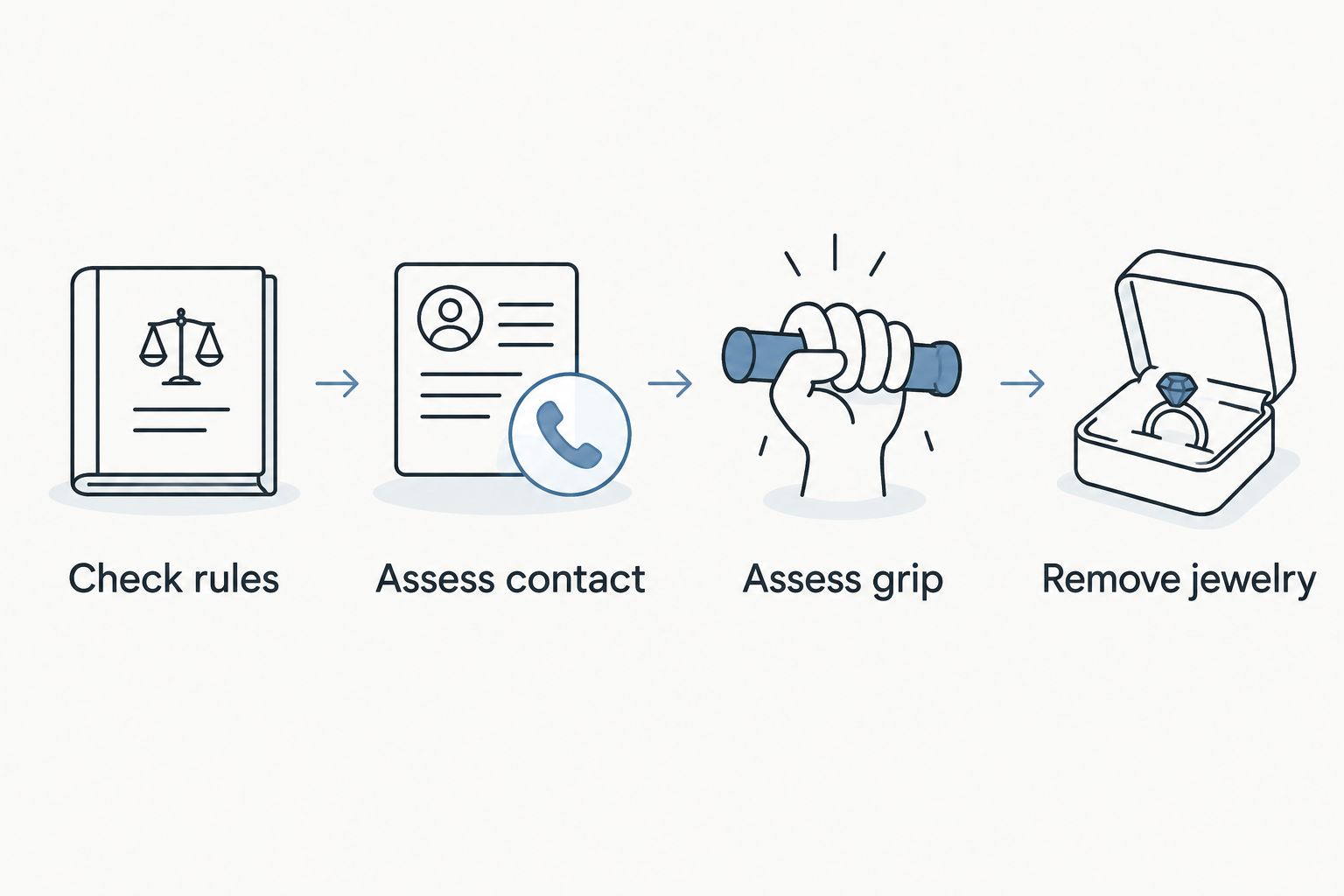
Your sport’s rules come before material or style preferences.
Test the fit when your hands are at rest
Use an existing comfortable ring as a reference. Have a jeweler check your size with a sizer. Choose one resembling your desired width. Do not measure immediately after a demanding workout. Exercise and temperature changes alter how snugly a ring feels.
Width, thickness, and inner profile all contribute to comfort. A broad band covers more skin. A rounded interior changes how the edge meets your finger. “Comfort-fit” describes an interior profile. It is not a safety certification.
For your 2026 purchase, compare actual dimensions rather than relying on a photograph. A band that looks restrained in a close-up can feel substantial when you make a fist. Check the fit with relaxed hands, then with ordinary movements—not by testing it under a heavy load.
- Ask for sizing with a similar-width ring.
- Check that the band clears your knuckle without force.
- Make a relaxed fist and notice pressure against neighboring fingers.
- Compare the interior profile and edge shape.
- Discuss persistent tightness or difficult removal with a jeweler.
A side-by-side view helps distinguish width from profile. A narrower ring and a broader ring can both have rounded interiors. However, they occupy different amounts of space on your finger.
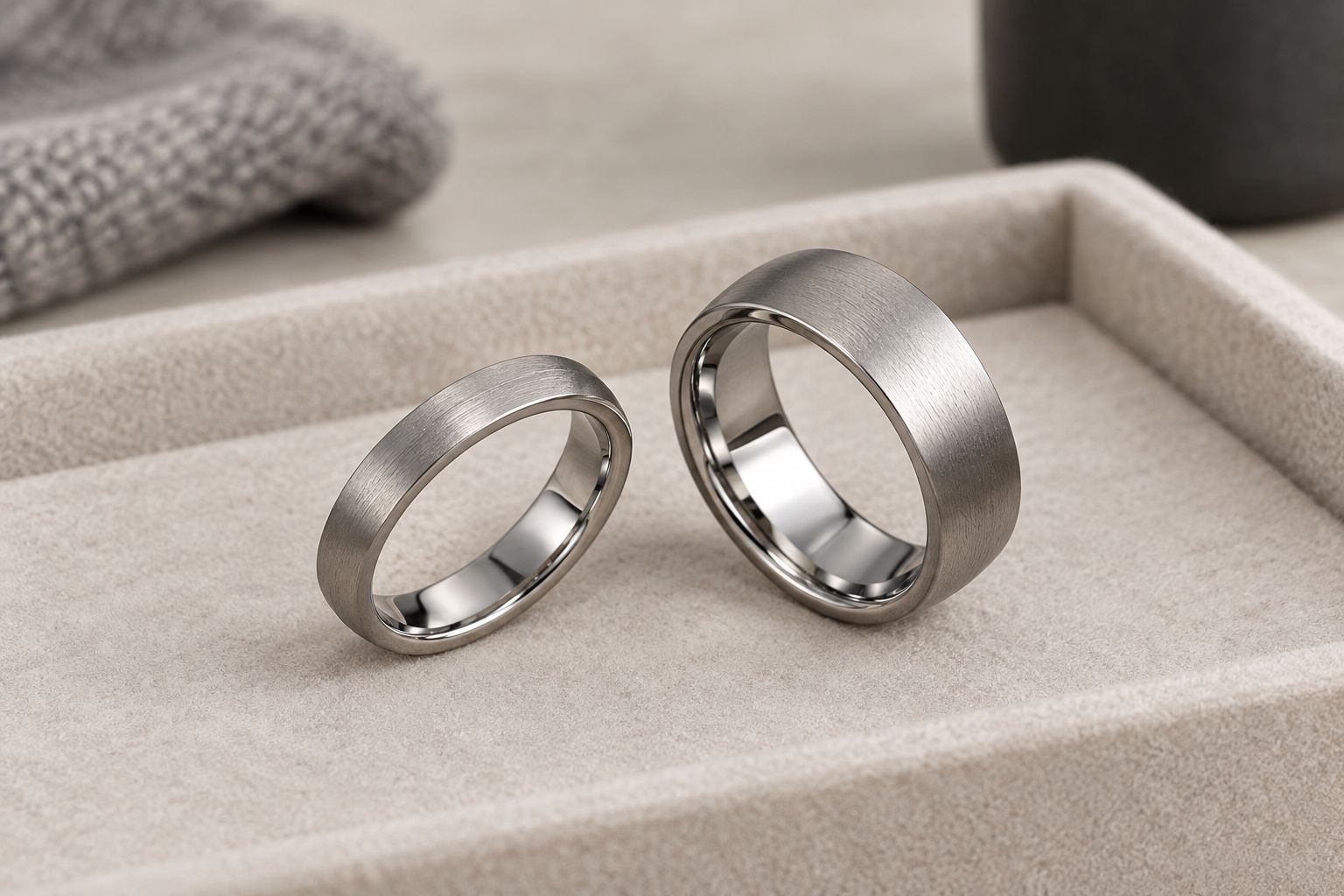
Compare width and interior shape separately when judging comfort.
Match the everyday ring to your personal style
Before shopping, write down what you want. Consider warm or cool metal color. Do you want a plain or decorative surface? Is your preference a narrow or broad silhouette? Do diamonds matter to you? This shortlist stops “athletic” styling from replacing your own taste.
Then compare the exact listing with your requirements. Balacia wedding bands are for couples choosing a meaningful everyday ring. They are not for protective sports equipment. Custom design is an option when your desired combination needs discussion. The Custom Ring CAD Design Mockup provides a specific starting point for that conversation.
A CAD design discussion concerns appearance and construction. It does not establish that a finished ring is safe for lifting, contact sport, or climbing. Keep the design brief separate from the training-removal decision.
- List your preferred metal color and surface finish.
- Decide whether you want a plain band or visible stones.
- Compare exact widths, thicknesses, and fit descriptions.
- Ask about the finished profile rather than judging a rendering alone.
- Confirm any sizing or alteration questions before choosing.
Choose a material by its trade-offs
No material wins every test. Gold can scratch and deform; tungsten carbide is hard and scratch-resistant but brittle enough to fracture. A coating or decorative inlay introduces another surface to maintain, separate from the underlying band.
For your 2026 shortlist, distinguish surface durability from repairability and finger safety. Tungsten bands are generally not resized by conventional cutting and soldering. Gold bands offer more scope for alteration. The exact design determines what a jeweler can do. Stone placement and construction are also factors.
Do not assume a dark finish is the natural color of the underlying material. Where a listing specifies PVD or plating, that describes a surface treatment. Likewise, an imitation decorative material should be chosen for its appearance—not mistaken for natural provenance.
- Read the exact metal and coating description.
- Ask how the finish should be cleaned and maintained.
- Confirm whether the specific design can be resized.
- Check whether stones or inlays affect alteration options.
- Reject “indestructible” as a reason to wear a ring during risky activity.
Create a removal and storage routine
The manual solution is simple: use a dedicated protective container in a consistent place. Remove the ring before training, close the container, and put it somewhere secure. A loose locker shelf, towel, or open gym-bag pocket leaves too much room for a small item to disappear.
A silicone band is an optional substitute for activities that permit jewelry and do not create an unacceptable ring hazard. Its flexibility is useful, but it does not override a rulebook or eliminate snagging. A bare finger remains the appropriate choice when jewelry is prohibited or the activity calls for removal.
Make the routine easy enough to repeat on a busy morning. If you forget to remove your ring at the gym, take it off at home. Leave it securely stored instead of carrying it unnecessarily.
- Choose a dedicated, closable ring container.
- Assign the container a consistent secure location.
- Remove the ring before handling training equipment.
- Keep jewelry away from loose towels and clothing bundles.
- Put the ring back on only when your hands feel comfortable.
Maintain the ring between training sessions
Follow the care instructions for the exact ring rather than applying one cleaning method to every metal, coating, or setting. A plain metal band and a diamond-set ring do not have identical maintenance needs. Inlays and treated surfaces also deserve their own instructions.
After exercise, wash and dry your hands. Then put the ring back on. If the band feels unusually tight, do not force it. Persistent swelling, pain, numbness, or a stuck ring needs prompt attention. A finger that changes color or loses sensation requires urgent medical help.
Your 2026 care routine should include checking the ring’s condition. Also check its appearance. A rough edge, damaged surface, or loose stone means stopping wear. Ask a jeweler to inspect it.
- Use the cleaning method specified for the exact ring.
- Dry your finger before replacing the band.
- Inspect edges and any stone settings.
- Stop wearing a ring that develops a rough or damaged area.
- Seek urgent help for circulation changes or loss of sensation.
Compare wedding-band options for athletes
Best for training with ring hazards: no ring. Best for everyday wear: the band that fits your hand and your relationship. The table separates those roles rather than pretending one purchase does both.
The 14K White 8 mm Grooved Milgrain Wedding Band lists an 8 mm width. It has a comfort-fit interior. Its approximate weight is 7.11 grams. The Black and Yellow Tungsten 8mm Wedding Band lists black PVD and yellow-gold plating. These are specific construction details. They are not claims that either ring suits sport.
| Option | Best for | Main advantage | Key limitation |
| No ring during training | Contact, snag, or loaded-grip situations requiring removal | Removes the ring from the activity | Requires secure storage and a repeatable routine |
| Silicone band | Permitted activities where a flexible substitute is appropriate | Flexible alternative to a rigid band | Not injury-proof; jewelry rules still apply |
| 14K White 8 mm Grooved Milgrain Wedding Band | Everyday wear with a broad, detailed style | Verified comfort-fit interior and 8 mm width | Broad coverage deserves careful fit testing; remove for hazardous sport |
| Black and Yellow Tungsten 8mm Wedding Band | Everyday wear with contrasting surface colors | Tungsten construction with a specified decorative finish | Surface treatments need care; tungsten is not conventionally resized |
| 6 mm beveled-edge tungsten band | Shoppers considering a narrower tungsten profile | Listed 6 mm width and beveled edges | Verify coating, interior fit, and sizing details before choosing |
| Tungsten band with imitation meteorite and carbon-fiber inlay | Shoppers drawn to a decorative inlay | Distinctive listed material combination | Imitation meteorite is not natural meteorite; confirm care instructions |
For Balacia shoppers, the following everyday options illustrate a broad comfort-fit design and a contrasting tungsten finish. Choose them for personal style after resolving fit and care questions—not because a product photograph suggests athletic suitability.
Everyday bands to consider

14K White 8 mm Grooved Milgrain Wedding Band
Listed with an 8 mm width, comfort-fit interior, and approximate weight of 7.11 grams.
$1,700

Black and Yellow Tungsten 8mm Wedding Band
Listed with black PVD and 18K yellow-gold plating; approximate weight is 9.50 grams.
$330
Common mistakes athletes make when choosing wedding bands
Treating scratch resistance as finger protection
A scratch-resistant band protects its appearance better against some everyday abrasion. It does not protect your hand from a ring catching on equipment. Choose the material for ordinary wear, then assess training hazards independently.
Buying a tighter ring to stop movement
A ring should fit securely, but deliberately choosing a constricting size is not a solution for exercise. Finger swelling can make removal difficult. Check the everyday fit with a jeweler and remove the ring before training that creates pressure or snagging.
Assuming a comfort-fit interior makes lifting safe
A rounded interior changes how a band feels against your finger. It does not remove the pressure created when a rigid ring sits between your hand and a bar. Comfort-fit is a wearing preference, not permission to keep jewelry on during heavy gripping.
Choosing a gift without discussing removal
Surprising your partner with the style can be romantic; guessing their fit and training habits is less helpful. Discuss the type of ring they want, how they will store it, and whether their sport prohibits jewelry. The everyday ring and the workout routine should work together.
Forgetting the finish and future sizing
An athlete’s priorities extend beyond the first comfortable try-on. Ask about the exact coating, decorative inlay, and alteration limits. A band you love today still needs a realistic care plan and a clear answer about future fit changes.
FAQ
What are the best mens wedding bands for athletes?
The best mens wedding bands for athletes fit comfortably everyday. Remove them before activities with contact, snagging, or loaded-grip hazards. Choose material and design for personal preference. Then follow your sport’s jewelry rules.
Can I wear my wedding band while lifting weights?
Remove your wedding band before lifting weights. Do this when grip places pressure on the ring. Also remove it if equipment creates a catching hazard. A comfort-fit interior or scratch-resistant material does not prevent those risks.
Is a silicone wedding ring safe for every sport?
No, a silicone wedding ring is not safe for every sport. Flexibility does not override jewelry prohibitions. It does not guarantee protection against injury. Remove all rings when rules or activity require it.
Is tungsten better than gold for an active lifestyle?
Tungsten suits shoppers prioritizing scratch resistance. Gold offers different styling and alteration possibilities. Tungsten can fracture and is not conventionally resized. Neither material is a reason to keep a ring on during hazardous training.
Should athletes choose a narrow or wide wedding band?
Athletes should choose the width that fits comfortably during everyday movements rather than selecting width as a safety feature. Compare similar-width sizing samples and check the interior profile, thickness, and pressure against neighboring fingers.
Can Balacia wedding bands be worn during sports?
Balacia wedding bands should be evaluated as jewelry, not sports safety equipment. Follow your sport’s rules and remove the ring before activities involving hazardous contact, catching, or gripping pressure.
What should I do if my wedding ring gets stuck after exercise?
Stop forcing the ring. Seek help if swelling prevents removal. Pain, numbness, loss of sensation, or a change in finger color requires urgent medical attention. Do not repeatedly attempt to pull the ring off.
One last thing
For your 2026 wedding-band purchase, choose a storage place before choosing the final finish. That small decision makes safe removal easier to repeat, whether you train before work or head straight to practice afterward.
The ring represents your commitment even when it is safely stored. Pick an everyday band you enjoy wearing, and let your training routine protect the hand—and the meaningful gift—that carries it.