


Tradespeople’s wedding-band selection is choosing a lasting symbol of marriage that suits hands-on work without treating any ring as safety equipment. The best durable wedding bands for construction workers belong off your hand whenever the task, glove instructions, or site rules require removal; this 2026 guide helps you choose the ring you will enjoy wearing outside those hazards.
- Choose durable wedding bands for construction workers by separating scratch resistance, impact resistance, comfort, and workplace safety.
- Balacia wedding bands suit tradespeople choosing a meaningful off-duty ring, not protective equipment.
- Tungsten resists scratches but can fracture; gold scratches but offers more conventional resizing options.
- Silicone rings are not permission to wear jewelry around machinery or electrical hazards.
- Check workplace rules first, then compare wedding-band materials, fit, finishes, and care.
Why wedding-band selection matters for tradespeople
Construction workers, mechanics, electricians, and other manual laborers need to answer a question that a dress-ring shopper can overlook: When should this ring come off? A band that looks unchanged after ordinary wear still presents a snagging hazard around moving equipment. A comfortable fit does not remove that risk.
Your wedding ring carries personal meaning, but its daily routine should follow the work rather than the sentiment. You can choose a ring you love from Balacia and leave it safely stored during hazardous tasks. Taking it off protects the person who wears it and the promise it represents.
Balacia wedding bands are best for tradespeople choosing a meaningful off-duty ring, not protective equipment. Material choice helps determine appearance, maintenance, and repair options; workplace rules determine whether you wear a ring on the job.
For your 2026 purchase, start with your actual duties rather than a general description such as heavy-duty or work-ready. Climbing, handling rotating tools, servicing electrical equipment, and carrying abrasive materials create different concerns. No single metal solves all of them.
How to choose a wedding band for hands-on work
1. Check your workplace jewelry rules
Read your employer’s safety requirements before comparing rings. Ask your supervisor about the tasks you perform, not just whether wedding bands are generally allowed. Rules for office areas do not necessarily apply beside machinery, on ladders, or during equipment maintenance.
For electrical work, OSHA’s general-industry electrical safety standard, 29 CFR 1910.333(c)(8), addresses conductive jewelry where it might contact exposed energized parts. Do not turn a material comparison into an electrical-safety judgment. A jewelry seller is not the authority on whether your work permits a particular ring.
Treat ring removal as a planned action. Repeatedly improvising a storage spot makes it harder to follow the same safe routine during a busy shift.
- Read the jewelry policy for your specific work area.
- Ask about rotating equipment, climbing, and electrical tasks separately.
- Follow equipment and glove instructions alongside site rules.
- Choose a secure storage location before your first shift wearing the ring.
- Do not substitute a silicone ring when the rule requires no jewelry.
2. Separate the kinds of durability you need
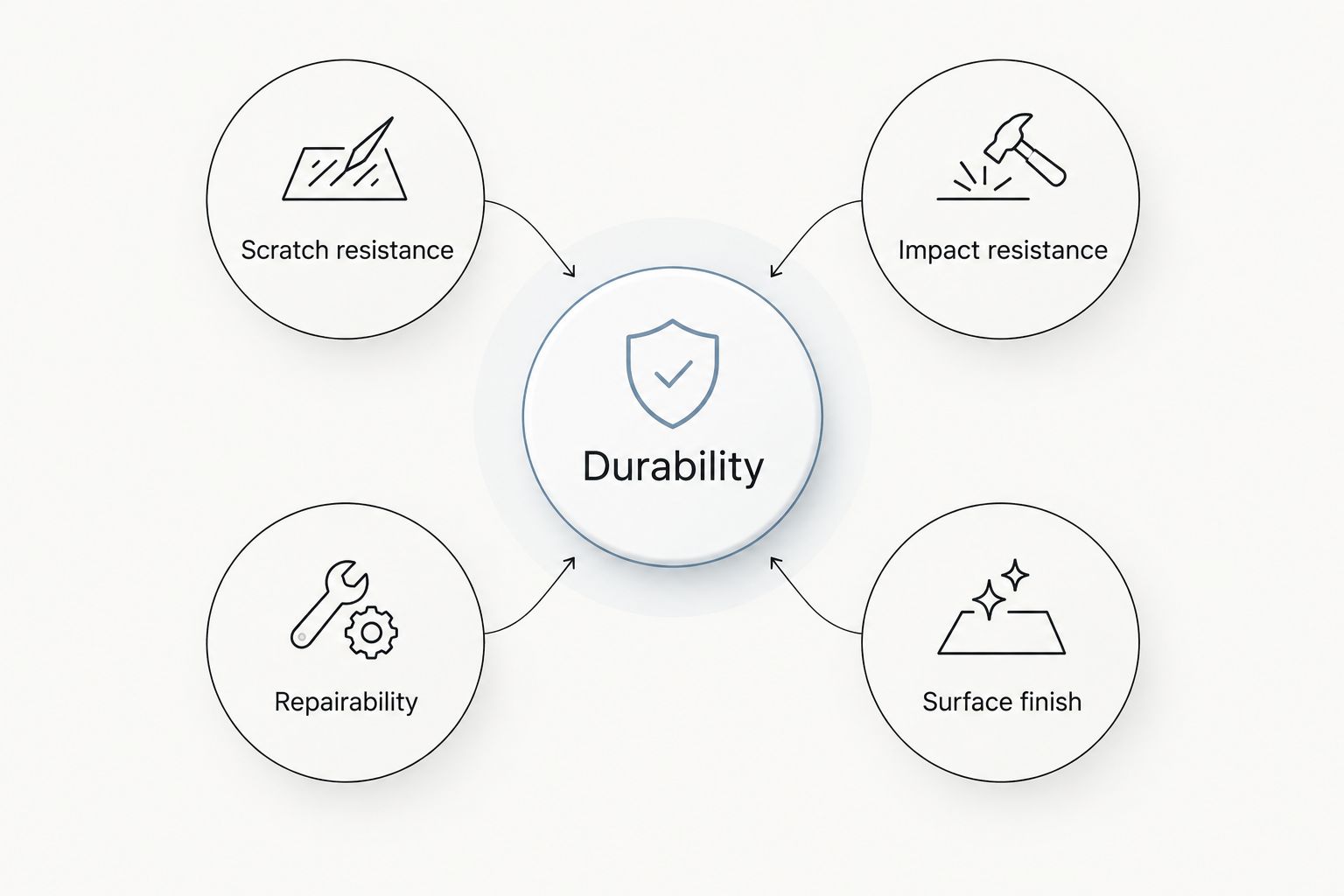
Scratch resistance, impact resistance, and repairability describe different things. A hard surface can resist abrasion while remaining vulnerable to fracture. A softer metal can collect marks yet still offer useful repair options. Neither property establishes that a ring is safe around tools.
Tungsten-carbide jewelry illustrates the distinction: it resists scratching, but it can crack or fracture under impact. Gold is more susceptible to scratches and deformation, while conventional gold bands often allow resizing and refinishing. Settings, construction, and decoration affect those options, so confirm them for the exact ring.
Write down the compromises you accept before you shop. If you want a band that develops visible wear with you, surface marks need not be a disappointment. If an unchanged finish matters most, ask about coatings as well as the underlying material.
- Scratch resistance: compare the base material and surface finish separately.
- Impact resistance: ask about cracking, denting, and deformation.
- Repairability: confirm resizing and refinishing for the exact design.
- Surface finish: identify plating, coatings, and inlays.
- Workplace safety: decide this independently of durability.
3. Compare complete ring constructions
Compare the whole band, not just its headline metal. A plated tungsten ring, an inlaid tungsten ring, and a plain metal band have different surfaces to maintain. Decorations also change what you need to inspect after wear.
Balacia lists an 8 mm tantalum comfort-fit band and a 6 mm tungsten band with a black PVD finish and an 18k yellow-gold reference in its product name. Those dimensions describe width, not a safety rating. Confirm whether a gold detail is plating or solid material rather than assuming the entire ring is gold.
Tantalum offers an alternative appearance to traditional gold, but the word alone does not establish scratch immunity or resizing options. Inlaid designs offer visual character, yet introduce another component whose care requirements need checking. For your 2026 shortlist, require a clear answer about both the band and its finish.
- Identify the base metal before comparing appearance.
- Confirm whether gold details are solid, plated, or otherwise applied.
- Ask how PVD finishes should be cleaned and maintained.
- Check the care requirements for each inlay material.
- Confirm whether resizing applies to the complete design.
4. Test width, edges, and fit on your hand
A wedding band should feel comfortable when you bend your fingers, grip ordinary objects, and relax your hand. Wider bands cover more skin and feel different from narrow ones. Do not assume your size in one profile transfers unchanged to another.
An 8 mm band gives a broader appearance than a 6 mm band, but neither width is automatically better for a tradesperson. Comfort-fit describes the inner profile; it does not guarantee comfort for every hand. Fit the actual style you intend to wear, especially if you are moving from a narrow ring to a wider one.
Test only ordinary, nonhazardous movements. A glove trial at home can identify uncomfortable pressure, but it cannot establish that wearing the ring during work is acceptable. If your finger is swollen or the ring becomes difficult to remove, stop treating tightness as a normal fit characteristic.
- Compare narrow and wide bands on the same finger.
- Check whether the edges press into neighboring fingers.
- Bend your fingers and make a relaxed fist without tools.
- Notice pressure from the inner profile and band thickness.
- Confirm fit when your hands are at their usual size.
5. Match the design to life outside the worksite
Choose the wedding band for the moments when you can safely wear it: evenings together, family gatherings, weekends, and celebrations. That keeps the decision personal without asking jewelry to perform as equipment. A ring can become a treasured reminder of your marriage even when it spends your shift in secure storage.
Start by noting your partner’s preferred color, width, and level of decoration. Then use the product specifications to narrow the choices. Custom design is another route when an existing style does not match the look you want, but discuss fit and maintenance alongside appearance.
The examples below show contrasting off-duty directions: a grooved gold band and a black-and-yellow tungsten band. The gold design suits someone who likes traditional detail; the tungsten design suits someone drawn to contrasting finishes. Both require the same separate workplace-safety decision.
- Choose a color your partner already enjoys wearing.
- Decide between an undecorated surface, grooves, inlays, or stones.
- Keep raised details away from any expectation of worksite suitability.
- Ask about engraving compatibility before choosing an inscription.
- Discuss custom design if the desired combination is not listed.


6. Build removal and care into your routine
A good removal routine starts before the hazardous task, not when a band catches or becomes uncomfortable. Use a dedicated container in a secure place permitted by your workplace. Avoid loose pockets, open tool trays, and other locations where a small object is easily misplaced.
Follow cleaning instructions for the exact construction. A method appropriate for an undecorated metal band is not automatically appropriate for a coated surface, an inlay, or a stone setting. Remove abrasive dust before rubbing the ring, and avoid using workshop solvents as jewelry cleaners.
Make your 2026 ring-care plan simple enough to repeat. Inspect the band when you put it back on, and arrange professional assessment for damage rather than testing it with force. If a ring becomes trapped or your finger shows circulation problems, seek urgent medical help instead of attempting workshop removal.
- Remove the ring before prohibited or hazardous tasks.
- Store it in the same secure container each time.
- Follow the exact product’s cleaning instructions.
- Inspect coatings, inlays, and settings after ordinary wear.
- Seek professional assessment for cracks, damage, or persistent fit problems.
Compare wedding-band options for tradespeople
Choose by the compromise you can live with, not by a claim of indestructibility. This comparison separates off-duty jewelry choices from the option of wearing no ring during work. Every jewelry option remains subject to task-specific removal rules.
| Option | Best for | Useful advantage | Key limitation |
|---|---|---|---|
| Tantalum 8 mm beveled-edge comfort-fit band | A broad off-duty band with a comfort-fit profile | Offers a different material choice from gold or tungsten | Width needs a fit check; confirm repair and resizing options |
| 6 mm beveled-edge tungsten band | A narrower tungsten style with contrasting details | Tungsten-carbide jewelry resists scratches | Impact can cause fracture; surface details need separate care |
| Tungsten band with imitation meteorite and carbon-fiber inlay | A distinctive off-duty design | An inlay adds visual character | Inlay care and repair need checking separately from the base band |
| Traditional gold band | A familiar appearance and conventional jewelry maintenance | Many plain designs allow resizing and refinishing | Gold scratches and can deform; exact repair options vary |
| Silicone ring | A flexible alternative where workplace rules permit it | Flexibility differs from a rigid metal band | Not protective equipment or permission to ignore jewelry restrictions |
| No ring during the task | Work that prohibits jewelry or presents snagging hazards | Removes the ring itself from the task | Requires a consistent storage routine |
For a gift, ask which limitation your partner would rather accept. Visible wear, a finish that needs care, and a design that cannot be conventionally resized are different commitments. A thoughtful conversation about these details is more useful than a surprise based only on appearance.
Common mistakes tradespeople make when choosing wedding bands
Treating scratch resistance as a safety feature
A scratch-resistant ring still catches on equipment and structures. Durability protects appearance; removal addresses ring-related exposure during hazardous tasks. Make those separate decisions before you choose a material.
Assuming a glove makes a ring acceptable
A glove does not cancel a jewelry restriction. It can also change how a ring feels against your finger. Follow the glove and equipment instructions rather than judging safety from whether the band stays hidden.
Buying a coated band as though its finish is permanent
The base material and decorative surface are different parts of the ring. Ask about coating care and restoration before buying. Do not interpret a tungsten description as a guarantee that every colored detail will resist wear in the same way.
Choosing a wide band without checking fit
An 8 mm profile can feel different from a slimmer ring even when the marked size matches. Check the exact width and inner profile. A broad, meaningful band should not require tolerating pressure or difficult removal.
Planning to remove the ring without planning where it goes
A removal habit is incomplete without secure storage. Decide on the container and location before wearing the ring to work. That small practical choice helps keep an emotionally important object out of a tool tray or loose pocket.
FAQ
What are the best durable wedding bands for construction workers?
The best durable wedding bands for construction workers are chosen for off-duty comfort, acceptable wear, and maintenance needs—not as safety equipment. Compare the complete ring construction and remove any ring when workplace rules or task hazards require it.
Is tungsten better than gold for a manual laborer’s wedding band?
Tungsten is better for scratch resistance, while conventional gold bands often offer more familiar resizing and refinishing options. Tungsten-carbide rings can fracture under impact, and gold can scratch or deform. Neither material makes a ring safe around machinery.
Can construction workers wear silicone wedding rings on the job?
Construction workers should wear silicone wedding rings only where workplace rules and task-specific instructions permit jewelry. Silicone is not protective equipment. If the task requires removing rings, that includes silicone rings.
Is an 8 mm wedding band too wide for someone who works with tools?
An 8 mm wedding band is not automatically too wide, but the exact profile needs a fit check. Compare it with a narrower band during ordinary, nonhazardous hand movements. Comfort does not establish permission to wear it while using tools.
Should electricians wear metal wedding bands?
Electricians must follow electrical-safety requirements and remove conductive jewelry where it could contact exposed energized parts. OSHA’s general-industry standard addresses this hazard. Choose an off-duty ring independently of the workplace decision.
Can a tungsten wedding band be resized later?
Conventional tungsten-carbide wedding bands generally cannot be resized using traditional jewelry resizing methods. Confirm the options for the exact design before purchasing. Do not assume a replacement or exchange policy exists.
Can I buy a diamond wedding band for a tradesperson?
Yes, a diamond wedding band can be a meaningful off-duty gift for a tradesperson. Consider the setting’s cleaning and inspection needs, and keep the ring out of tasks that prohibit jewelry. A decorative design should not be presented as a worksite ring.
What should I check before buying a wedding band in 2026?
Before buying a wedding band in 2026, check workplace rules, fit, complete material construction, and maintenance requirements. Confirm resizing and any coating or inlay care for the exact design. Choose secure storage before taking the ring to work.
One last thing
The most useful workday feature of a wedding ring can be the routine that keeps it off your hand. Choose secure storage with the same care you give the ring itself. Your commitment does not become less meaningful when you protect your hands and save the jewelry for time together.
When selecting a Balacia wedding band in 2026, let the personal details lead: the color your partner loves, a comfortable profile, and a design you will both enjoy seeing over the years. Then give that ring a place in your life that respects the work you do.