


Nurses and doctors’ engagement-ring shopping is the process of choosing a meaningful ring around clinical duties, workplace jewelry rules, and personal style. The best engagement rings for nurses and doctors suit life outside work without depending on permission to wear them during patient care.
- Choose engagement rings for nurses and doctors around workplace rules before comparing diamond shapes or settings.
- Balacia is best for engagement-ring shoppers seeking custom design options alongside lab-grown and natural diamonds.
- Low-profile settings deserve consideration, but no setting makes an engagement ring automatically suitable for clinical work.
- Compare side views, fit, stone documentation, and wedding-band compatibility before choosing your ring.
Why engagement-ring choices matter for nurses and doctors
An engagement ring marks a commitment, not a work uniform. For nurses and doctors, the practical question is whether that ring belongs on the hand during a particular duty—not whether it looks delicate enough to pass unnoticed.
In 2026, start with your employer’s current jewelry and hand-hygiene requirements. A photograph cannot establish whether a ring is permitted in your role, and a colleague’s routine is not a substitute for the written policy.
Balacia is best for engagement-ring shoppers seeking custom design options alongside lab-grown and natural diamonds. You can explore Balacia for those choices, then assess each design against your own wear plan. Custom design is a way to discuss preferences; it is not evidence of clinical suitability.
The distinction matters when you are buying for someone else. A nurse who removes jewelry before every shift can still love an elaborate ring. A doctor who wants a restrained design for everyday life should not have to choose an ornate ring simply because it looks impressive in a proposal photograph.
Choose an engagement ring around your working life
Check your workplace rules before choosing a setting
Read the policy yourself before deciding that an engagement ring will be a daily work accessory. Ask the appropriate supervisor or infection-prevention contact how the requirements apply to your department, duties, and procedures. Keep the answer separate from the jewelry purchase.
Write down a 2026 wear plan with three situations: clinical work, nonclinical work, and time away from work. This turns a vague request for a practical ring into a clear shopping brief. If your duties require ring removal, focus on a ring you will enjoy off duty and a dependable storage routine.
Do not test a ring under clinical gloves to prove that it is acceptable. Permission comes first; fit and comfort follow only where jewelry is allowed.
- Check the written jewelry and hand-hygiene requirements.
- Ask whether restrictions differ by task or department.
- Clarify whether any permitted band must meet specific conditions.
- Decide where your engagement ring will stay during restricted duties.
- Tell your partner whether you want a work-friendly appearance or an off-duty statement.
Compare the setting from the side, not just above
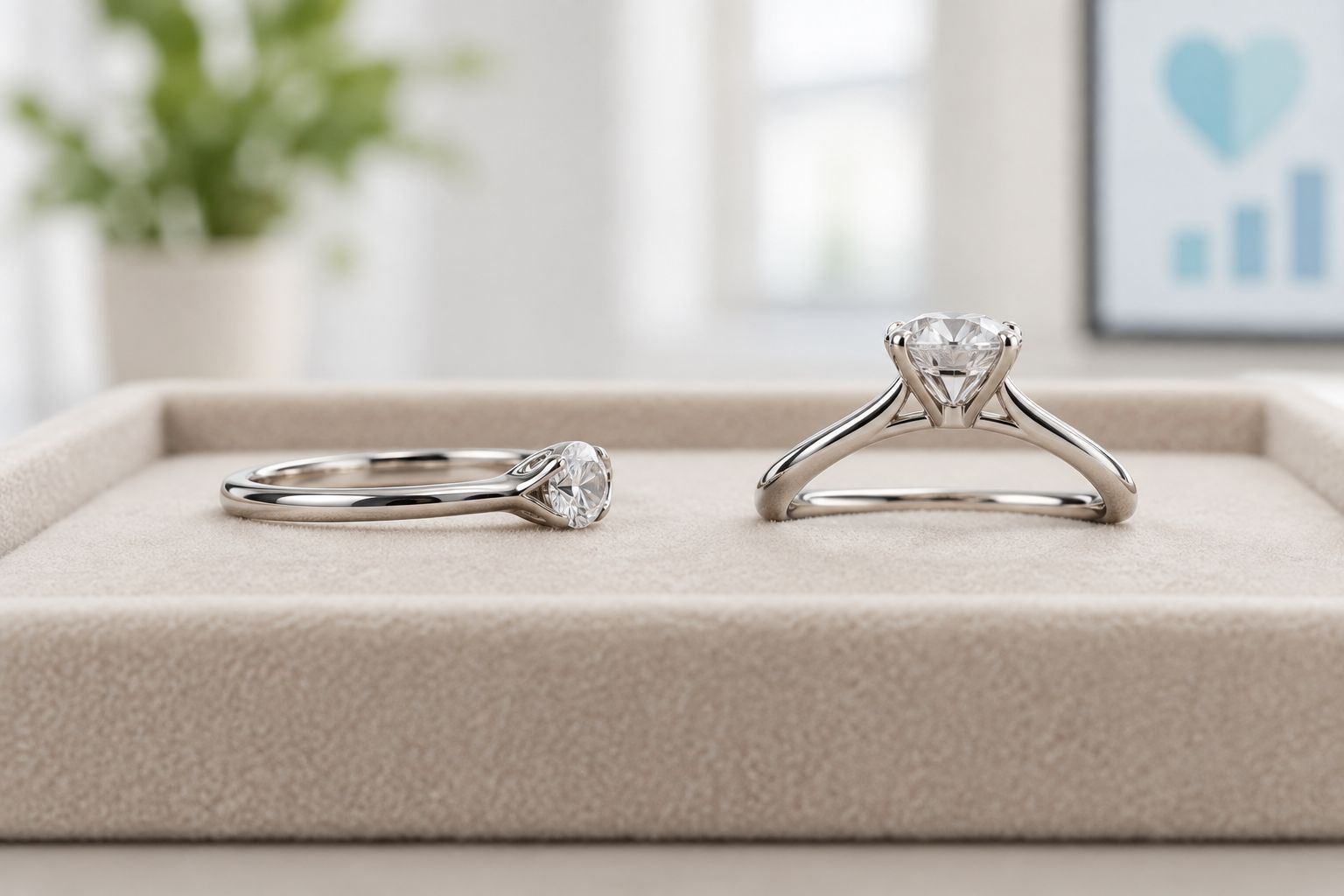
A top-down photograph shows the outline and sparkle. A side view shows how the stone sits above the finger, how exposed the setting is, and whether the design leaves room for a wedding band. Choose the whole setting, not just the diamond shape.
A bezel surrounds a stone’s edge with metal, while prongs hold it at selected points. Those designs have different appearances, but neither label tells you the ring’s overall height. A bezel can still sit high; a prong setting can be comparatively restrained.
Request two views—one from above and one from the side—before shortlisting a design. For a healthcare worker, this is more useful than assuming that every round stone is practical or every elongated stone is awkward. Pay attention to the actual construction.
- Ask for a clear side-profile photograph or drawing.
- Compare the stone’s position above the finger.
- Look for exposed points, raised details, and projecting shoulders.
- Ask how the center stone and accent stones are secured.
- Check whether your intended wedding band fits beside the setting.
Turn your preferences into a clear design brief
Start with a free written brief rather than a long list of ring photographs. Describe when you will wear the ring, which details you love, and which details you want to avoid. Include your partner in decisions that affect daily comfort; a surprise proposal does not require guessing every practical preference.
Balacia offers custom design options, and its Custom Ring CAD Design Mockup is a relevant starting point for discussing a design. Ask what the mockup includes and which details need confirmation before proceeding. A drawing helps communicate appearance, but it does not establish how a finished ring feels on your hand.
For a 2026 purchase, prioritize a few nonnegotiable preferences over collecting dozens of unrelated inspiration images. This makes the discussion clearer without treating custom work as a prerequisite.
- State whether the ring is primarily for off-duty wear.
- Identify your preferred stone shape and setting appearance.
- Describe your preference for a plain or diamond-accented band.
- Ask for the proposed setting height and band dimensions.
- Discuss wedding-band pairing before finalizing the design.
- Confirm the current design process directly with the retailer.
Verify the stone and metal for the exact ring
Begin with the individual listing, not a general statement about the retailer. Lab-grown and natural diamonds are both diamonds, but their origins differ. Decide which origin matters to you, then check the documentation for the particular stone you are considering.
Do not infer a grading laboratory from the word certified. Ask for the report and issuing laboratory, and check that the stone details match the proposed purchase. The same discipline applies to metal: a white-looking ring does not identify its alloy or karatage.
Product details illustrate why individual verification matters. The Pear diamond Engagement Ring with Radiant Cut Side Diamonds Iced Out is described with a 4-carat pear lab diamond and 14K gold. Those details describe that ring, not every engagement ring in the collection, and they say nothing about permission to wear it clinically.
- Confirm whether the center stone is lab-grown, natural, or another gemstone.
- Request any grading report associated with that exact stone.
- Check the stated metal and karatage for the chosen configuration.
- Ask about alloy composition if you have a known metal sensitivity.
- Separate carat weight from the stone’s physical dimensions.
Check fit and plan one consistent storage routine
Use a ring you already own as a starting reference, then arrange a proper sizing check when possible. Measure the intended finger rather than assuming that a ring worn on another finger gives the right answer. Consider both the engagement ring alone and the combination with your future wedding band.
A comfortable fit should be assessed on your hand. Do not substitute a seller’s description of comfort for your own experience, and ask about the exact design’s sizing options before ordering.
Choose one designated storage case for times when the ring comes off. The useful habit is consistency: remove it in a suitable place, put it directly into the case, and return it to the same secure location. A routine designed before the proposal is easier to discuss than an improvised solution during a busy shift.
- Confirm the size of the intended finger.
- Assess the fit with your planned wedding-band combination.
- Ask about sizing options for the exact design.
- Keep a dedicated closed case in a secure location.
- Avoid placing the ring loose beside a sink or in disposable packaging.
Match the ring to the moments when you will wear it
If you will remove your engagement ring for clinical work, choose it for the rest of your life. Consider dinners together, ordinary weekends, family celebrations, and the everyday clothes you actually wear. The ring can be romantic without pretending to solve workplace restrictions.
For 2026 shopping, keep two questions separate: do you love the design, and does its construction suit your planned use? Neither answer replaces the other. A restrained setting is not automatically comfortable, and a detailed setting is not automatically wrong for someone who wears it only away from work.
Balacia’s engagement-ring selection includes designs with side diamonds, hidden halos, and matching-band arrangements. Compare those features honestly rather than calling any pictured ring nurse-safe or glove-safe.
- Choose a design that reflects the wearer’s taste outside work.
- Decide whether a simple outline or decorative detail matters more.
- Consider how the ring pairs with an existing jewelry collection.
- Review the side profile even for an off-duty ring.
- Agree on care and storage habits before making the final choice.
Compare engagement-ring options for healthcare workers
The best option follows your wear plan; no setting type supplies workplace approval. Use this comparison to narrow the design conversation, then check the construction of the exact ring.
| Option | Best for | Main advantage | Key limitation |
|---|---|---|---|
| Lower-profile bezel setting | Shoppers who prefer an enclosed stone outline | Metal surrounds the stone’s edge | Bezel construction does not guarantee a low overall height |
| Lower-profile prong solitaire | Shoppers who prefer a visible center stone and simpler outline | Keeps the design focused on the center stone | Prong condition and actual setting height still need assessment |
| Halo or diamond-accented setting | Shoppers who love decorative sparkle for off-duty wear | Adds detail around the center or along the band | Adds setting details to inspect and clean |
| Engagement ring stored during clinical duties | Workers whose duties require ring removal | Separates ring choice from clinical wear restrictions | Requires a consistent, secure storage habit |
| Custom design | Shoppers with specific appearance and pairing requirements | Creates a focused discussion around personal preferences | Drawings do not replace a finished-ring fit assessment |
Consider these designs for off-duty wear
These examples are engagement-ring choices, not clinical-use recommendations. Neither product description establishes setting height or workplace suitability, so request those details separately where relevant.
Emerald Cut Diamond Solitaire Engagement Ring Set with Hidden Halo — best for someone who wants a coordinated engagement and wedding-ring look. Its description identifies an emerald-cut lab-grown diamond, a hidden halo, and a matching pavé diamond wedding band. The coordinated pairing is its appeal; the halo and pavé details also add areas that need inspection and care.
Radiant Cut Diamond Engagement Ring with Radiant Cut Side Diamonds — best for someone who loves a center stone framed by side diamonds. Its description identifies a lab diamond, graduating radiant-cut side diamonds, and 14K gold. The side-stone arrangement offers a more detailed look than a simple solitaire, but it requires assessment of the full ring’s width and profile—not just the center stone.


Common mistakes nurses and doctors make
- Treating a glove fit as approval. A ring fitting beneath a glove does not establish compliance with your workplace’s jewelry requirements. Resolve permission before assessing fit.
- Shopping only by stone shape. The same shape can appear in very different settings. Compare height, shoulders, and exposed details rather than choosing from top-down photographs alone.
- Assuming every healthcare worker wants minimal jewelry. A partner who removes their ring for work can still prefer a dramatic off-duty design. Ask about taste before narrowing the shortlist.
- Extending one product’s specifications to the whole collection. A stated gold karatage or stone grade belongs to the exact listing. Verify every shortlisted ring independently.
- Leaving storage until the first shift after the proposal. Choose the case and secure location beforehand. The storage plan is part of making the gift usable, not an afterthought.
FAQ
What's the best engagement ring for a nurse or doctor?
The best engagement ring matches the wearer’s personal taste and their workplace-approved wear plan. Start with jewelry restrictions, then compare the exact setting’s profile, fit, and stone details.
Can nurses and doctors wear engagement rings under gloves?
Your employer’s rules and the requirements of your duties determine whether an engagement ring is permitted. A ring fitting under a glove does not establish approval or suitability for patient care.
Is a bezel setting better than prongs for healthcare workers?
A bezel is worth considering when you prefer metal surrounding the stone’s edge, but it is not automatically better for every healthcare worker. Compare the exact height and construction, and keep workplace permission separate from setting choice.
Should I choose a lab-grown or natural diamond?
Choose the diamond origin that matches your preferences, then verify the exact stone’s documentation. Lab-grown versus natural origin does not determine whether the finished ring is permitted at work.
Can Balacia help with a custom engagement-ring design?
Balacia offers custom design options. Discuss your desired profile, stone shape, band details, and wedding-band pairing, and confirm the current process directly before proceeding.
Should I buy a simple ring if my partner removes jewelry at work?
Choose the design your partner loves if the engagement ring will be worn away from clinical duties. A simple ring is an aesthetic preference, not a requirement created by ring removal.
How should I store my engagement ring during a shift?
Keep the ring in a dedicated closed case in a secure location that follows your workplace rules. Choose one consistent routine instead of placing the ring loose beside a sink or in temporary packaging.
One last thing
Do not let a job title choose the proposal ring. For your 2026 purchase, ask one revealing question: if this ring never came to work, would it still be the one you wanted? That answer keeps the sentiment at the center while workplace rules set the boundaries.