

Avoid scattered messages about your wedding band engraving. Create one brief with ring details, wording, and instructions. This 2026 workflow guides you from choosing a message to checking the finished work. It removes guesswork regarding spelling, placement, and material compatibility.
TL;DR
- Engrave personal message wedding band checklist: confirm fit, verify material compatibility, and approve the exact inscription before work begins.
- Balacia wedding bands suit couples exploring fine jewelry with custom design options; confirm engraving eligibility for the exact ring.
- Short wording gives the engraver more room to preserve readable lettering; request a proof rather than assuming a character limit.
- Treat paired wedding bands as separate engraving jobs, each with its own wording, placement, and approval.
Why this matters
A private inscription turns a wedding band into a special reminder. The challenge is translating that feeling into lettering. It must fit the actual ring, not just look lovely on your phone.
Balacia is best for couples seeking wedding bands alongside custom jewelry design options. Explore Balacia for the jewelry itself, then confirm engraving arrangements for your chosen piece before authorizing any work. Custom design options do not establish that every band accepts every engraving method.
For a 2026 wedding, keep your engraving decision separate from your ceremony deadline. Ask for the actual completion schedule before deciding when the ring must leave your hands.
Before you start
- Gather the ring details. Have the exact product name or order reference, material description, current size, and photographs if an engraver requests them. For an existing ring, bring it for an assessment rather than identifying the material by color alone.
- Prepare the message and approval route. Save the inscription as plain text, including capitals, spaces, punctuation, and accents. Decide who will authorize the final version and keep the correspondence together.
- Settle fit before lettering. Ask whether sizing or other planned work must happen first. Resizing can affect an inscription, and not every band material or construction permits resizing; a message that fits before alterations is not automatically suitable afterward.
You do not need a particular account or software for this workflow. A saved document and jeweler exchange are enough. Use the provider's actual ordering instructions. Do not assume there is an engraving field at checkout.
Ring eligibility and fit
Confirm the exact band
- Identify the ring. Copy its full name and material description into your engraving brief. Distinguish the underlying material from a surface treatment; a gold-colored finish does not establish a solid-gold band.
- Request an assessment. Ask whether the particular ring can be engraved, which method the provider recommends, and whether existing marks, stones, inlays, or coatings restrict the available area.
- Confirm the fit. Try the band on before approving permanent personalization. If you are still checking size, start with the measure your ring size at home guide, then confirm the fit of the actual band.
- Agree on the work order. Ask the jeweler to sequence sizing, finishing, and engraving for that ring. Do not prescribe the order yourself when the construction needs professional assessment.
Expected result: You have written confirmation that the band is suitable. Fit and finishing work are addressed first.
Compare the ring details that affect your questions
Balacia lists wedding bands in different materials and widths. The examples below show why the exact product matters; neither listing establishes engraving eligibility.
| Band | Best for | Verified details | Advantage for choosing | Limitation to resolve |
| 14K Yellow/White/Yellow 6 mm Flat Edge Band with Hammer Finish | Couples seeking a mixed-color gold band with texture | Gold; 6 mm shoulder width; 1.85 mm thickness; comfort fit | Provides specific material and dimension details for an assessment | Width and thickness do not establish usable engraving space |
| Black PVD Tungsten 8 mm Half Round Band Size 10 with Satin Finish | Couples seeking a black-finish tungsten band | Tungsten; 8 mm width and size 10 stated in the product title | Clearly identifies the underlying material and surface treatment | The engraver must assess the tungsten and PVD finish before recommending a method |
A 6 mm band and an 8 mm band do not automatically have corresponding character limits. Interior shape, ring size, existing markings, and lettering style also affect the proposed layout.
Choose the band for fit and personal style; approve the engraving only after its separate assessment. These products are starting points for that conversation, not promises of engraving compatibility.
Wedding bands to discuss with your engraver

14K Yellow/White/Yellow 6 mm Flat Edge Band with Hammer Finish
Gold band with a 6 mm shoulder width, 1.85 mm thickness, and comfort fit.
$1,900

Black PVD Tungsten 8 mm Half Round Band Size 10 with Satin Finish
Tungsten band with a listed weight of 14.70 grams.
$330
Message brief and layout
Write the final inscription
- Choose the meaning. Decide whether the inscription should record a person, a date, or a shared promise. Start with the feeling you want to keep, not an assumed character allowance.
- Draft a shorter alternative. Keep the full wording and a concise version in your notes. Submit only one version for approval so the engraver does not have to choose between drafts.
- Preserve every character. Type the exact capitalization, punctuation, accents, and spacing. Explain any symbol separately and ask whether the provider supports it.
- Make dates unambiguous. For a 2026 ceremony, writing the month in words avoids confusion between month-first and day-first formats. If space requires a numeric date, confirm its intended reading in the brief.
- Identify the recipient ring. For a pair, associate each message with a distinct ring description. Never rely on the order of photographs or attachments to communicate which inscription belongs where.
Expected result: Your brief contains one final inscription per ring, with no unresolved alternatives or unexplained symbols.
Choose a message style
These are writing approaches, not quotations or promises of available engraving formats.
| Message style | Best for | Strength | Trade-off |
| Initials and date | Couples who want a clear record of their wedding | Easy to connect with a person and occasion | Initials alone can feel less personal than shared language |
| A private phrase | Couples with a meaningful expression | Carries a story without explaining it to anyone else | Longer wording needs careful layout review |
| Complementary phrases | Couples who want the rings to form a pair | Gives each band a connection to the other | Each half should still feel meaningful when worn alone |
| A meaningful place | Couples who associate their relationship with a location | Recalls a meeting, proposal, or shared home | Full place names can require shortening |
Read your draft aloud. If it sounds like something you would never say to your partner, simplify it; intimacy matters more than formal wording.
Build a reusable wedding band engraving brief
Use the following headings in your own document. They are document labels, not claimed website fields or checkout controls:
- Ring identity: Exact product name, order reference if applicable, and distinguishing details.
- Final inscription: The precise text to reproduce, without surrounding quotation marks unless those marks belong in the engraving.
- Placement: Your requested location, subject to the engraver's assessment.
- Lettering: Your preference and a request to see the provider's available styles.
- Restrictions: Characters, marks, or wording that must not be substituted.
- Approval: A request for written confirmation before work begins.
Proof approval and finished-ring check
Review the proposed layout
- Request a proof or written layout confirmation. Ask how the provider shows the proposed inscription before engraving. A typed message alone does not demonstrate its scale or placement.
- Check the lettering. Compare every character against your saved final text. Review names, accents, punctuation, and easily confused letters separately.
- Check the position. Confirm the agreed location and orientation, plus how the inscription will sit around any existing interior marks.
- Check readability. Ask whether the proposed lettering remains readable at the intended size. If the message is cramped, shorten the wording rather than automatically requesting smaller text.
- Approve one identified version. Reply with a clear approval tied to the final proof or written specification. If anything changes afterward, request a revised confirmation.
Expected result: Both you and the provider use the same approved wording. You avoid different messages in a conversation thread.
The sequence is simple: Confirm fit, Verify material, Finalize wording, Approve proof, Inspect engraving. Keep those checkpoints separate so a beautiful message does not distract from an unresolved ring detail.
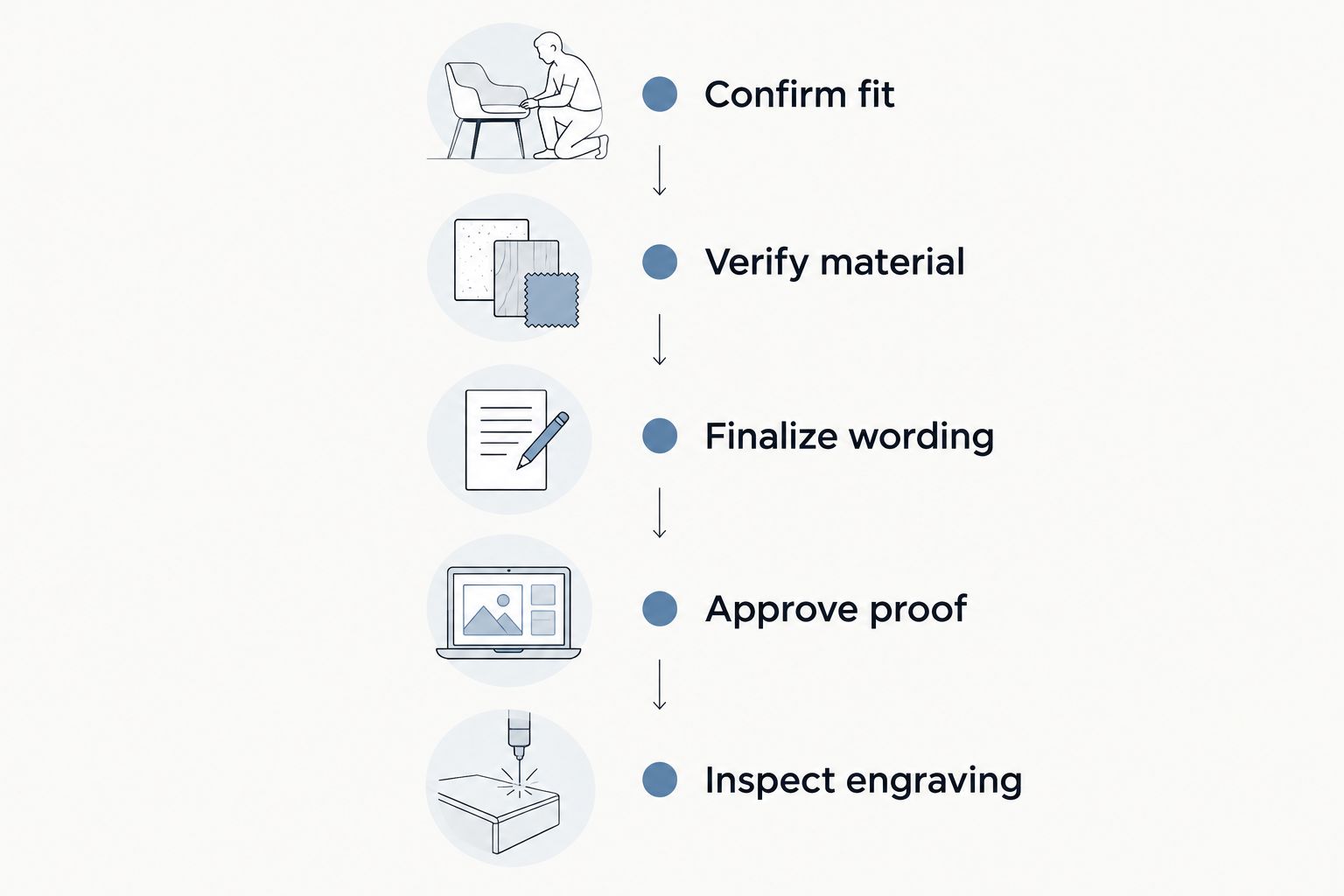
Approve the wording and layout only after the ring's suitability is confirmed.
Inspect the completed inscription
Compare the finished ring with the approved version under good light. Check the message, placement, and comfort. Ask the provider to explain any differences from the approval.
Keep the proof with your jewelry records. Save the approved file separately from early drafts. This ensures old versions are not used during collection.
Second workflow: personalize an existing wedding band
An anniversary inscription follows the same approval process, but the starting point is a ring with a history. Existing engraving, repairs, and wear need assessment before you add another message.
- Record what is already there. Photograph the existing inscription and interior markings. Tell the jeweler about previous alterations you know about.
- Choose preservation or addition. Decide whether your priority is keeping the original wording untouched or adding a new sentiment. Ask what the available space permits before committing to either plan.
- Request an updated layout. Show how the proposed wording relates to the existing inscription. Do not assume new lettering will match the older lettering exactly.
- Approve the revised brief. Use the same character-by-character check as you would for a new ring.
Expected result: The new message respects the existing band rather than treating its interior as an unused surface. For a 2026 anniversary, a fresh inscription can mark the occasion without replacing the meaning already carried by the ring.
Troubleshooting
The message does not fit
Shorten the wording and request a revised layout. Keep the essential meaning. Remove repeated names and unnecessary punctuation. Do not accept unreadable lettering to preserve a draft.
A symbol or accented letter is unsupported
Ask which characters the provider can reproduce accurately. Approve a written alternative yourself rather than allowing an automatic substitution that changes a name or meaning.
The ring needs a different size
Pause the engraving approval. Ask if the band can be resized. Learn how this affects the inscription. Settle the fit before submitting a replacement approval.
The coating or material changes the engraving plan
Request an explanation of the proposed method. Ask how it will look on that ring. If the result is uncertain, leave the band unengraved. Do not experiment on a sentimental piece.
The finished wording differs from the proof
Photograph the inscription and contact the provider with the approved version. Request an assessment before authorizing correction, removal, polishing, or re-engraving; the appropriate remedy depends on the ring and the error.
Customize your workflow
For paired Balacia wedding bands, keep a separate brief for each ring and one shared approval record. Matching sentiment does not require identical lettering: different ring sizes and interiors need individual layouts.
If the inscription depends on a special design detail, discuss both together before finalizing the ring. The benefit is a clearer plan; the limitation is that a design preference still needs material and manufacturing approval.
You can also keep a longer explanation in a handwritten note given with the band. Let the ring hold the shortest meaningful phrase while the note preserves the story behind it.
FAQ
How do I engrave a personal message on my wedding band?
Confirm the band is suitable and settle its fit. Submit the final inscription. Approve the wording and layout before engraving. Inspect the finished ring against that approval.
Can every wedding band be engraved?
No—engraving suitability depends on the specific ring, its material, construction, surface treatment, and available space. Ask the provider to assess the actual band rather than relying on appearance or width alone.
How many characters can I put inside a wedding band?
The provider must confirm the character allowance for your particular ring and layout. Ask whether spaces, punctuation, and symbols count, and request a proof before approving the inscription.
Should I resize my wedding band before engraving it?
Settle the fit and ask the jeweler to determine the work sequence before engraving. Resizing can affect an inscription, and some band materials or constructions do not permit resizing.
Can I engrave a tungsten wedding band with a colored finish?
Have the provider assess the exact tungsten band and finish before approving engraving. Confirm the recommended method and expected appearance; a colored surface does not establish compatibility.
Does Balacia offer engraving on every wedding band?
Confirm engraving arrangements for your selected Balacia wedding band before ordering personalization. The exact ring needs an eligibility check, even when custom design options are part of your jewelry plans.
Can I add an anniversary message to an existing wedding ring?
Ask a jeweler to assess the existing band, inscription, and available space before adding an anniversary message. Approve a layout that identifies which original details must remain untouched.
One last thing
Read the final inscription without looking at your draft first. Familiar wording can hide errors. A fresh, character-by-character check is a useful safeguard for your 2026 keepsake.