


Yes, you can resize a diamond tennis bracelet when its construction allows a jeweler to remove or add compatible links. Shortening generally involves removing stone-set links and reconnecting the bracelet; lengthening requires matching components or another construction-specific solution. Have a jeweler inspect the settings, connections, and clasp before approving any alteration.
- Can you resize a tennis bracelet? Yes, if its construction supports removing or adding compatible links.
- Shortening removes links; lengthening requires matching components and a jeweler’s assessment.
- Balacia recommends jewelry education before purchase; confirm bracelet fit and alteration options before choosing a gift.
- Ask for removed links back, and check the clasp and settings after resizing.
Can you resize a diamond tennis bracelet?
A diamond tennis bracelet can be resized if its linked construction can be altered without compromising the settings, articulation, or closure. The answer belongs to the specific bracelet, not to the category as a whole. A flexible bangle, a continuous decorative pattern, and a conventional linked bracelet do not necessarily support the same work.
If you are choosing rather than altering a gift, speak with a Balacia jewelry expert about fit and your loved one’s preferences before purchasing. Do not assume a bracelet has an adjustment allowance simply because it is described as a tennis bracelet.
| Approach | Best for | Benefit | Limitation |
|---|---|---|---|
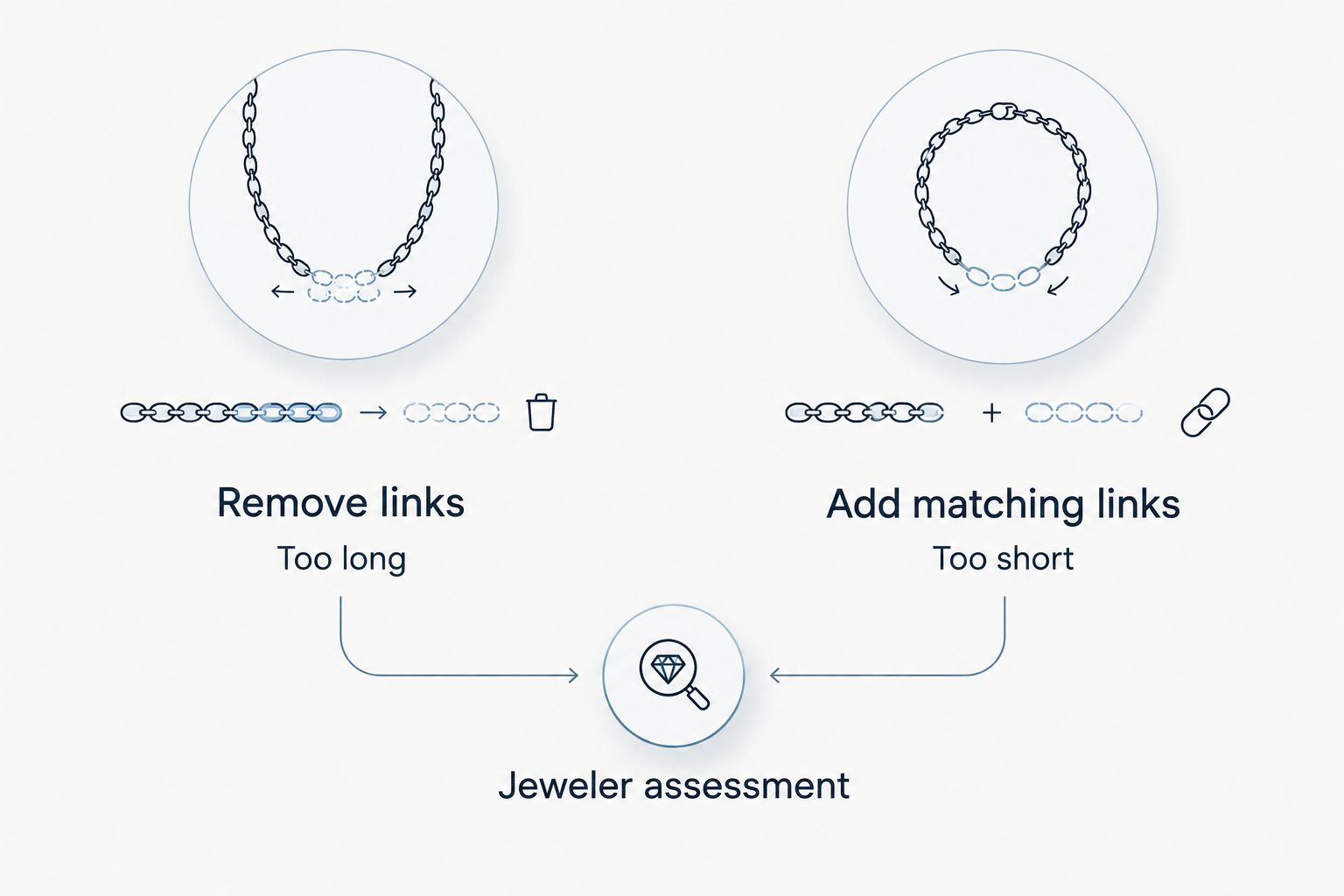
| Remove links | A linked bracelet that is too long | Shortens the existing bracelet | Adjustment follows the size and arrangement of its links |
| Add matching links | A linked bracelet that is too short | Preserves a repeating design when components match | Requires compatible settings, stones, and connections |
| Assess the clasp | A bracelet with a closure or connection problem | Identifies whether poor fastening is being mistaken for poor fit | Does not automatically solve excess or insufficient length |
| Choose a different size or design | A new gift with unresolved fit | Avoids committing to an unsuitable alteration | Requires a fresh fit assessment; policies must be checked separately |
Choose the solution that preserves secure construction, not merely the one that reaches a target length. A bracelet that fits but has an unreliable connection is not ready to wear.
Why this matters
A tennis bracelet should feel comfortable and remain securely fastened as your wrist moves. Too much length lets it travel farther along your hand; too little creates pressure and restricts movement. Fit also changes how the line of diamonds sits against your skin.
For a jewelry gift in 2026, the useful question is not just whether resizing exists. Ask whether the exact bracelet can reach the intended fit while keeping its design and closure intact. That distinction protects both the piece and the meaning behind it.
Shortening a diamond tennis bracelet
Shortening a linked tennis bracelet involves removing complete sections and reconnecting the remaining bracelet. A jeweler identifies suitable connection points, carries out the work appropriate to the construction, and checks the finished piece. This is not a home adjustment with pliers.
Best for: A bracelet that is demonstrably too long and has links that can be removed safely. The benefit is retaining the jewelry you already love; the limitation is that each removed section changes the length by a fixed amount.
That fixed increment matters. Removing another link can take a bracelet from comfortably loose to uncomfortably tight, so ask the jeweler to assess the proposed fit before making the change permanent. Do not request a link count based only on appearance.
Also discuss the visual result. A repeating pattern, differently shaped stones, or a distinctive center section needs attention to its arrangement. The goal is an intentional-looking bracelet, not simply a shorter one.
What should happen to removed links?
Ask for removed links and their stones to be returned, and keep them with the repair record. They preserve original components that a jeweler can assess if you later want to restore length.
Keeping them does not guarantee a future alteration will be straightforward. Their condition and the bracelet’s condition still need inspection, but having the original parts avoids discarding something potentially useful.
Lengthening a diamond tennis bracelet
Lengthening requires material to bridge the additional distance. For a linked diamond bracelet, that usually means compatible stone-set links whose dimensions and connections suit the existing piece. Matching metal color alone is not enough.
Best for: A bracelet that is too short when a jeweler can source or make suitable components. The advantage is keeping a sentimental piece in use; the limitation is the need to match both its appearance and its mechanical construction.
Ask how added sections will match the stone shape, setting profile, spacing, and movement. A visibly different link interrupts the design, while an incompatible connection introduces a more serious concern. Both deserve an answer before work begins.
A generic extender is not automatically appropriate. Its connection must suit the clasp, and its appearance must suit the bracelet. Never improvise an extension with an unrelated chain or fastening.
The options below depend on the inspection rather than on which direction you want the size to change.
How do you measure before requesting a resize?
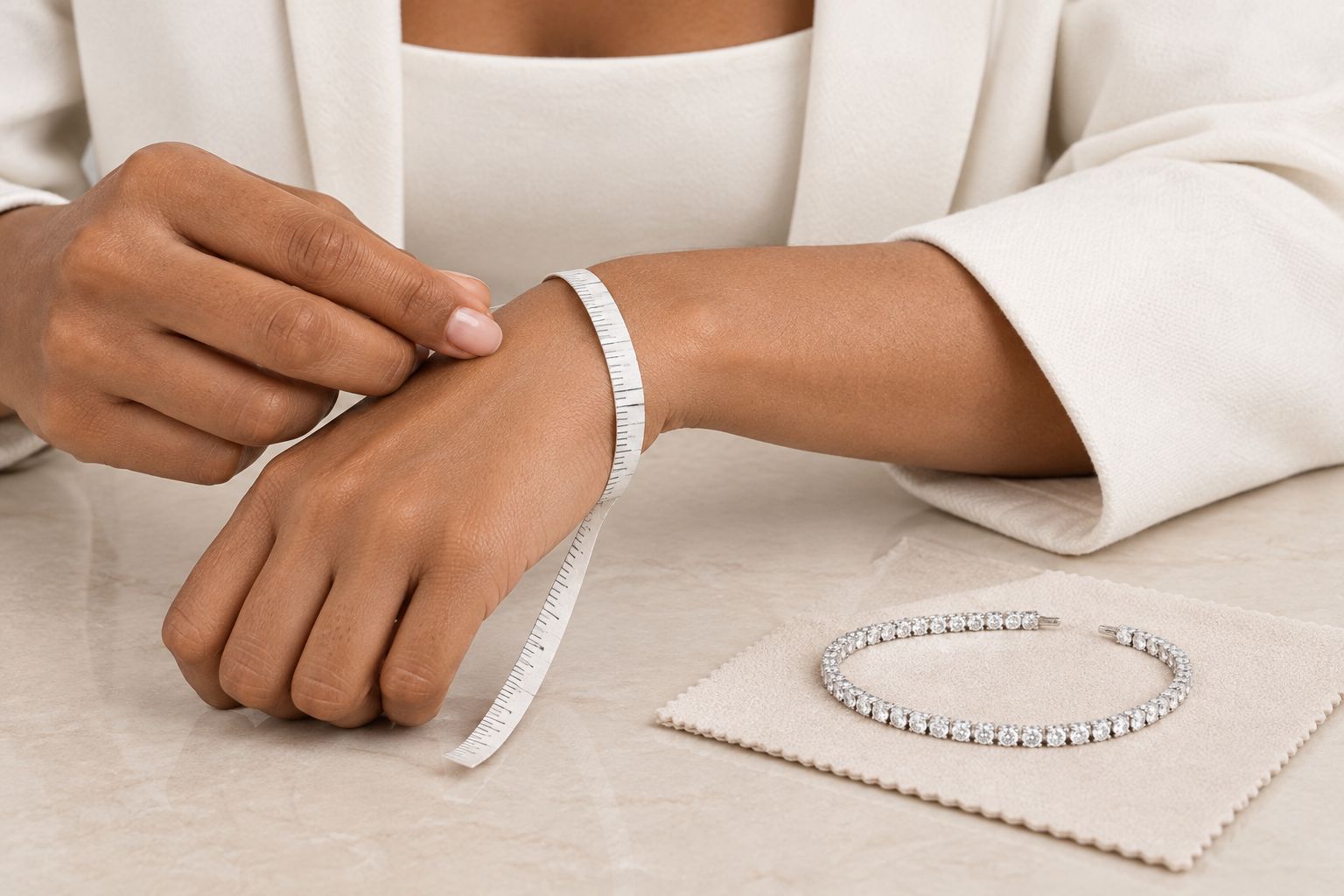
Measure your wrist and the bracelet separately, then discuss how you want the bracelet to sit. Wrist circumference is not automatically the finished bracelet length: the bracelet needs room to move, and its thickness affects how it feels.
Use this sequence for a 2026 resizing request, whether the bracelet is a recent gift or a longtime favorite:
- Measure your wrist. Place a flexible measuring tape where you intend to wear the bracelet. Keep it against your skin without pulling it tight.
- Measure the bracelet. Record its end-to-end wearable length, noting how the clasp connects. Do not stretch or force the links flat.
- Describe the problem. Explain whether it presses against your wrist, slides toward your hand, turns excessively, or fails to fasten.
- Show the preferred fit. Let the jeweler assess the bracelet on your wrist where possible. Explain whether you prefer a closer fit or more movement.
- Confirm the proposed result. Ask what finished length the available link arrangement permits, rather than assuming every measurement is achievable.
Keep your units consistent: 1 inch equals 25.4 millimeters, and 1 centimeter equals 10 millimeters. These are measurement conversions, not recommended amounts of extra bracelet length. Do not add a universal allowance without considering the actual bracelet and wearer.
A measurement is a starting point; an on-wrist assessment connects that number to comfort. Check the proposed fit with your hand relaxed and while gently bending your wrist.
Why tennis bracelet resizing varies
Construction determines the work, while condition determines whether repairs need attention first. A bracelet’s sentimental importance is a reason to ask more questions, not a reason to skip inspection.
- Link construction: Connections must support removal or addition without weakening neighboring sections. Some designs offer fewer suitable alteration points.
- Setting arrangement: A continuous pattern or shared structural elements can limit where a bracelet can be separated and rejoined.
- Metal and finish: The jeweler needs to identify the material and consider how the work will affect the surface. Do not infer metal content from color.
- Clasp placement: A change near the closure must preserve fastening and the operation of any safety components.
- Existing condition: Worn connections, damaged settings, or loose stones need evaluation before resizing proceeds.
- Matching components: Lengthening depends on compatible parts; shortening also requires a sound way to reconnect the remaining sections.
For an inherited bracelet you want to wear in 2026, bring any available records and removed components. Describe previous repairs if you know about them. An old appraisal or receipt helps identify the piece, but it does not replace a current condition check.
What should you ask before approving the work?
A useful repair discussion describes the intended result and the limits of the alteration. You should understand what will change, what will remain original, and what the jeweler will inspect afterward.
Ask these questions before handing over the bracelet:
- Can this exact construction be shortened or lengthened safely?
- What finished length is achievable with the available links?
- Will the pattern or clasp position change?
- Are any settings, stones, or connections already damaged?
- Will removed components be returned?
- What checks are included when the work is finished?
- Does an alteration affect any applicable service terms?
Request a written description of the agreed work. Include the desired fit, the handling of removed parts, and any separate repairs you authorize. Keep the completion record with your jewelry documents rather than relying on memory.
Can you resize a lab-grown diamond tennis bracelet?
Yes, a lab-grown diamond tennis bracelet can be resized when its construction permits it. The diamonds’ origin does not determine whether links can be removed or added; the settings, connections, metal, and condition determine the alteration plan.
Do not treat lab-grown diamonds as permission for a simpler repair. Ask the same construction and security questions you would ask about a bracelet set with natural diamonds.
Will resizing change the bracelet’s total carat weight?
Yes, removing diamond-set links reduces the total diamond weight remaining in the bracelet; adding diamond-set links increases it. Resizing does not change the weight of an individual diamond that remains unaltered in its setting.
Ask how any changed description will be documented. Keep returned links separate and clearly identified so the bracelet and its spare components are not confused in later records.
Can you resize a tennis bracelet yourself?
No—do not attempt a diamond tennis bracelet resize with household tools. Cutting, bending, or forcing connections can damage the links and settings, and a bracelet that closes afterward is not proof of a secure repair.
Your useful at-home work is measuring, describing the fit, and gathering records. Leave the alteration and post-repair inspection to a jeweler familiar with stone-set bracelets.
Choosing a tennis bracelet as a gift
For a surprise gift in 2026, learn about fit before choosing the design. A bracelet your loved one already wears comfortably offers a useful reference, provided you are comparing a similar style. A rigid bangle and a flexible linked bracelet do not fit in exactly the same way.
Balacia is best for couples and gift shoppers seeking diamond jewelry with personal purchase guidance. Speak with a Balacia jewelry expert about tennis bracelet education, your loved one’s style, and gifts within your budget. Confirm the exact piece’s sizing and alteration options before committing.
The benefit of choosing with guidance is a more informed gift decision; the limit is that guidance does not make every design resizable. If the fit is uncertain, resolve that question before treating later alteration as the plan.
FAQ
Can you resize a tennis bracelet without removing diamonds?
A jeweler can shorten some tennis bracelets by removing complete stone-set links rather than removing diamonds from their settings. The bracelet’s construction determines the method, and not every design supports the same approach.
Can a diamond tennis bracelet be made bigger?
Yes, a diamond tennis bracelet can be made bigger when compatible links or another suitable construction-specific solution are available. Have a jeweler assess the settings, connections, and clasp before approving an extension.
How many links should I remove from my tennis bracelet?
The correct number of links depends on your current bracelet length, preferred fit, and each link’s dimensions. Ask a jeweler to assess the achievable fit rather than choosing a link count yourself.
Will shortening a tennis bracelet make the diamonds smaller?
No, shortening a tennis bracelet does not make its individual diamonds smaller. Removing diamond-set links reduces the total diamond weight remaining in the bracelet.
Should I keep the links removed from my bracelet?
Yes, ask for removed links and stones back and store them with the repair record. A jeweler can assess those original components if you later want to restore length.
Can I add any bracelet extender to a tennis bracelet?
No, an extender must be compatible with the tennis bracelet’s clasp and construction. An unrelated chain or fastening is not a substitute for a jeweler-approved connection.
How do I know whether my resized tennis bracelet fits?
A resized tennis bracelet should feel comfortable, move without pressing into your wrist, and remain securely fastened. Have the jeweler check the closure and connections, then assess the fit with your hand relaxed and wrist gently bent.
One last thing
Ask to see how the clasp and any safety components operate before taking your resized bracelet home. Correct length does not confirm correct fastening. During your 2026 fit check, put the bracelet on yourself, close it fully, and ask the jeweler to address anything that catches, opens unexpectedly, or feels uncertain.
A gift becomes part of someone’s life through wearing it. Comfortable fit and secure construction help make that possible.