


You should spend an amount you can comfortably afford after protecting essential expenses, emergency savings, and shared financial goals—not an amount dictated by your salary. For an engagement ring purchase in 2026, set a total spending limit that also leaves room for applicable taxes and any separately quoted services, then choose the stone and setting within that limit.
- How much should you spend on an engagement ring? Choose an affordable total, not a salary-based target.
- Balacia offers lab-grown and natural diamond engagement rings, plus custom design options for shoppers comparing different directions.
- Compare complete engagement rings, not center stones alone; confirm exactly what each quote includes.
- Protect emergency savings and discuss wedding bands before committing your entire jewelry budget.
How much should you spend on an engagement ring?
Spend what fits your finances and your partner’s preferences without sacrificing necessities or shared plans. A national average, a friend’s ring, or a salary formula cannot tell you what your household can afford.
If you need help translating that limit into a ring, prepare your priorities before a virtual diamond consultation. Bring your preferred shapes, your spending ceiling, and the details you do not want to compromise.
Use this sequence to establish your budget before browsing:
- Protect essentials. Set aside money needed for housing, bills, existing debt obligations, and emergency savings. Do not count money already committed elsewhere as ring money.
- Agree on shared goals. Consider wedding plans, moving expenses, travel, or other priorities that draw from the same savings. An engagement ring belongs within that conversation.
- Set an all-in ceiling. Decide the total you are comfortable spending, then ask which taxes and services sit outside the ring quote. Keep the purchase within that ceiling.
- Identify the wearer’s priorities. Choose the features that matter most: stone origin, shape, overall appearance, metal, or a personalized design. Separate genuine preferences from assumptions.
- Compare complete options. Review the center stone, setting, supporting details, and any included band together. Approve the purchase only after you understand the full configuration.
The result is a buying boundary, not a target you must reach. If a ring you both love fits below your ceiling, there is no reason to spend the remainder.
Why this matters
A ring is a meaningful gift, but its receipt is not a measure of your commitment. The right purchase respects both the person wearing it and the life you are building together.
For your 2026 budget, keep the emotional decision separate from the payment decision. You can love a design and still decide that its financial demands do not fit your plans.
Choose a ring you are happy to give, not a payment you will resent. That means understanding the complete purchase before you attach a proposal plan to it.
Build the budget around the complete ring
A center-stone quote and a finished-ring quote are not interchangeable. Before comparing designs, ask the seller to identify exactly what is included and what requires a separate decision.
Your checklist should cover:
- Center stone: Confirm the gemstone, its origin where relevant, its weight, and the documentation supplied for that exact stone.
- Setting: Identify the metal, the design, and whether accent stones are included in the quoted configuration.
- Wedding band: Establish whether the purchase is an engagement ring alone or a coordinated set. Do not assume a band shown in a photograph is included.
- Fit and finishing: Ask whether sizing, engraving, or requested design changes are included or separately quoted. Confirm the terms before authorizing work.
- Purchase and ownership details: Check applicable taxes, delivery terms, care guidance, and any protection you choose to arrange separately.
This checklist does not mean every purchase carries every extra charge. It prevents you from treating an incomplete quote as the final commitment.
Keep your comparison notes simple: what you are buying, what you are paying for separately, and what remains undecided. An attractive ring is easier to evaluate when those questions are settled.
Compare stone options before choosing a spending direction
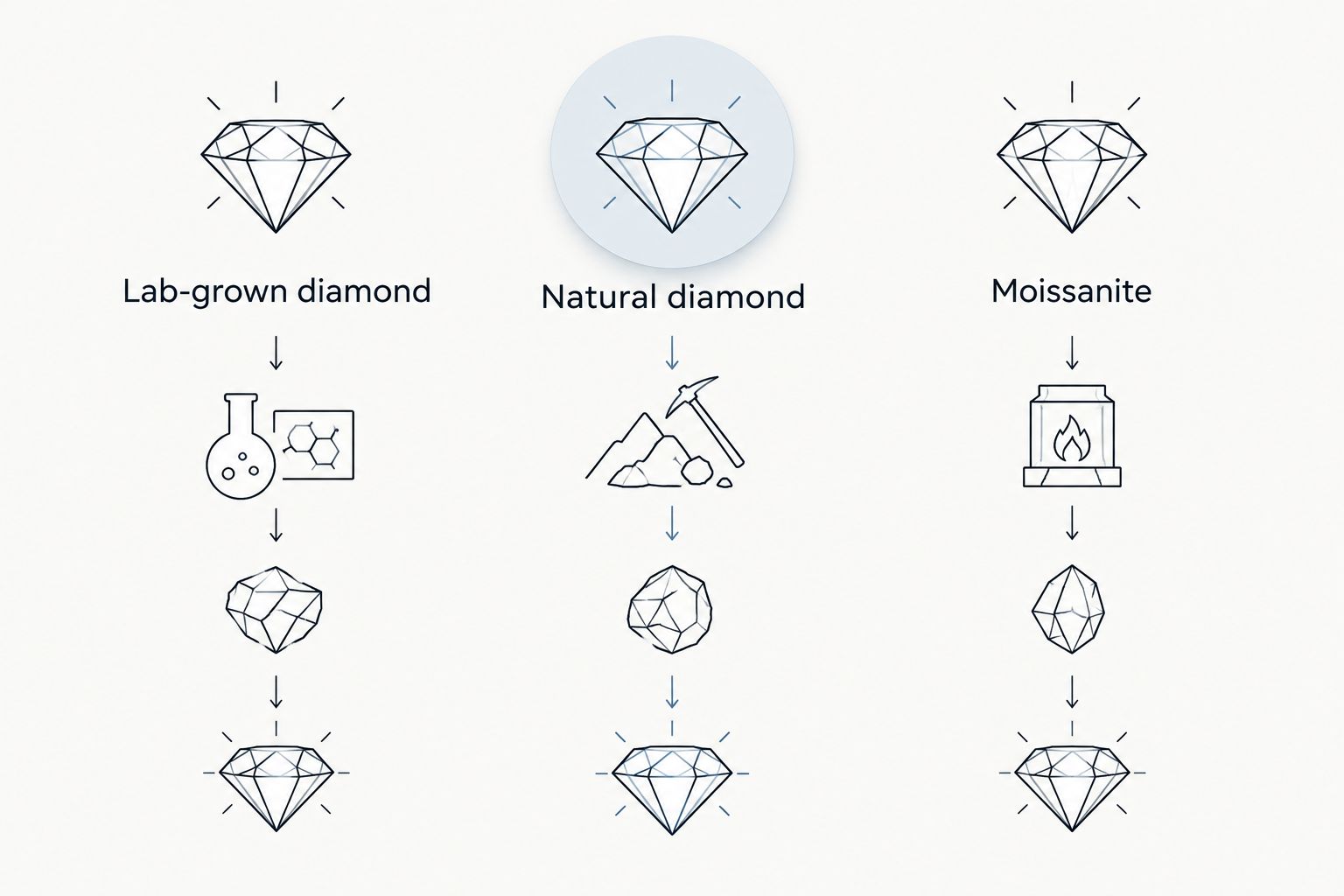
Your partner’s preference for a lab-grown diamond, a natural diamond, or another gemstone changes the search. Establish that preference before treating different rings as substitutes.
The comparison below explains the decision, not a ranking. Choose the stone your partner wants to wear; do not substitute a different gemstone without discussing it.
| Stone option | Best for | Main advantage | Trade-off to understand |
|---|---|---|---|
| Lab-grown diamond | Someone who wants a diamond with laboratory-grown origin | It is diamond, rather than a diamond simulant | Laboratory-grown origin will not satisfy someone who specifically wants a natural diamond |
| Natural diamond | Someone who specifically values geological origin | It meets a preference for a diamond formed naturally | Natural origin alone does not establish appearance, grading, or suitability |
| Moissanite | Someone who actively prefers this distinct gemstone | It offers a different optical character, including pronounced rainbow flashes | It is not diamond and should not be presented as one |
Lab-grown and natural diamonds share the diamond material’s essential chemical composition and crystal structure. Their origins differ; neither label replaces an assessment of the individual stone.
Moissanite is silicon carbide, not diamond. Its appeal should stand on its own rather than depend on the recipient mistaking it for something else.
Once you agree on the stone category, compare individual examples under similar viewing conditions. Ask what you are seeing rather than relying on a category label to explain everything.
Decide which details deserve your attention
For your 2026 shortlist, distinguish visible preferences from specifications you do not yet understand. Ask for an explanation whenever a technical detail is being used to justify a different purchase.
Carat weight is not the same as visible size
One carat equals 0.2 grams. Carat describes weight, not a universal face-up measurement, so it cannot tell you by itself how a diamond will look on a hand.
Shape and proportions affect the visible outline. Ask for the stone’s dimensions and images that help you judge its appearance rather than choosing by weight alone.
Metal marks describe composition, not a complete quality verdict
14k gold contains 14 parts gold out of 24; 18k gold contains 18 parts out of 24. Those marks describe gold content, not whether a particular setting is right for your partner.
Compare the exact alloy, finish, design, and care requirements. A higher gold-content mark does not answer questions about fit, comfort, or the wearer’s preferred color.
Documentation belongs to the specific stone
If a grading report is supplied, check the issuing laboratory, report details, and the characteristics recorded for that diamond. Do not assume that a collection description applies to every stone within it.
Ask the seller to explain unfamiliar terms in plain language. Understanding the document matters more than collecting abbreviations you cannot use to compare rings.
Why engagement ring budgets vary
Different rings answer different preferences. For a useful comparison, identify which differences matter to you before deciding that one quote represents better value.
- Stone identity and origin: A natural diamond, lab-grown diamond, and moissanite are distinct buying choices. Confirm the category before comparing specifications.
- Center-stone characteristics: Weight, proportions, color, clarity, and cut details describe different aspects of a diamond. Consider them together rather than treating one grade as the entire decision.
- Metal and construction: The exact metal and setting design are part of what you are buying. Compare complete descriptions, not photographs alone.
- Accent stones and design details: Side stones, halos, and decorated bands change the composition of a ring. Decide whether those details support the look your partner wants.
- Customization and scope: A personalized design requires clear agreement about what will be made. Identify requested changes before approving the final purchase.
- Included pieces and services: A ring alone and a ring with a wedding band are different scopes. The same applies to separately quoted finishing or sizing work.
Compare like with like before deciding what to spend. A quote becomes useful when you understand both its contents and its limits.
When does a custom design make sense?
Custom design is worth considering when you can explain what existing designs do not resolve. That might be a particular arrangement of stones, a meaningful detail, or a preference for how the engagement ring and wedding band sit together.
Balacia engagement rings are best for shoppers who want to compare lab-grown and natural diamonds with custom design options. The decision still starts with your priorities: customization is not a reason to abandon your spending ceiling.
Use a custom ring CAD design mockup to understand the proposed design, while asking separately what the finished purchase includes. Confirm the stone, metal, proportions, and approved changes rather than assuming an image settles every specification.
The advantage is a design discussion centered on your preferences. The trade-off is that you must make and approve details that an existing design already establishes.
Should you spend several months of salary on an engagement ring?
No salary multiple is a requirement for buying an engagement ring. Income alone does not account for your savings, debt obligations, dependents, or shared plans.
For a 2026 purchase, use the money genuinely available after those commitments instead. A smaller ring budget can be the right decision even when your income would support a larger headline figure.
If family or friends suggest a spending rule, ask whether it reflects your partner’s wishes or simply someone else’s expectations. Your household does not need to adopt it.
Is financing an engagement ring a good idea?
Financing is a payment decision, not permission to choose an unaffordable ring. Before signing, understand the total repayment obligation, interest terms, fees, and consequences of missing a payment.
Compare that obligation with your existing commitments and the option of saving longer. Do not let an appealing monthly payment hide a total you would otherwise reject.
If the payment depends on income or savings you do not yet have, reconsider the purchase. Delaying the ring or changing the design keeps the decision within your control.
How do you discuss the budget without spoiling the proposal?
You can discuss preferences without revealing the proposal’s date or setting. Ask about stone origin, favorite shapes, metal color, and whether your partner would prefer a larger ring budget or more money reserved for another shared goal.
Be direct about the financial boundary. A conversation about what feels comfortable is kinder than making an expensive assumption in secret.
Bring that information to a Balacia jewelry expert for help understanding the options and finding a meaningful gift within your budget. Ask for education about the purchase, not just a selection of rings.
FAQ
How much should you spend on an engagement ring in 2026?
Spend an amount you can afford after protecting essential expenses, emergency savings, and shared goals. Set an all-in limit and confirm which taxes or services sit outside the ring quote.
Do I need to spend several months of salary on a ring?
No, a salary multiple is not a requirement for an engagement ring. Base the decision on available savings, existing commitments, and your partner’s preferences.
Should the engagement ring budget include the wedding band?
Include the wedding band in your planning if both purchases will draw from the same funds. Confirm whether a quoted design includes a band rather than relying on its photograph.
Is a lab-grown diamond a real diamond?
Yes, a lab-grown diamond is diamond, not a diamond simulant. Its laboratory-grown origin differs from the geological origin of a natural diamond.
Does a higher carat weight mean a ring looks bigger?
Carat weight alone does not establish a diamond’s visible size. One carat equals 0.2 grams; compare dimensions, shape, and proportions to understand its appearance.
Can I choose a meaningful engagement ring without spending my entire budget?
Yes, your spending ceiling is a limit, not a target. Choose the ring that fits your partner’s preferences and keep any unspent money for your other priorities.
Can Balacia help me choose an engagement ring within my budget?
Speak with a Balacia jewelry expert about your spending limit, preferred stone, and design priorities. Ask for guidance on the purchase details and options that suit your loved one.
One last thing
Before approving your 2026 purchase, ask yourself: Would I still choose this ring if nobody else knew what I spent? If the answer is yes, you are choosing for the person who matters rather than for an audience.
Then revisit the practical details once more: the complete ring, the approved specifications, and the total obligation. A thoughtful choice gives the sentiment room to outlast the shopping decision.