


Yes, you can wear a diamond tennis necklace every day when it fits comfortably, its stones and clasp are secure, and you remove it for activities that expose it to pulling, impact, or chemicals. Everyday wear does not mean wearing it around the clock: take it off for sleep, workouts, swimming, and household cleaning. The diamonds resist scratching, but the settings, connecting links, and clasp still need care.
- Can you wear a tennis necklace every day? Yes, but remove it for sleep, exercise, swimming, and cleaning.
- Diamond hardness does not protect a tennis necklace’s clasp, links, or settings from damage.
- Balacia diamond tennis necklace shoppers should prioritize comfortable fit, secure closures, and care instructions.
- Stop wearing a necklace that catches, twists unusually, or has a loose stone or unreliable clasp.
Can you wear a diamond tennis necklace every day?
A diamond tennis necklace suits ordinary daily wear, not uninterrupted wear. Wearing it at your desk or out to dinner creates different demands from wearing it while lifting weights, sleeping, or handling cleaning products.
Use this activity guide in 2026 to decide when to enjoy your necklace and when to put it away. Any care instructions supplied for your exact necklace take priority over general advice.
| Activity | Everyday-wear recommendation | Benefit or concern |
|---|---|---|
| Desk work and ordinary errands | Wear it if the fit and clasp are secure | Adds sparkle without requiring an occasion; watch for bag straps and clothing snags |
| Dinner and social events | Wear it | A natural setting for a tennis necklace; apply fragrance before putting it on |
| Sleeping | Remove it | Bedding, hair, and movement create opportunities for catching and pulling |
| Exercise and contact sports | Remove it | Equipment, impact, and pulling put the necklace at risk |
| Swimming and hot tubs | Remove it | Avoid chemical exposure and losing jewelry in water |
| Showering | Remove it | Soap residue dulls the appearance, and wet hands make handling harder |
| Household cleaning | Remove it | Cleaning chemicals are not appropriate jewelry-care products |
For help choosing jewelry around your routine, speak with a Balacia jewelry expert. Explain when you expect to wear the necklace, not just how you want it to look.
Why this matters
A tennis necklace brings a continuous line of sparkle close to your face. That makes it a lovely everyday signature, but it also means many settings and connections work together whenever you move.
The practical question is not whether diamonds are hard enough. It is whether the whole necklace suits your habits. A beautiful gift becomes easier to enjoy when fastening it, wearing it, and storing it feel comfortable rather than worrying.
For a 2026 gift purchase, discuss the recipient’s routine before choosing the design. Someone who loves dressing for dinner has different needs from someone who must remove jewelry repeatedly throughout the workday.
What makes a tennis necklace suitable for daily wear?
Look beyond the sparkle in a photograph. Comfort, construction, and condition determine whether you will reach for a necklace regularly.
A clasp you can operate confidently
Ask the jeweler to demonstrate how the clasp opens, closes, and confirms that it is secure. If the design includes an additional safety closure, learn how that works too; do not assume every necklace has one.
Try fastening and unfastening the necklace yourself. A closure that is difficult for you to operate deserves attention before purchase, even if you love the appearance.
Do not wear a necklace with a clasp that fails to engage reliably. An additional safety feature is not a reason to ignore a faulty primary closure.
A fit that stays comfortable when you move
Check the necklace while sitting, turning your head, and wearing your usual neckline. It should not feel restrictive or repeatedly catch on the collar you wear most often.
Length alone does not guarantee comfort. Your neck shape, the necklace’s width, and the way its links articulate all affect how it rests. Ask to see the necklace worn, rather than judging its drape only from a flat product photograph.
Settings and links in sound condition
Look for an even appearance, intact connections, and stones that sit consistently within their settings. A visual check helps you notice changes, but it does not replace a jeweler’s examination.
If a section suddenly bends differently, catches your clothing, or feels rough, stop wearing the necklace. Do not bend it back yourself or test a suspected loose stone with a sharp object.
Why everyday wearability varies
The same necklace does not suit every person or activity. These factors explain why a comfortable daily piece for one wearer becomes an occasional piece for another:
- Clasp design and condition: A secure closure matters every time you put the necklace on. Ease of use matters too.
- Setting profile: Raised or exposed details need attention around textured fabrics, hair, and anything that catches.
- Length and drape: A necklace that rests comfortably with one neckline can interfere with another.
- Metal and construction: Metal composition, link design, and workmanship affect the finished piece; a metal label alone cannot establish durability.
- Your daily activities: Sports, hands-on work, and chemical handling create reasons to remove jewelry.
- Maintenance and storage: Keeping the necklace clean, checking changes, and storing it separately support regular wear.
For your 2026 purchase, ask specific questions about the exact necklace. General claims such as suitable for everyday wear do not explain its closure, care requirements, or fit on your body.
Does diamond hardness make the necklace damage-proof?
No. Diamond resists scratching, but a diamond necklace is not damage-proof. Diamonds can chip under impact, and their hardness does not strengthen the metal holding them.
Diamond ranks 10 on the Mohs hardness scale. That scale describes scratch resistance, not resistance to every kind of blow, snag, or bending force. Treating hardness as permission to sleep or exercise in a necklace confuses the stone’s properties with the construction of the finished jewelry.
Metal descriptions also need context. For example, 14k gold contains 14 parts gold out of 24, while 18k gold contains 18 parts out of 24. Those proportions identify gold fineness; they do not tell you whether a particular clasp or connection is well made.
Ask about the actual necklace’s metal, settings, and care needs. Do not infer those details from its color, its diamond origin, or a photograph.
How should you care for a tennis necklace you wear regularly?
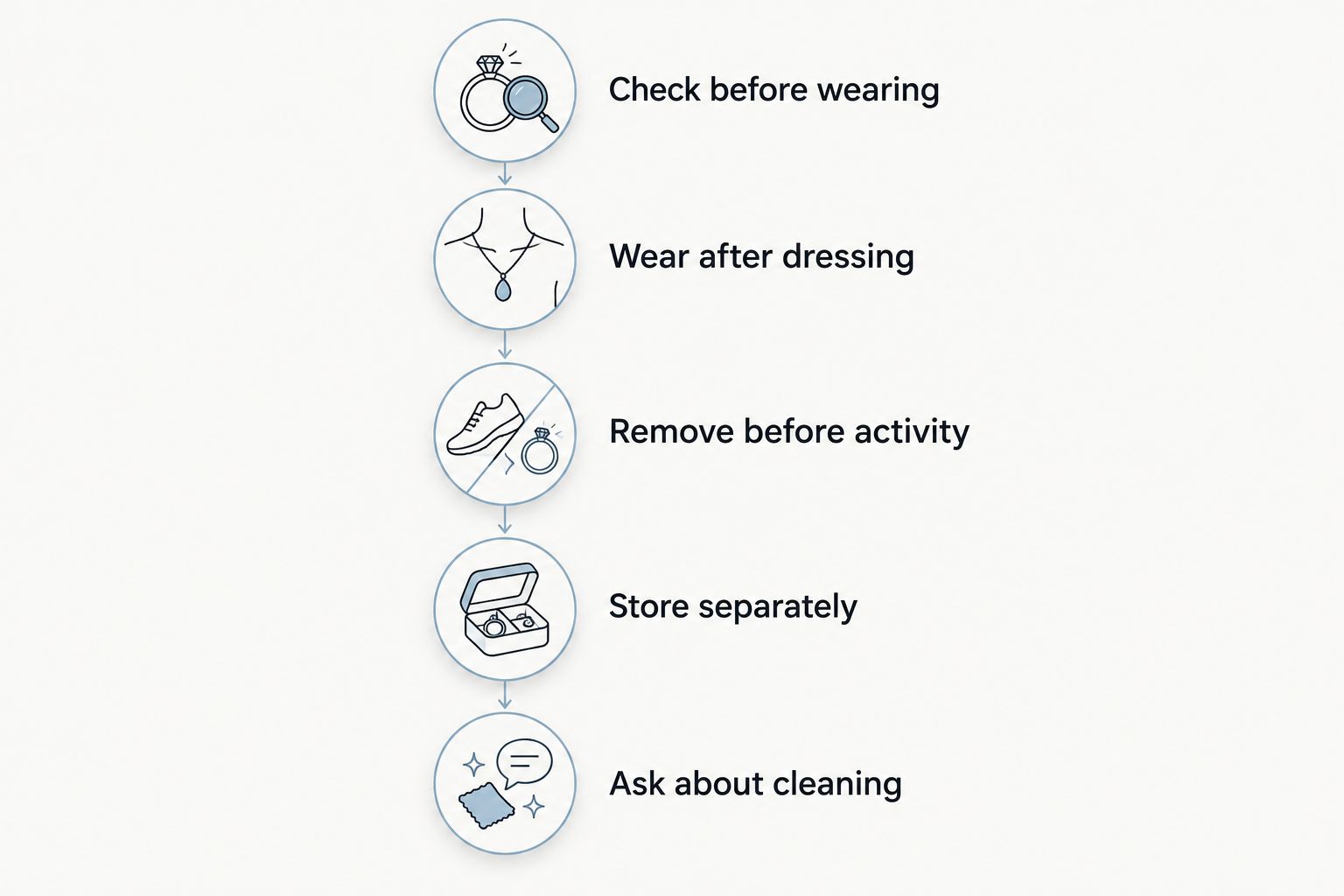
Build care around putting it on and taking it off, rather than waiting until it looks dull. This 2026 routine keeps the decisions simple without imposing an unsupported cleaning or inspection schedule.
- Check before wearing. Look at the clasp, connections, and settings in good light. Stop if you notice a change or cannot close the necklace securely.
- Wear after dressing. Finish applying cosmetics, lotion, and fragrance first. Put on clothing that must pass over your head before fastening the necklace.
- Remove before activity. Take it off before sleep, exercise, swimming, showering, and cleaning. Put it directly into its storage place.
- Store separately. Keep it away from other jewelry that can tangle with it or rub against it. Lay it without sharp folds, following any supplied storage instructions.
- Ask about cleaning. Follow the instructions for your exact piece. Have a jeweler examine loose stones or damaged settings before cleaning.
If your jeweler confirms that home washing is suitable, mild dish soap, lukewarm water, and a soft brush are common care tools for diamond jewelry. Work over a bowl, not an open drain, and avoid forceful scrubbing around settings.
Do not assume an ultrasonic cleaner or steam cleaner is suitable. Stone treatments, other materials, and the condition of the settings affect that decision. A professional should advise you about the finished piece, not just the fact that it contains diamonds.
Can you sleep in a diamond tennis necklace?
Remove a diamond tennis necklace before sleeping. Bedding and hair create snagging opportunities, and sleeping movements can pull on the necklace without you noticing.
Keep its storage place near your usual evening routine, but away from an exposed sink edge. A consistent place to put it is more useful than relying on remembering where you left it.
Can you shower or swim in a tennis necklace?
Remove a tennis necklace before showering or swimming. Soap and personal-care products leave residue, while pools and hot tubs add chemical exposure that jewelry does not need.
Taking it off also avoids handling a valuable piece with wet, slippery hands. Remove it before entering the bathroom or pool area rather than leaving it loose on a shared surface.
Are lab-grown diamonds suitable for everyday necklaces?
Lab-grown diamonds are suitable for everyday necklaces under the same wear-and-care principles as natural diamonds. Diamond origin does not eliminate the need for secure settings, a reliable clasp, and removal during risky activities.
Choose the finished necklace on its own merits. Ask which details are documented for the actual stones, and do not assume an entire necklace or every individual diamond comes with a grading report.
How do you choose a tennis necklace as an everyday gift?
Start with the recipient’s preferences rather than choosing the largest-looking design. Notice whether they wear necklaces regularly, favor a subtle or noticeable look, and feel comfortable removing jewelry when their activities change.
Balacia is best for couples and gift shoppers who want help choosing diamond jewelry. Speak with a Balacia jewelry expert for education about the purchase and help discovering a gift within your budget. Ask about fit, closure, care, and any documentation supplied for the exact piece.
One design to discuss is The Bettyanne Graduated Diamond Tennis Necklace. Its graduated design makes it relevant to a conversation about the look you want; confirm its specifications and suitability for the recipient rather than assuming details from the name.
The advantage of a tennis necklace is its continuous sparkle and ability to dress up familiar clothes. The trade-off is responsibility: it needs careful handling, a removal routine, and attention to its settings and closure. For a 2026 anniversary or milestone gift, include that conversation as part of choosing something meaningful.
FAQ
Can you wear a tennis necklace every day?
Yes, you can wear a tennis necklace every day if it fits comfortably and its clasp, settings, and links are secure. Remove it for sleeping, exercise, swimming, showering, and household cleaning.
Is a diamond tennis necklace too dressy for everyday outfits?
A diamond tennis necklace can work with everyday outfits if you enjoy its appearance and feel comfortable wearing it. Choose its visual scale and fit around your usual clothes rather than saving it automatically for formal occasions.
Should I take my tennis necklace off every night?
Yes, take your tennis necklace off before sleeping. Bedding, hair, and movement create opportunities for snagging and pulling.
Why does my diamond tennis necklace keep flipping?
Repeated flipping needs an assessment of the necklace’s fit, balance, and construction. Ask a jeweler to examine how the actual piece rests on you rather than assuming a different length will solve it.
How often should I have a tennis necklace checked?
Ask your jeweler for an inspection schedule based on the necklace’s construction and how you wear it. Arrange an examination promptly if a clasp becomes unreliable, a section catches, or you suspect a loose stone.
Can I wear another necklace with my tennis necklace?
You can layer necklaces, but contact between them adds opportunities for tangling and rubbing. Wearing the tennis necklace alone is the simpler choice when protecting its settings is your priority.
Can Balacia help me choose a tennis necklace as a gift?
Speak with a Balacia jewelry expert for help understanding your purchase and discovering gifts within your budget. Share the recipient’s style, everyday routine, and preferences so the conversation addresses wearability as well as appearance.
One last thing
The most useful everyday-wear test is whether you feel comfortable taking the necklace off. A piece you love should fit your life, including the moments when jewelry belongs safely in its box.
Before gifting it, talk through where it will be stored and which activities call for removal. Those small habits help turn a special present into jewelry your loved one can enjoy often and care for over time.