

A Dutch marquise diamond has an elongated hexagon shape, with straight sides and pointed ends, rather than the curved sides of a regular marquise. It can be fashioned with different facet arrangements, including step-cut styles. Dutch marquise diamonds are usually accompanied by an IGI grading report, and natural Dutch marquise diamonds over 1 carat are extremely rare. Compare the actual outline, facet arrangement, and grading report before choosing your ring.
- A Dutch marquise is an elongated hexagon, while a regular marquise has curved sides and pointed ends.
- Dutch marquise diamonds can have different faceting styles, including step-cut arrangements; the shape does not dictate one facet pattern.
- Dutch marquise diamonds are usually IGI-certified and lab grown. Natural dutch marquise diamonds over 1 carat are extremely rare.
- Choose your diamond shape for its appearance, then assess light performance, documentation, and protection at the tips.
Why this matters
An unusual cut name can capture exactly the feeling you want: distinctive, romantic, and a little unexpected. But a name is not a specification. Your engagement ring should match the stone you pictured, not merely the wording in a listing.
For your 2026 ring search, keep two questions separate: what shape do you love, and what does the individual diamond actually deliver? If you are considering a custom engagement ring, Balacia offers custom design options. Bring reference photographs and ask for an explanation of the outline before discussing the setting.
Is a Dutch marquise diamond different from a regular marquise cut?
Yes. A Dutch marquise has an elongated hexagon outline, while a regular marquise has curved sides and a point at each end. The Dutch marquise’s six-sided silhouette gives it a more geometric appearance. Its facet arrangement can vary, including step-cut styles, so compare the actual stone’s photographs and grading report as well as its shape.
Use this comparison to distinguish observable features from assumptions:
| Feature | Regular marquise | Dutch marquise |
|---|---|---|
| Outline | Curved sides meeting at pointed ends | Elongated hexagon with straight sides and pointed ends |
| Facet arrangement | Commonly fashioned as a brilliant cut | Can feature different faceting styles, including step-cut arrangements |
| Appearance to assess | Curves, symmetry, sparkle, and central darkness | Angularity, symmetry, reflections, and any persistent dark areas |
| Best for | Someone who wants a flowing, pointed silhouette | Someone seeking an elongated, geometric silhouette |
| Main caution | Pointed ends need suitable protection | Both the outline and any vulnerable corners need assessment |
| What the name does not prove | Origin, quality, or condition | Origin, quality, condition, or a particular cutting location |
The regular marquise offers a flowing outline; the Dutch marquise offers the straight-sided geometry of an elongated hexagon. Neither shape guarantees attractive light performance or establishes which individual diamond is better. Compare the facet arrangement and appearance of each stone.
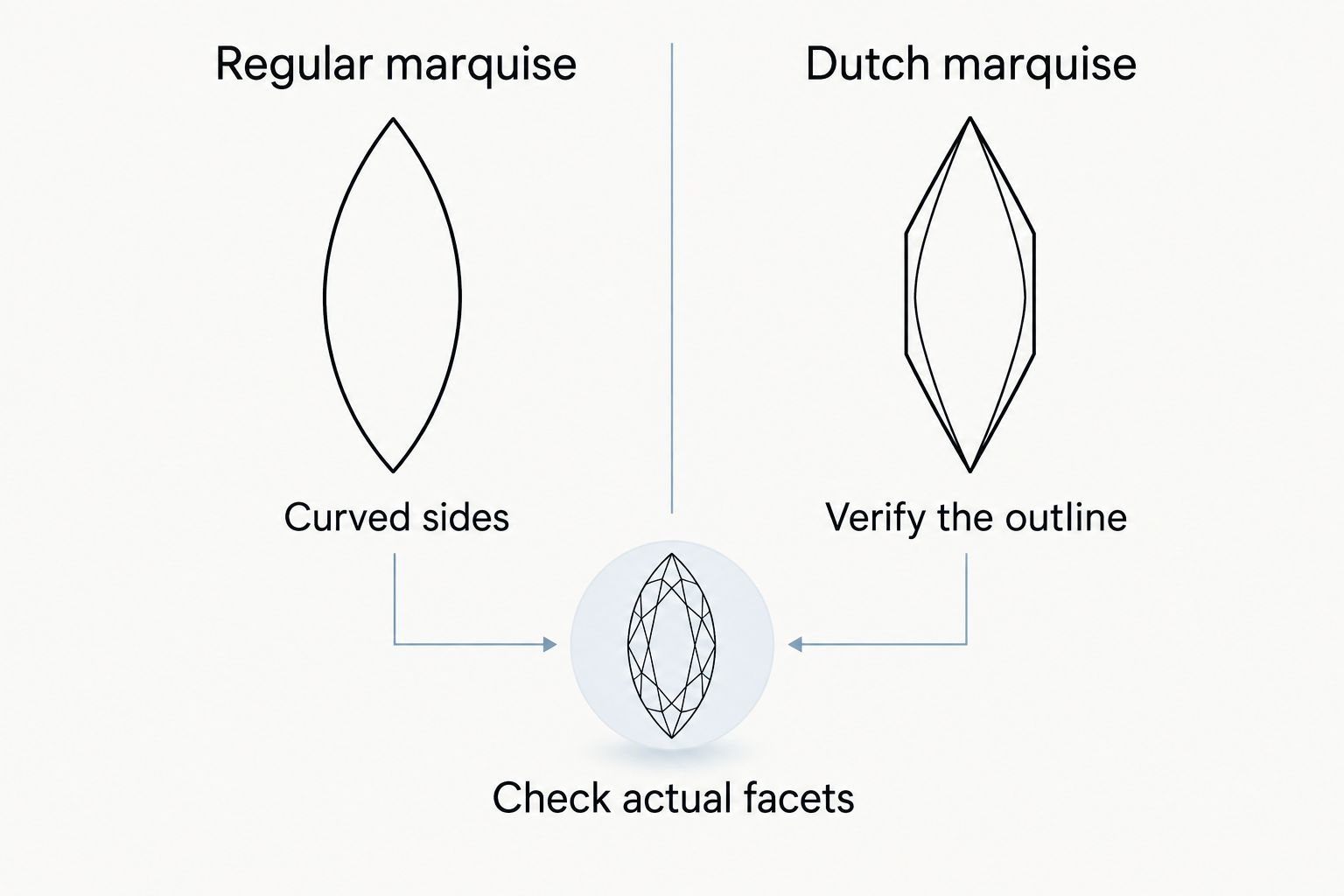
Regular marquise: Best for a flowing silhouette
A regular marquise suits someone drawn to a long, curved shape with a distinct point at either end. Its outline can become the central design feature of a ring without extra decoration.
Look for balance. The two ends should align visually, and the curves on opposite sides should look consistent rather than noticeably uneven. Judge the stone face-up, not only in an angled glamour photograph.
The advantage is its recognizable, flowing silhouette. The trade-off is that pointed ends require thoughtful setting protection, and elongated brilliant-cut diamonds can display a dark central area commonly called a bow tie. Choose a regular marquise because you love its curves, then assess the individual stone in motion.

Dutch marquise: Best for a more geometric direction
A Dutch marquise suits someone who wants the length of a marquise with the straight-sided silhouette of an elongated hexagon. Its six-sided outline creates a more angular design direction than a regular marquise.
A Dutch marquise can be faceted in different styles, including step-cut arrangements. Step-cut diamonds also have facets: the distinction is how those polished surfaces are arranged, not whether the stone is faceted. Outline describes the perimeter; facet arrangement influences the pattern of reflections inside it. Ask to see the actual stone in motion to compare the look you prefer.
Natural Dutch marquise diamonds over 1 carat are extremely rare. If you want a natural diamond in this shape and size, allow flexibility in your search rather than assuming a matching stone will be readily available. Rarity does not replace an assessment of the individual diamond’s appearance, quality, or suitability for your ring.

Why Dutch marquise descriptions and appearances vary
The elongated hexagon outline identifies the shape, but it does not specify a single facet arrangement. For a useful 2026 comparison, separate these factors before deciding whether two listings describe comparable stones:
- Outline: The Dutch marquise’s elongated, six-sided perimeter distinguishes it from the curved sides of a regular marquise.
- Facet arrangement: The placement and shape of polished surfaces influence the pattern of reflections. Dutch marquise diamonds can feature step-cut or other faceting styles.
- Proportions: Length, width, and depth affect appearance; carat weight alone does not describe visible size.
- Symmetry: Uneven sides or misaligned ends can change the impression of an otherwise appealing shape.
- Lighting and photography: A still photograph records one viewing condition, not the diamond’s full behavior.
- Setting design: Prongs and surrounding metal can emphasize, soften, or conceal parts of the outline.
These factors also explain why matching names do not guarantee matching looks. Ask to compare the actual diamonds under similar lighting and at a similar viewing scale.
How do you verify a Dutch marquise diamond before buying?
Use a simple sequence that moves from identity to appearance to wearability. Save the information for the specific stone rather than relying on a general description of the cut.
1. Identify the stone
Ask whether the diamond is natural or laboratory-grown and request its grading report. Dutch marquise diamonds are usually accompanied by an IGI grading report, but the laboratory name alone does not establish whether a stone is natural or laboratory-grown. Read the report for the specific diamond.
Match the report details to the stone being offered. A report for a similar example is not documentation for your diamond.
2. Confirm the outline
Request a face-up photograph of the actual diamond. Look for the elongated hexagon outline and ask to see its straight sides, pointed ends, and corners clearly. Confirm the facet arrangement separately, including whether the diamond is step-cut or has another faceting style.
If the seller provides a sketch, establish whether it represents the selected stone or only a design concept. A sketch is helpful for communication, but it is not evidence of the finished diamond’s appearance.
3. Read the measurements
Compare length, width, and depth in millimeters alongside carat weight. One carat equals 200 milligrams; it measures mass, not the face-up dimensions of a diamond. That distinction matters when you are choosing an elongated silhouette.
Do not select a stone solely because it has the greater carat weight. Ask how its dimensions will look on the intended finger and within the proposed setting.
4. Review the diamond in motion
Request a video that shows the diamond moving through different angles. Look for reflections that change across the stone rather than judging sparkle from one brightly lit frame.
A dark area in one photograph is not enough to assess the whole diamond. Conversely, a single flattering image does not demonstrate that a persistent dark area disappears in ordinary viewing.
5. Match the documentation
Dutch marquise diamonds are usually IGI-certified. Match the IGI report number and listed details to the diamond being offered, and read the report’s description of its origin, carat weight, measurements, and grading details. Do not expect the report to use exactly the same descriptive cut name as the seller.
If the particular stone instead comes with a GIA report, the guide to verifying a diamond’s GIA certification addresses that verification step.
Diamond clarity assessment commonly uses 10× magnification. That does not mean every feature visible under magnification will be equally noticeable without it; ask how the specific diamond looks at ordinary viewing distance.
6. Review the setting
Ask how the design protects pointed ends or exposed corners. Confirm that the proposed prongs support the actual outline instead of adapting a setting intended for a different shape without explanation.
For a gift, include the recipient’s daily routine in this conversation. A beautiful silhouette still needs a setting that makes sense for the person wearing it.
How does the setting change the look of an elongated diamond?
The setting controls how much of the perimeter you see. Prongs can interrupt an outline, while surrounding metal can frame it; neither effect is automatically good or bad. Ask to see the center stone’s outline within the proposed design.
Understanding how gemstone cuts affect appearance starts with separating the outer silhouette from the pattern of reflections inside it. Apply that distinction when reviewing a ring: the mounting changes the frame, while the diamond’s facets determine its internal light pattern.
For your 2026 design review, compare the ring from above and from the side. A face-up view explains the silhouette; a side view helps you discuss height, exposed edges, and how the ring will sit beside a wedding band.
Keep the emotional goal in view, too. If your loved one prefers quiet, simple jewelry, an elaborate setting should not become the default simply because the center stone has an unusual name.
Does “Dutch” mean the diamond was cut in the Netherlands?
No—the name alone does not establish where a diamond was cut. Geographic provenance needs separate evidence, not an inference from a descriptive label.
If cutting location matters to your purchase, ask for documentation that addresses it directly. Keep that question separate from whether the diamond is natural or laboratory-grown and from where its material originated.
Is a Dutch marquise better than a regular marquise?
Neither name establishes a better diamond. A documented stone with an appealing outline, balanced appearance, and suitable setting is a stronger choice than one selected for terminology alone.
For a 2026 shortlist, write down what you actually prefer: flowing curves or angular edges, a slender appearance or a fuller outline, and a simple frame or a more decorative setting. Those preferences give a jeweler something concrete to work with.
What should you ask a jeweler about a Dutch marquise diamond?
Ask the jeweler to explain the specific stone rather than repeat the listing title. These questions make the conversation practical:
- Can you show the elongated hexagon outline clearly?
- Is this diamond step-cut, or does it have another faceting style?
- Does it come with an IGI grading report or a report from another laboratory?
- Is it natural or laboratory-grown, and what does its report confirm?
- Can you show the actual diamond face-up and moving?
- What are its length, width, and depth in millimeters?
- How will the setting protect its points or corners?
- If I want a natural Dutch marquise over 1 carat, what sourcing flexibility will I need?
Balacia is best for couples seeking guided custom engagement ring design rather than choosing by a cut name alone. Speak with a Balacia jewelry expert about diamond education, your preferred silhouette, and a meaningful gift within your budget. Ask for both the attractive features and the practical limitations of the proposed design.
FAQ
What is the difference between a Dutch marquise diamond and a regular marquise?
A Dutch marquise has an elongated hexagon shape with straight sides and pointed ends, while a regular marquise has curved sides and pointed ends. A Dutch marquise can feature different facet arrangements, including step-cut styles.
Is a Dutch marquise diamond always step-cut?
No. A Dutch marquise can have step-cut or other faceting styles. Step-cut diamonds also have facets; the distinction is the arrangement of those facets. Confirm the individual stone’s facet pattern through photographs, video, and its report.
Are Dutch marquise diamonds usually IGI-certified?
Dutch marquise diamonds are usually accompanied by an IGI grading report. Check the specific stone’s report to confirm its natural or laboratory-grown origin, carat weight, measurements, and grading details.
Are natural Dutch marquise diamonds over 1 carat rare?
Yes. Natural Dutch marquise diamonds over 1 carat are extremely rare. Allow flexibility when searching for this combination of natural origin, shape, and carat weight, and assess the individual stone rather than choosing on rarity alone.
Does a Dutch marquise diamond come from the Netherlands?
The name alone does not establish that a Dutch marquise diamond comes from the Netherlands. Cutting location and material origin require separate documentation.
Can a Dutch marquise diamond be laboratory-grown?
A diamond’s shape does not establish whether it is natural or laboratory-grown. Verify the origin of the specific stone through its documentation rather than its cut name.
Will a marquise diamond have a bow tie?
A marquise diamond can display a bow-tie effect, but its visibility depends on the individual stone and viewing conditions. Review a moving video instead of relying on one still photograph.
Does a one-carat marquise have a fixed length?
A one-carat marquise does not have a fixed length. One carat equals 200 milligrams, while length, width, and depth describe the stone’s dimensions.
Can Balacia help me choose a custom engagement ring?
Balacia offers custom design options for engagement rings. Speak with a jewelry expert about the silhouette you love, the documentation for any proposed diamond, and your budget.
One last thing
Before approving your 2026 ring design, try covering the listing title and looking only at the stone, measurements, and proposed setting. Can you explain what you love without using the words Dutch marquise?
If the answer is its angular silhouette, shifting reflections, or graceful length, you have a useful design brief. The name should help you describe the ring—not make the decision for you.
Related guides
- Marquise-cut engagement rings
- From inspiration board to custom engagement ring
- Is it safe to buy an engagement ring online?