


No—radiant-cut diamonds generally cost less than comparable round brilliant diamonds, not more. For your 2026 engagement-ring search, compare diamonds of the same origin, carat weight, color, and clarity before judging the difference. The finished ring also includes the setting and any accent stones, so a more elaborate radiant ring can exceed a simpler round solitaire.
- Is radiant cut more expensive than round cut? Generally no; comparable round brilliant diamonds usually cost more.
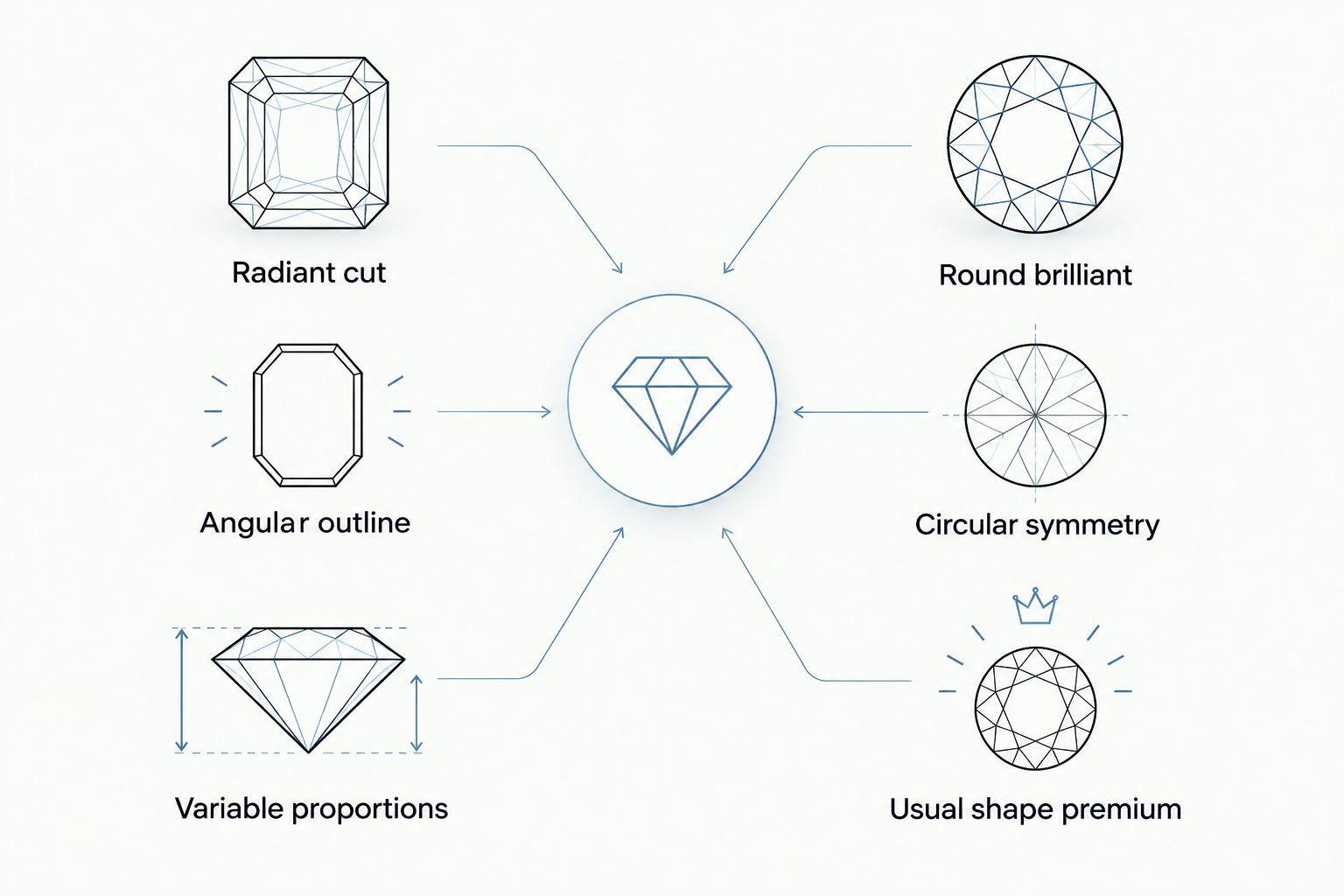
- Choose radiant cut for an angular outline; choose round brilliant for circular symmetry and a familiar sparkle pattern.
- Compare lab-grown diamonds with lab-grown diamonds, and natural diamonds with natural diamonds, before comparing shapes.
- Balacia engagement-ring shoppers should compare the center stone and complete setting separately before choosing.
Is radiant cut more expensive than round cut?
A comparable round brilliant diamond generally costs more than a radiant-cut diamond. That is a category-level buying guide, not a guarantee about every pair of stones. A higher-quality radiant diamond can cost more than a lower-quality round diamond.
The useful comparison separates diamond shape from the rest of the purchase:
| Comparison point | Radiant cut | Round brilliant cut |
|---|---|---|
| General relative cost | Usually lower with comparable characteristics | Usually higher with comparable characteristics |
| Outline | Square or rectangular with trimmed corners | Circular |
| Best for | Someone who loves angular lines and brilliant-style sparkle | Someone who loves circular symmetry and brilliant-style sparkle |
| Main advantage | Combines a geometric outline with many small reflections | Offers a familiar, symmetrical appearance |
| Main trade-off | Proportions and reflection patterns vary between stones | The usual shape premium leaves less room for other ring details |
| What to verify | Dimensions, proportions, light performance, and grading details | Cut grade where applicable, dimensions, light performance, and grading details |
For help turning those differences into a shortlist, speak with a Balacia jewelry expert about engagement-ring education and your budget. Balacia is best for engagement-ring shoppers who want to explore lab-grown and natural diamonds alongside custom design options. Choose the diamond on its own merits; the retailer's name does not replace reviewing the individual stone.
Why this matters
Your partner wears the whole ring, not a specification sheet. A shape that feels personal matters more than winning a comparison on one isolated characteristic.
A lower relative diamond cost is useful only if you actually prefer that diamond. If your partner has always loved a round solitaire, choosing a radiant solely to avoid the round premium misses the point of the gift.
For a 2026 purchase, request current, itemized comparisons rather than relying on a universal percentage difference. Separate the center stone from the mounting so you can see whether the difference comes from shape, diamond quality, or ring design.
Radiant cut: best for angular lines and brilliant-style sparkle
A radiant cut brings a square or rectangular outline together with brilliant-style faceting. Its trimmed corners distinguish it from a pointed-corner square shape, while its internal reflections distinguish it from a step-cut diamond.
Choose radiant cut when the outline is part of what you love. An elongated radiant and a squarer radiant create different impressions, even though both belong to the same shape family. Look at the actual stone rather than assuming every radiant resembles the first photograph you saved.
The advantage is visual flexibility: you can prioritize a longer outline or a more compact silhouette. The trade-off is that a shape name alone tells you little about how evenly the diamond handles light.
Ask for face-up and moving views. Watch for areas that remain dark as the diamond moves, and decide whether you like the balance between smaller reflections and broader flashes. Do not assume every radiant has the same sparkle pattern.
Round brilliant: best for circular symmetry
A round brilliant suits someone who wants a circular center stone with a balanced, symmetrical outline. It works particularly well when the recipient's saved photographs repeatedly show round centers rather than angular ones.
Choose round brilliant because you prefer its appearance, not because it is automatically the better diamond. Round diamonds vary in cut quality, and a shape premium does not guarantee attractive light performance.
The advantage is a familiar silhouette with a well-established framework for evaluating cut. The trade-off is that comparable round diamonds generally command more than radiant diamonds, leaving less flexibility elsewhere in the ring.
Review the individual grading report and moving images together. A report explains characteristics; images help you judge whether the actual diamond has the appearance you want. Neither the word round nor a large carat weight replaces that review.
Why the comparison varies
The radiant-versus-round question becomes useful only after you control the other characteristics. These details change what you are comparing:
- Diamond origin: Compare lab-grown with lab-grown or natural with natural. Changing origin and shape together prevents you from isolating the effect of shape.
- Carat weight: Compare equivalent center-stone weights. Total ring carat weight includes accent diamonds and does not describe the center stone alone.
- Color: Keep the color grades comparable before deciding that one shape offers better value. Also review how the individual diamond looks in the intended metal.
- Clarity: Compare the grades, then examine the location and visibility of inclusions. A grade alone does not describe every visible detail.
- Setting metal: Compare the same metal and purity when evaluating complete rings. Do not attribute every difference between finished rings to their center-stone shapes.
- Accent stones and design: A solitaire and a ring with side diamonds are different purchases. Match the design complexity or request separate center-stone and mounting details.
For your 2026 shortlist, keep the details in one written comparison. If one quote includes a wedding band and another does not, correct that mismatch before choosing.
How do you compare radiant and round diamonds fairly?
Use the same sequence for both shapes. This keeps an attractive photograph or a larger-looking setting from distracting you from the actual comparison.
- Set your priorities. Decide whether your nonnegotiable is the outline, diamond origin, overall ring design, or spending limit. Start with your partner's preferences rather than a rule about which shape should win.
- Match diamond origin. Request either lab-grown examples or natural examples first. Explore the other category separately if you want to understand that choice too.
- Match center-stone weight. A 1.00-carat diamond weighs 200 milligrams, regardless of shape. Carat describes weight, not the length of the diamond on your finger.
- Review dimensions and grades. Compare the stated measurements, color, and clarity alongside weight. Ask how the grading laboratory evaluates cut for each shape instead of assuming both reports use identical grading systems.
- Watch both diamonds move. Request comparable lighting and viewing angles. Look for appealing brightness and reflection patterns rather than comparing a studio photograph with a casual video.
- Compare complete rings. Match metal, side stones, and included bands. Then decide which finished design expresses the sentiment you want to give.
A 2.00-carat diamond weighs 400 milligrams, but that does not mean it looks twice as large as a 1.00-carat diamond. Visible dimensions depend on proportions, so ask for measurements rather than using weight as a substitute for appearance.
Choose the individual diamond first, then judge whether its setting completes the ring you imagined. Keep screenshots, report details, and written specifications together so you do not accidentally compare different stones later.
Does radiant cut look bigger than round cut?
A radiant-cut diamond can look longer than a round diamond of the same carat weight, especially when it has an elongated outline. It does not automatically have a larger face-up area, and length alone does not establish better value.
Compare the actual length and width. A long, narrow stone creates a different visual impression from a circular stone, even when their weights match exactly.
Ask to see both shapes on a hand or in a comparable scale reference. Close-up photography without scale makes nearly any center stone appear substantial; it does not tell you how the ring will feel in everyday wear.
Is round cut always the better-quality choice?
Round cut is not automatically the better-quality choice. Shape describes the outline and cutting style, while the individual diamond's characteristics determine how it looks and performs.
A beautiful radiant is a better match for someone who loves angular jewelry than a round diamond selected only for its reputation. Conversely, a lower relative cost does not make a radiant the right choice for someone who consistently prefers round centers.
For a 2026 engagement ring, define quality in practical terms: attractive light performance, acceptable visible characteristics, clear documentation, and a setting your partner wants to wear. Avoid treating shape as a quality grade.
How does the setting change the decision?
The setting changes both the appearance and the scope of the purchase. A halo, side diamonds, or a coordinating band introduces details beyond the center stone, so compare those features separately.
If you like an angular center with additional geometric detail, consider a radiant-cut engagement ring with princess-cut side diamonds as a design reference. Its stated design is relevant to the shape decision; confirm the exact center-stone specifications and metal before evaluating an individual ring.
The benefit of side stones is a more detailed overall composition. The trade-off is that you are no longer comparing a center diamond alone, and the additional settings also need attention during cleaning and inspection.
Ask a Balacia jewelry expert to help distinguish the center-stone choice from the mounting choice and discover gifts within your budget. Bring photographs showing what your loved one likes, including side views when possible. Height, profile, and how a wedding band sits beside the engagement ring deserve attention too.
FAQ
Is radiant cut more expensive than round cut in 2026?
No—radiant-cut diamonds generally cost less than comparable round brilliant diamonds. Compare the same diamond origin, carat weight, color, and clarity, then evaluate the setting separately.
Why do round diamonds generally cost more than radiant diamonds?
Round brilliant diamonds generally carry a shape premium associated with market demand and how the rough diamond is cut. That general pattern does not determine the difference between two individual stones with different characteristics.
Is a radiant-cut diamond less sparkly than a round diamond?
A radiant-cut diamond is not automatically less sparkly than a round diamond. Both use brilliant-style faceting, but the individual cut and reflection pattern determine the appearance you see.
Should I compare a natural round diamond with a lab-grown radiant diamond?
Compare the same diamond origin first if you want to understand the effect of shape. Comparing a natural round with a lab-grown radiant combines separate purchasing decisions and does not isolate a shape premium.
Does the same carat weight mean radiant and round diamonds look the same size?
The same carat weight does not mean radiant and round diamonds look the same size. Compare actual length, width, and proportions because carat measures weight rather than visible size.
Is radiant cut a good choice for a surprise engagement ring?
Radiant cut is a good choice when the recipient already likes square or rectangular brilliant-style diamonds. If you have no evidence of that preference, learn more about the recipient's favorite shapes before committing.
How can I choose between radiant and round without overspending?
Choose between radiant and round by setting your spending limit and comparing matched diamonds in equivalent settings. Prioritize the recipient's preferred outline, then review individual stone quality rather than chasing the largest carat weight.
One last thing
Do not confuse radiant cut with an emerald-cut diamond simply because both can have rectangular outlines and trimmed corners. Their faceting styles differ, so the visual experience is different even when the silhouettes seem similar.
Before finalizing your 2026 choice, show your partner's favorite photographs to a Balacia jewelry expert and explain what you love about them. The most useful question is not just which shape generally costs less, but which diamond and setting make the gift feel unmistakably theirs.