


A men's gold wedding band's cost depends on whether it contains gold throughout or has a gold-colored coating, along with its weight, dimensions, and design. The amount you pay for the ring also needs to be considered separately from any engraving, sizing, or future maintenance you request. For your 2026 purchase, compare the underlying material first—not just the color or the karat number in the name.
- How much does a mens gold wedding band cost? Compare material, weight, dimensions, and design before choosing.
- Balacia wedding bands include gold-tone tungsten options; a gold coating is not the same as a gold alloy throughout.
- A 14k gold ring contains approximately 58.3% gold; an 18k gold ring contains 75% gold.
- Choose solid gold for gold throughout, or gold-tone tungsten when the appearance and material suit your partner.
Why this matters
Wedding bands can look similar in photographs while containing very different materials. A yellow-gold-colored tungsten ring and a yellow gold ring are not interchangeable purchases, even when both suit the same wedding outfit.
Balacia is best for couples who want to compare gold jewelry and gold-tone tungsten wedding bands with personal guidance. Speak with a Balacia jewelry expert about your budget, your partner's preferences, and the details that matter before you choose.
The goal is not to buy the most elaborate ring. It is to choose a band your partner understands, enjoys wearing, and associates with the promise you are making together.
How much does a men's gold wedding band cost?
There is no single amount that represents every men's gold wedding band. Start by separating gold-alloy rings from gold-coated alternative-metal rings, then compare current product details within each group.
For a useful 2026 comparison, write down the base material, gold purity where applicable, weight, width, and any stones. Otherwise, you risk comparing the appearance of two rings rather than what you are actually buying.
| Material or design | Best for | Main advantage | Main limitation | What to compare |
|---|---|---|---|---|
| Gold-alloy band, such as 14k gold | Someone who wants gold throughout the ring | Gold content is part of the ring's underlying material | Gold purity alone does not explain its weight, construction, or fit | Karat, gram weight, width, thickness, construction |
| Gold PVD tungsten band | Someone who wants a gold-tone alternative-metal ring | Combines a tungsten base with a gold-colored surface treatment | The coating does not make the entire ring gold | Base metal, coating, width, profile, care instructions |
| Gold band with diamonds | Someone who wants visible sparkle in a wedding band | Combines gold with a decorative stone design | Stones introduce additional specifications and care considerations | Gold details, diamond type, total carat weight, setting |
Compare like with like before deciding which ring offers the right value. Two bands with the same width can still have different thicknesses, profiles, weights, and materials.
What belongs in your purchase comparison?
Separate the ring itself from any additional work you ask a jeweler to perform. Ask whether engraving, size adjustments, or design changes are included in the current selection, rather than assuming they are.
Also ask about the care the exact ring requires. These questions do not establish a universal ownership cost; they help you understand the particular ring you are considering without mistaking an attractive photograph for a complete specification.
14k gold bands: best for gold throughout the ring
A 14k gold alloy contains approximately 58.3% gold. The remaining material consists of other metals in the alloy; the exact composition depends on the piece.
That purity describes the material, not the ring's total gold weight. A lightweight 14k band and a heavier 14k band share the same stated purity but do not contain the same amount of gold.
For example, the 14K Yellow 3.2 mm Round Mens Ring has a listed weight of 12.34 grams and an approximate shoulder width of 7.2 mm. Those specifications describe that product only—not every men's gold wedding band.
Best for: someone who specifically wants a gold-alloy ring rather than a gold-colored coating. The trade-off is that you still need to investigate construction, dimensions, and suitability; the words 14k gold do not answer every buying question.
Ask for clarification whenever a product title and its detailed measurements seem to describe different parts of the ring. A dimension in a name does not necessarily represent the width across the top of the finger.
18k gold bands: best for higher gold purity
An 18k gold alloy contains 75% gold. That is a higher gold proportion than 14k, but it does not make every 18k design the better wedding band for every wearer.
Purity and construction are separate decisions. You still need the ring's actual dimensions and weight to understand how much material it contains and how it will feel.
Best for: someone who places particular importance on a higher gold proportion. The limitation is that purity is not a substitute for assessing fit, finish, design, or the care required by the exact alloy.
When comparing rings in 2026, make sure 18k describes the ring's underlying gold alloy—not merely a surface treatment. That distinction changes the meaning of the specification completely.
Gold PVD tungsten bands: best for a gold-tone alternative
A gold PVD tungsten band has a tungsten base and a surface treatment. An 18k gold PVD description does not mean that the entire ring consists of an 18k gold alloy.
The 18K Yellow Gold & Black PVD Tungsten 6 mm Beveled-Edge Band lists tungsten as its material, a comfort fit, and an approximate shank base width of 6 mm. Its listed weight is 26.85 grams; that figure is the product's weight, not a statement of its gold content.
Best for: someone who likes a two-tone appearance and deliberately wants a tungsten band. The limitation is the material distinction itself: this is not a substitute for gold throughout if that is your partner's priority.
Do not infer gold content from total weight. A heavier tungsten ring does not contain more gold than a lighter gold-alloy ring simply because it weighs more.
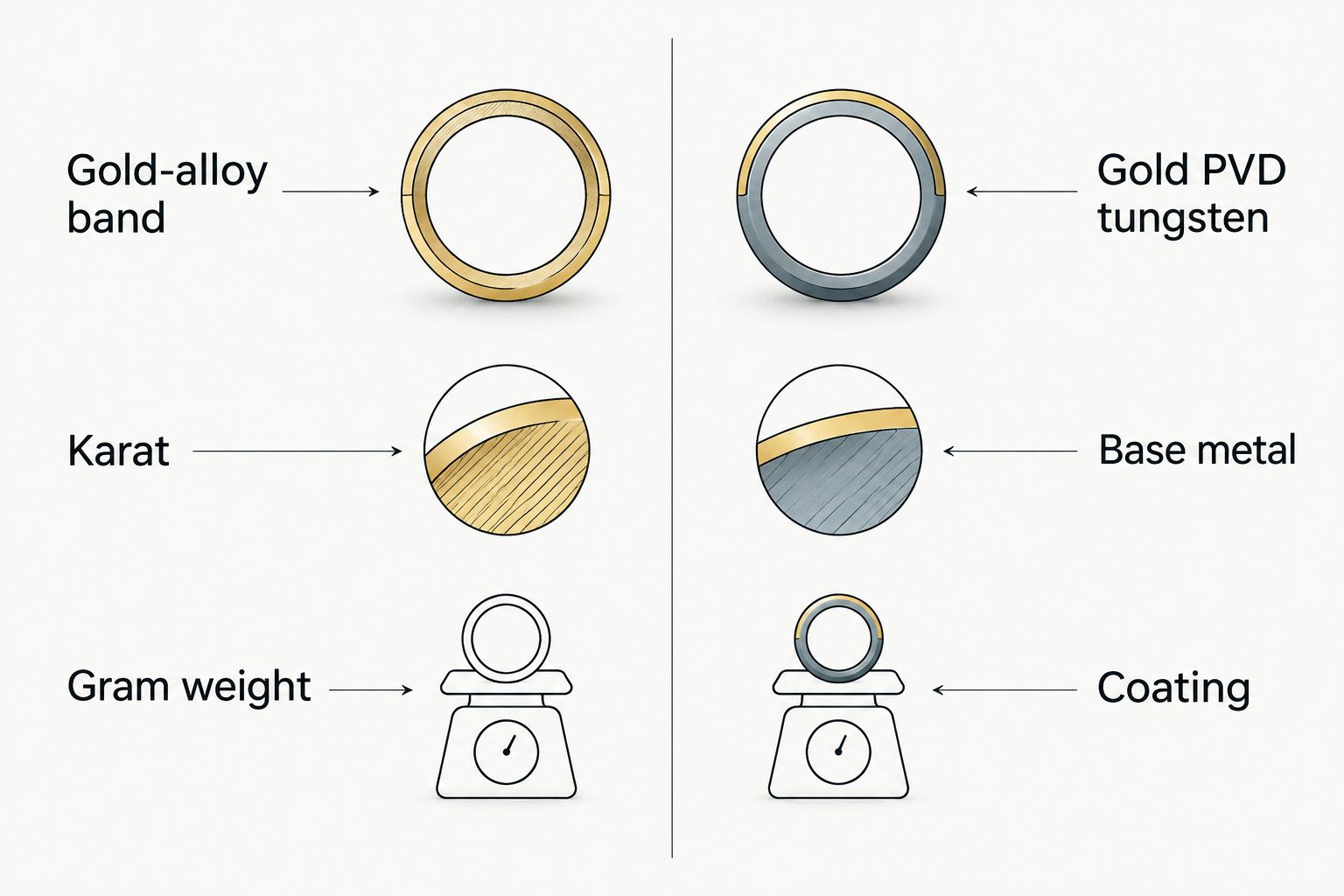
Why men's gold wedding band costs vary
These are the specifications to compare when two rings look alike but represent different purchases. Use the same checklist for every candidate on your 2026 shortlist.
- Underlying material: Gold alloy, tungsten, and coated alternative metals describe different constructions. Establish this before comparing decorative details.
- Gold purity: A 14k and an 18k gold alloy contain different proportions of gold. Keep purity separate from color and total ring weight.
- Metal weight: Within comparable gold alloys, a heavier ring contains more material. Do not compare weights across different metals as if they represented equal gold content.
- Width and thickness: A broad band is not necessarily thick, and a narrow band is not necessarily lightweight. Request the actual dimensions.
- Stones and setting: A plain band and a diamond band require different evaluations. For a diamond design, check the stone type, total carat weight, and setting details.
- Design and personalization: Grooves, contours, engraving, and custom design change the specification. Ask for the details of your exact request rather than borrowing assumptions from another ring.
Does a wider gold band always contain more gold?
A wider band does not automatically contain more gold than every narrower band. Thickness, ring size, profile, and construction also affect the amount of material.
Compare rings with the same alloy and similar construction before using width as a guide. Gram weight is more informative than judging the photograph alone.
Is an 18k gold PVD ring an 18k gold ring?
An 18k gold PVD ring is not necessarily an 18k gold-alloy ring throughout. In a tungsten product, the tungsten description identifies the underlying material, while PVD identifies a surface treatment.
Read both parts of the specification. If you want gold throughout, say that explicitly when discussing options with a jeweler.
Should I choose a plain band or a diamond band?
Choose a plain band if your partner prefers an uninterrupted metal design; choose a diamond band if visible sparkle is part of the appeal. Neither choice proves that a ring is more meaningful or better suited to your marriage.
For diamond bands, do not assume that every stone has an individual grading report. Ask what documentation applies to the exact ring and stones.
How to choose a band without buying the wrong material
A practical shortlist begins with your partner's preferences, not a spending rule. Follow this sequence before making your 2026 decision.
- Set your budget. Decide what you are comfortable spending on the wedding band, separately from other wedding jewelry and expenses.
- Choose the material. Establish whether gold throughout matters or whether a gold-tone tungsten band fits the brief.
- Confirm the dimensions. Compare width, thickness, profile, and listed weight rather than relying on enlarged product photos.
- Check the fit. Confirm the intended finger and size, and ask how the exact band's shape affects the fitting process.
- Ask about care. Request material-specific advice, including any restrictions on adjustments or surface maintenance.
- Review the details. Confirm the exact selection and any personalization before completing the purchase.
The two Balacia selections below illustrate different material choices, not equivalent versions of the same ring. Choose the gold ring if gold throughout is essential; consider the tungsten band only if its underlying material and two-tone design match what your partner wants.


Buying a wedding band as a gift
A surprise wedding band needs more preparation than a surprise bouquet. Keep the emotion in the presentation, but make the material, fit, and wearing preferences a shared decision whenever possible.
Notice whether your partner already wears yellow, white, rose, or mixed metal tones. Treat that as a conversation starter, not proof of which alloy or coating they want.
If you hope the ring becomes an heirloom, explain that intention to a Balacia jewelry expert. Ask for help choosing within your budget and understanding the material's care needs, without assuming any ring is maintenance-free or guaranteed to last unchanged.
FAQ
How much does a mens gold wedding band cost in 2026?
A men's gold wedding band's cost depends on its underlying material, gold purity, weight, dimensions, and design. Compare current selections within the same material category, and confirm any additional work separately.
Is 14k gold real gold for a wedding band?
Yes, 14k gold is a gold alloy containing approximately 58.3% gold. The karat describes purity, not the ring's total weight or whether its construction is hollow or solid.
Is 18k gold better than 14k for a men's wedding band?
18k gold has a higher gold proportion at 75%, but that does not automatically make it the better wedding band. Choose according to the exact alloy, design, fit, and your partner's preferences.
Does gold PVD tungsten mean solid gold?
No, gold PVD tungsten identifies a tungsten ring with a surface treatment, not gold alloy throughout. Read the base material and coating descriptions separately.
Can I use a ring's weight to work out how much gold it contains?
Weight alone does not establish gold content. You also need the underlying material and purity; a tungsten ring's total weight cannot be treated as gold weight.
Should I buy a wider wedding band for my partner?
Choose width according to your partner's preferred appearance and fit, not an assumption that wider is better. Compare the exact dimensions and arrange appropriate sizing before choosing.
Can a jeweler help me choose a wedding band within my budget?
Yes, discussing your budget and material preferences with a Balacia jewelry expert helps focus the selection. Ask about gold throughout versus coatings, dimensions, fit, and care before deciding.
One last thing
The most useful question is not just what karat the ring is—it is where that gold is. Gold throughout an alloy and gold in a surface treatment describe different purchases, even when a product name includes the same karat number.
Before choosing, explain the material back in plain language. If you can say what the ring is made from, how it fits, and why your partner will love it, you are making a more informed choice than appearance alone allows.