

Your 2026 custom ring cost depends on the stone, metal, setting, and design. It is not a universal fee. Confirm if the total cost includes the stone, revisions, taxes, and delivery. A design mockup is not a finished ring.
TL;DR
- Custom engagement ring cost depends on the exact stone, metal, setting, and approved design—not the word custom.
- Balacia offers custom engagement ring options for couples who want a personal design.
- Compare itemized quotes with matching specifications, including stone origin and center-stone weight.
- Confirm design revisions, taxes, delivery, and aftercare terms before committing.
Why this matters
An engagement ring carries a promise, but choosing it should not require guessing what you are paying for. A useful budget separates the details your partner will treasure from the details you can change without losing the meaning.
Balacia is a fit for couples seeking custom engagement ring options alongside lab-grown and natural diamond choices. Explore its custom ring CAD design mockup. Distinguish the design service from the finished jewelry. Confirm what the purchase covers.
How much does a custom engagement ring cost in 2026?
A custom engagement ring requires a quote for a defined design. Do not compare custom versus noncustom in the abstract. Compare one complete ring specification against another with the same inclusions.
Use this breakdown to understand the total before you approve it:
| Quote component | What you should see | What to clarify |
| Center stone | Stone type, origin, shape, weight, and relevant quality details | Whether the actual stone is selected and included |
| Setting | Metal, purity, ring size, and construction details | Whether accent stones and their setting work are included |
| Design work | Drawings or CAD scope and approval process | Which revisions are included and how changes are handled |
| Production | Work needed to turn the approved design into jewelry | Whether further charges require your approval |
| Purchase total | Applicable taxes and delivery charges | Whether the written total includes these items |
| Aftercare | Written resizing, repair, and maintenance terms | Which services are included and which are separate |
Treat this as a question list, not a statement that every jeweler charges separately for every component. An item can be included, excluded, or unnecessary for your design. What matters is that you know which applies.
Compare complete written quotes, not isolated center-stone listings or design-service listings. A lower-looking figure is not useful if it leaves out the work needed to finish your ring.
Why custom engagement ring cost varies
The design brief determines what you need quoted. These factors deserve separate attention because changing one can change the specifications of the whole ring:
- Center-stone choice: Identify whether you want a lab-grown diamond, natural diamond, or another gemstone before comparing options.
- Stone specifications: Match shape, carat weight, dimensions, and relevant quality information. A shared carat weight does not make two stones equivalent.
- Metal and construction: Specify the metal, purity, band dimensions, and ring size rather than asking for a generic gold setting.
- Accent details: Halos, side stones, and stone-set bands add components and setting work that a plain band does not require.
- Design scope: Adapting an established design and developing a new arrangement require different briefs. Ask what drawings, revisions, and approvals your project includes.
- Existing materials: Reusing a stone introduces questions about its condition, measurements, removal, and suitability for the proposed setting.
For a 2026 quote, ask the jeweler to identify which decisions are settled and which remain estimates. That distinction helps you understand what you are approving before you become attached to a rendering.
Which center stone should you choose for a custom ring?
Choose the kind of stone your partner actually wants before adjusting its specifications. A different stone is not automatically a satisfying substitute just because it fits the design.
| Stone option | Best for | Advantage | Trade-off |
| Lab-grown diamond | Someone who wants a diamond without mined origin | It is diamond, with the same underlying chemical composition as natural diamond | It does not provide natural geological origin if that matters to the recipient |
| Natural diamond | Someone who specifically values mined origin | Its origin matches that preference | Natural origin alone does not establish cut quality or suitability for the design |
| Moissanite | Someone who intentionally wants a distinct gemstone | Its optical character offers a different kind of sparkle | It is not diamond and should not be presented as diamond |
Lab-grown and natural describe origin, not a complete quality grade. Ask for the information attached to the actual stone rather than assuming that a category name answers every quality question.
Carat weight also needs context. 1 carat equals 200 milligrams; it measures mass, not the visible width of a gemstone. Compare actual dimensions and the proposed setting as well as weight, especially when you are comparing different shapes.
If documentation accompanies a stone, check that it identifies the stone being quoted. Do not assume that every ring, accent stone, or custom project carries an individual grading report.
How do metal and setting details affect your decision?
Specify metal purity as well as color. 14-karat gold contains approximately 58.3% gold, while 18-karat gold contains 75% gold. Those descriptions identify composition; neither tells you the finished ring's weight, dimensions, or suitability on its own.
A quote should name the metal and describe the band clearly. A narrow rendering does not replace measurements. A top-down view does not show how high the ring sits.
Discuss these setting choices together:
| Setting direction | Best for | What it offers | What to examine |
| Plain-band solitaire | Someone who wants the center stone to lead | A clear focal point without surrounding accent stones | Prong design, setting height, and wedding-band clearance |
| Halo | Someone who enjoys a stone-framed center | A defined outline around the main stone | Additional stones, setting details, and access for cleaning |
| Side-stone design | Someone who wants detail beyond the center | A composition extending across the finger | Overall width, stone proportions, and fit beside a wedding band |
These are design directions, not fixed tiers. A solitaire with substantial construction cannot be compared fairly with a halo. They use different materials and specifications.
Choose the outline your partner loves, then ask the jeweler to explain the construction behind it. The best drawing is one you can also understand from the side.
How do you get a useful custom engagement ring quote?
Start with a short brief rather than a folder of unrelated pictures. Your goal is to tell the jeweler what must stay, what can change, and what needs an explanation.
- Set priorities. Identify the preferred stone type, shape, metal color, and overall style. Separate essentials from details you are simply curious about.
- Confirm specifications. Request the actual stone details and the proposed setting measurements. Include ring size and any wedding-band plans.
- Review the design. Ask for views that show height, proportions, and the relationship between the center stone and band. Clarify whether images are illustrative or represent the approved design.
- Check inclusions. Read the revision terms, purchase total, and aftercare terms before approving production. Ask how later changes will be documented.
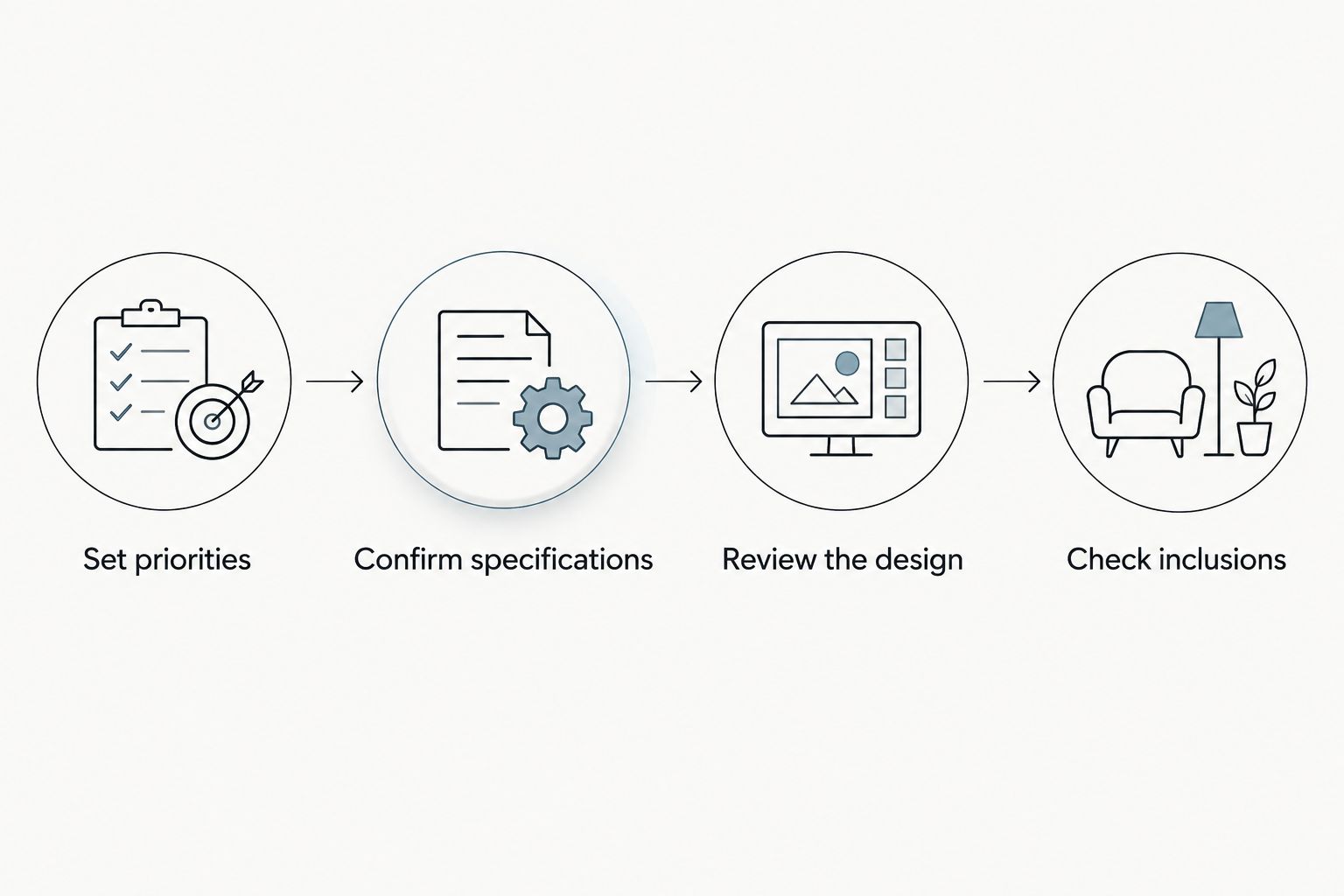
Agree on the specifications and inclusions before approving production.
When requesting a second quote, send the same brief. Otherwise, you can end up comparing different stones, different band dimensions, and different amounts of design work without realizing it.
Ask how long the quote remains valid, too. A written proposal should explain its own terms; a saved screenshot does not establish what a later order includes.
How can you control the budget without losing the meaning?
Protect the sentiment first and simplify around it. If your partner loves an oval outline and yellow gold, use those preferences. Discuss the surrounding details from there.
Ask for alternatives that change one feature at a time. For example, compare the same center-stone specification in a plain-band setting and an accent-stone setting. Then ask separately about a different center-stone size, keeping the setting consistent.
This approach makes the trade-offs visible. Changing many details at once produces a different ring. It does not show which choice mattered most to the quote.
Avoid treating a salary rule as a requirement. Your budget belongs alongside your shared plans. A thoughtful design does not need an elaborate explanation of cost.
For your 2026 purchase, keep one approved specification sheet with the final quote. It gives you a clearer reference than a conversation spread across messages, pictures, and revised drawings.
Does custom always mean more expensive than an existing design?
Custom does not establish a price relationship by itself. You need matching stone, metal, construction, and service details before you can compare a custom proposal with an existing design.
Existing designs give you a defined starting point. Custom designs allow personal changes but require clear decisions. Neither label tells you if the ring suits your partner better.
At Balacia, custom options sit alongside an existing selection. Use this choice to clarify your needs. See if an established style already expresses what you want.
Can you use a family diamond in a custom engagement ring?
A family diamond needs a jeweler's assessment before planning. Ask about its condition and measurements. Check its compatibility with the setting and the work to remove it.
Reusing a stone does not remove every other part of the project. You still need an approved setting design, a clear description of the work, and written handling terms.
The emotional advantage is personal: a familiar stone can connect your proposal to an existing family story. The practical limitation is that the new setting must accommodate the actual stone, not just a reference photograph.
FAQ
What's included in a custom engagement ring quote?
A custom engagement ring quote should identify the center stone, setting, design scope, production work, and purchase inclusions. Confirm taxes, delivery, revisions, and aftercare terms rather than assuming they are included.
Is a CAD mockup the same as buying a custom engagement ring?
A CAD mockup is a design representation, not the finished engagement ring. Check whether the purchase covers design work only or forms part of a separate agreement for the completed ring.
Does custom engagement ring cost include the center diamond?
Custom engagement ring cost includes the center diamond only when the quote explicitly includes it. Ask whether the proposal is for a complete ring, a setting, or design work.
Is a lab-grown diamond a real diamond?
A lab-grown diamond is a real diamond, not a simulant. Its origin differs from a natural diamond. Confirm which origin your partner prefers and the documentation provided.
Does a bigger carat weight mean a wider-looking diamond?
Carat weight measures mass, not face-up width: 1 carat equals 200 milligrams. Compare the actual dimensions, shape, and proportions rather than weight alone.
Should I choose 14-karat or 18-karat gold for a custom ring?
Choose 14k or 18k gold after discussing alloy and wear needs. 14k gold is 58.3% pure. 18k gold is 75% pure. Purity alone does not determine the best ring.
What should I check before approving a custom ring in 2026?
Before approving a ring, check the stone, metal, size, and final quote. Review the written terms. Confirm how changes are handled and keep specifications together.
One last thing
Ask to see the engagement ring beside the kind of wedding band your partner intends to wear. A top-down rendering can hide a gap or a setting that prevents the bands from sitting together as expected.
That question brings the decision back to daily life. The ring should feel personal at the proposal and make sense in the years of ordinary, meaningful moments that follow.