

Yes, lab-grown diamonds can pass a standard diamond tester because they have the diamond properties those testers measure, including high thermal conductivity. A passing result does not prove natural origin, and some thermal-only testers also identify moissanite as diamond. For a purchase in 2026, use the tester as a screening tool—not as a substitute for documented origin and professional identification.
- Can lab grown diamonds pass a diamond tester? Yes; a standard tester does not establish natural origin.
- Thermal-only diamond testers can also give moissanite a diamond reading.
- Specialized screening and laboratory analysis distinguish lab-grown diamonds from natural diamonds.
- Balacia diamond jewelry buyers should confirm stone origin and documentation before choosing a meaningful gift.
Why this matters
A tester's reassuring beep answers a narrower question than you might expect. It measures a physical response; it does not tell you where the stone formed, how it was graded, or whether it matches the description on your receipt.
If you are choosing an engagement ring or anniversary gift, that distinction protects an informed decision without taking away any of the sentiment. Balacia sells both lab-grown and natural diamond jewelry, so start by deciding which origin you want—not by treating a tester result as a ranking of the two.
The useful question in 2026 is not simply whether a stone passes. It is what the instrument actually establishes about that stone.
Can lab-grown diamonds pass a diamond tester?
Yes. Lab-grown diamonds are diamonds, not look-alike materials designed merely to trigger an instrument. Their crystal structure and physical properties explain why a conventional tester generally recognizes them as diamond.
The instrument matters, however. A handheld thermal probe, a combined thermal-and-electrical tester, and a specialized origin-screening instrument perform different jobs.
| Testing method | Best for | Main benefit | Main limitation |
|---|---|---|---|
| Thermal-only tester | Initial screening against many simulants | Checks heat conduction associated with diamond | Cannot distinguish lab-grown from natural diamond; moissanite can pass |
| Combined thermal-and-electrical tester | Separating diamond from moissanite | Adds an electrical measurement to thermal screening | Does not establish natural origin; follow the instrument's restrictions |
| Specialized diamond screening | Checking for possible laboratory-grown origin | Examines characteristics beyond a basic thermal response | A referral result needs further examination, not an immediate verdict |
| Gemological laboratory analysis | Resolving identity and origin | Uses specialized analysis and expert interpretation | Requires the appropriate service and access to the stone |
A diamond reading establishes neither natural origin nor a quality grade. Before accepting a result, ask which instrument produced it and what that instrument is designed to detect.
Thermal-only testers: useful screening, not origin proof
A thermal tester measures how heat moves away from its probe. Diamond conducts heat exceptionally well, which helps distinguish it from many imitation stones.
The limitation is overlap. Moissanite also conducts heat well enough to produce a diamond response on thermal-only instruments, so that response does not settle identity by itself.
Combined testers: a different question, not a complete answer
Combined testers add electrical conductivity to help separate diamond from moissanite. That makes them useful for a question a thermal-only probe cannot reliably answer alone.
It does not turn them into lab-grown-diamond detectors. Some diamond properties also complicate electrical testing, so use the manufacturer's instructions and refer unclear results to a qualified professional.
What happens when different stones meet a tester?
Lab-grown diamonds, natural diamonds, and simulants should not be grouped together merely because they can look similar in jewelry. A simulant resembles diamond but is a different material; a laboratory-grown diamond is diamond with a different growth origin.
| Stone | Typical thermal-only response | What that response means | What remains unresolved |
|---|---|---|---|
| Lab-grown diamond | Diamond reading when tested correctly | Consistent with diamond's thermal behavior | Growth origin, grading, and report match |
| Natural diamond | Diamond reading when tested correctly | Consistent with diamond's thermal behavior | Grading and confirmation of natural origin |
| Moissanite | Can produce a diamond reading | Thermal screening alone is insufficient | Correct material identification |
| Cubic zirconia | Normally a non-diamond reading | Thermal behavior differs from diamond | Exact identity still needs appropriate examination |
This is why a demonstration showing only a green light or a beep is incomplete evidence. Ask what other materials the instrument can confuse with diamond and whether the person demonstrating it has checked origin separately.
Do not use a passing result to conclude that lab-grown and natural diamonds are interchangeable in every purchase detail, either. Origin should match the description you agreed to buy.
Why diamond tester results vary
Different readings do not automatically mean a stone is misrepresented. Testing conditions and instrument capabilities matter, especially when a small stone is already set in jewelry.
- Instrument capability: Thermal-only, combined, and origin-screening devices answer different questions. Identify the device before interpreting its display.
- Probe contact: The tip must contact the stone correctly. Contact with surrounding metal can interfere with the test or trigger a metal warning on equipped devices.
- Stone size and access: Small accent diamonds and crowded settings can prevent proper probe placement. Check the instrument's stated testing limits.
- Surface condition: Oil, dirt, or moisture can interfere with reliable contact. Follow the device's cleaning and preparation instructions.
- Operating conditions: Battery condition, readiness, and stone temperature matter. Use the manufacturer's procedure rather than copying an online demonstration.
- Material properties: Moissanite and certain electrically conductive diamonds complicate simple interpretations. An unexpected reading needs investigation, not a guess.
Treat conflicting readings as a reason to stop and check—not as a reason to press harder or keep testing until you get the answer you want. A jeweler can assess whether the stone is suitable for that instrument.
How do you verify a diamond before buying in 2026?
Use a process that separates the seller's description, the instrument's result, and the supporting documentation. Each answers a different question, and none should silently stand in for the others.
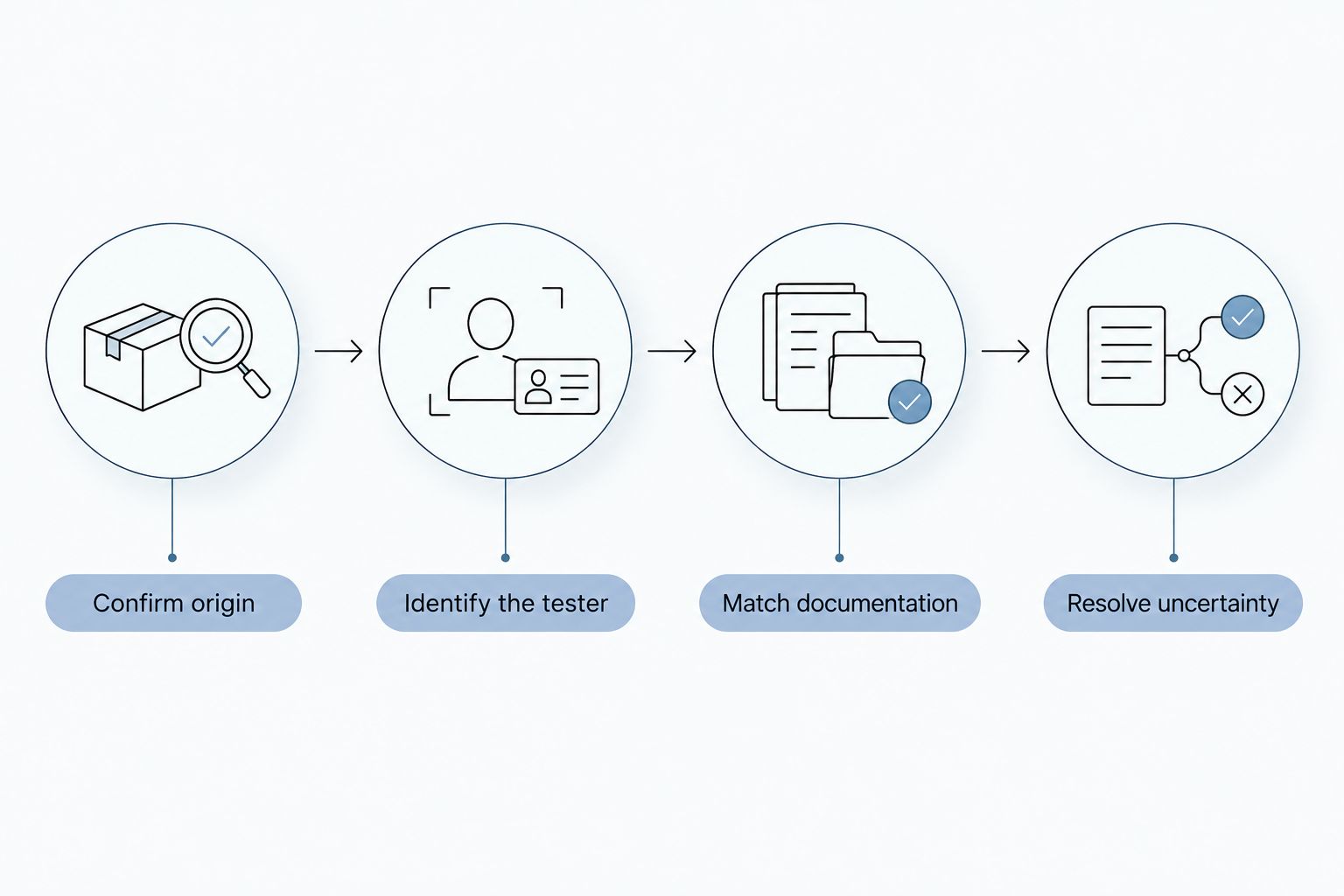
- Confirm origin. Ask whether the stone is laboratory-grown or natural, and make sure the purchase description states it clearly.
- Identify the tester. Ask whether the device screens for diamond, separates moissanite, or evaluates possible laboratory-grown origin.
- Match documentation. Where a laboratory report is supplied, verify its details through the issuing laboratory and compare them with the stone's description.
- Resolve uncertainty. Ask a qualified gemologist or gemological laboratory to investigate conflicting results before you commit.
A report number by itself is not enough. Check the recorded shape, measurements, weight, and other identifying details; when an inscription is present, have it examined and compared with the report. An inscription alone is not a substitute for matching the stone.
For a 2026 purchase, keep the product description, receipt, and any supplied report together. This gives you a clear record of what was represented, rather than leaving you dependent on a remembered demonstration.
What should you ask about an engagement ring?
Start with the center stone, then ask separately about the accents. Documentation for a center diamond does not automatically describe every small diamond in the setting.
For example, the Radiant Cut Engagement Ring with Princess Cut Side Diamonds lists its main stone as laboratory-grown, with F color and VS1 clarity. Those details describe the main stone; they do not make a handheld tester capable of verifying its origin or grades.
Ask which laboratory issued any supplied report and which stone it covers. Specific documentation is more useful than a general assurance that the ring passes a tester.
Can a jeweler tell whether a diamond is lab-grown?
A jeweler with appropriate screening equipment or access to laboratory testing can investigate growth origin. A standard handheld diamond tester alone cannot provide that answer.
Specialized instruments examine characteristics such as optical responses and growth-related features. Laboratory analysis interprets evidence that a basic heat-conduction test does not measure.
An origin-screening result marked for referral is not the same as a confirmed laboratory-grown identification. It means the stone needs additional examination under that instrument's procedure.
Does passing a diamond tester prove a stone's quality?
Passing a diamond tester does not prove cut, color, clarity, carat weight, or craftsmanship. Those require separate assessment, measurements, and documentation.
Carat weight is a useful example: 1 carat equals 0.2 grams, and 1 carat contains 100 points. A thermal tester measures neither weight nor points, just as it does not assign a color or clarity grade.
When choosing a gift, examine the jewelry beyond the center stone. Ask about setting security, wear suitability, sizing, and care rather than allowing a single test to stand in for the whole purchase.
Should a passing tester result change which diamond you choose?
Choose laboratory-grown or natural origin intentionally; do not let a tester choose for you. Both are diamond, but knowing the origin is part of knowing what you are buying.
Balacia is a fit for couples and gift shoppers choosing lab-grown or natural diamond jewelry. The retailer offers both categories and custom design options; the practical limitation remains that an individual purchase needs its own verified details, not assumptions drawn from the wider collection.
For your 2026 shortlist, speak with a Balacia jewelry expert about diamond education, the documentation for your chosen stone, and gifts within your budget. Explain how your loved one wears jewelry and what the occasion means to you. Technical clarity should support the sentiment, not crowd it out.
FAQ
Will a lab-grown diamond beep on a diamond tester?
Yes, a lab-grown diamond can trigger a standard diamond tester's diamond response. The sound or display indicates the measured response, not proof of natural origin.
Can a cheap diamond tester tell lab-grown diamonds from natural diamonds?
A basic thermal diamond tester cannot distinguish lab-grown diamonds from natural diamonds. Instrument capability, rather than its price alone, determines what a tester can establish.
Does moissanite pass a diamond tester too?
Moissanite can produce a diamond reading on a thermal-only tester. Combined thermal-and-electrical testing helps separate the materials, subject to the instrument's operating limits.
Why did my lab-grown diamond fail a tester?
A non-diamond reading needs investigation before you draw a conclusion about the stone. Incorrect contact, unsuitable testing conditions, instrument limitations, or a misidentified material can explain an unexpected result.
Can you tell a lab-grown diamond by looking at it?
You cannot reliably establish laboratory-grown origin by looking at a diamond with the unaided eye. Appropriate screening or laboratory analysis examines characteristics beyond ordinary appearance.
Does every diamond in a bracelet need its own grading report?
An individual grading report is not the same as screening every diamond in a bracelet. Ask what documentation covers the finished piece and how the seller establishes the identity and origin of its stones.
Does a passing result mean my diamond is certified?
A passing tester result does not mean a diamond has a laboratory report. Ask whether a report exists, who issued it, and whether its identifying details match the stone.
Will lab-grown diamonds still pass diamond testers in 2026?
Lab-grown diamonds pass standard diamond screening in 2026 because of their diamond properties. Specialized origin-screening equipment serves a different purpose and should not be confused with a basic thermal probe.
One last thing
Before a tester demonstration, ask: Does this instrument identify diamond, or does it distinguish natural from laboratory-grown origin? That question makes the result easier to understand before the first beep.
A clearly disclosed lab-grown diamond passing a tester is behaving as expected. For a gift meant to hold years of memories, the strongest reassurance is knowing what you chose, why you chose it, and which records support it.