


LGBTQ+ couples’ custom engagement rings are individually planned rings that express your commitment through each partner’s preferred style, fit, and symbolism. This 2026 guide explains how to turn those preferences into a clear design brief, with Balacia as an online retailer offering custom design options rather than a prerequisite for getting started.
- Custom engagement rings for LGBTQ couples work best when each partner’s preferences lead the design, not gendered categories.
- Balacia offers custom design options for couples shopping for engagement rings online.
- Coordinated rings can share one meaningful detail without matching in shape, width, or stone size.
- Review ring fit, stone documentation, and wedding-band compatibility before approving a custom design.
Why custom engagement rings matter for LGBTQ+ couples
You do not need matching rings, matching budgets, or assigned proposal roles to make your engagement feel shared. A custom design gives you a way to express that choice through something you will wear, rather than through a category label on a shopping page.
The practical challenge is translating personal meaning into physical details. One partner might want a prominent center stone; the other might prefer a plain band. Those preferences belong in separate design briefs, even when you want the finished rings to feel connected.
For your 2026 search, separate the emotional decisions from the construction decisions. Decide what the rings should represent together, then assess each ring’s comfort, materials, and everyday use independently. A beautiful shared idea still needs to work on two different hands.
How to design custom engagement rings for LGBTQ couples
1. Choose roles
Start with a conversation, not a jewelry catalog. Decide whether one partner will propose, whether you will exchange rings, or whether you want to choose the rings together and keep the proposal itself a surprise. None of those arrangements dictates a particular ring style.
If you both want engagement rings, agree on how decisions will happen. Shared approval protects against an expensive surprise that misses the wearer’s taste; separate choices preserve individuality. You can also choose a common design theme while keeping each finished ring private until the exchange.
Keep the discussion specific. Ask what your partner wants to wear, not what you think their gender or presentation suggests. A person’s identity does not tell you their preferred band width, stone shape, or appetite for sparkle.
- Decide who will receive an engagement ring.
- Agree on which design decisions stay private.
- Set a spending boundary for each ring separately.
- Identify any names or personal details you want kept out of inscriptions.
- Record each partner’s non-negotiable preferences.
2. Collect references
Build a small reference folder before approaching a jeweler. Save images for individual features: a stone shape, a band profile, a finish, or the relationship between an engagement ring and wedding band. Explain what you like about each image instead of asking someone to copy an entire ring.
Try different silhouettes in person when possible. A ring that looks balanced in a close-up photograph can feel quite different on your hand. Broad bands, raised settings, and textured surfaces deserve a physical comfort check rather than an assumption based on appearance.
Look beyond gendered shopping labels during your 2026 research. Describe the actual feature you want: a substantial band, a low-profile setting, an elongated stone, or a restrained finish. Those descriptions give a designer more useful direction than masculine or feminine alone.
- Label each reference with the feature you like.
- Save examples of styles you do not want.
- Try both narrow and broad bands.
- Photograph preferred silhouettes on your own hand.
- Distinguish a must-have feature from an interesting possibility.
3. Write brief
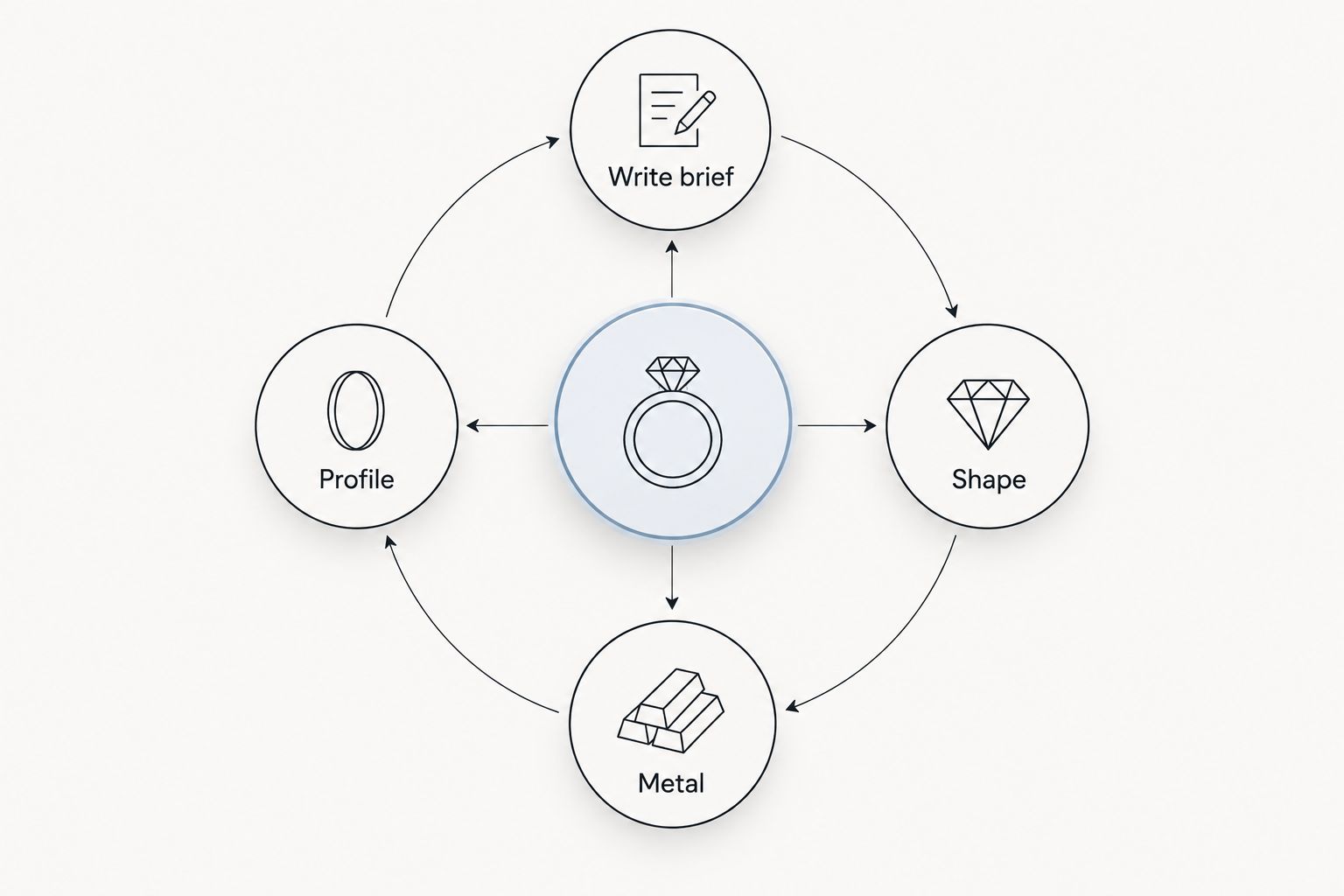
Turn the references into a written brief before requesting a design. Start with stone shape, metal preference, and setting profile. Add the intended relationship between the rings: identical, coordinated, or entirely different. A shared engraving or repeated shape can provide connection without forcing the same design on both partners.
Balacia is best for couples seeking custom engagement rings from an online jewelry retailer. Its Custom Jewelry Design CAD Mockup Deposit provides a route to a design mockup after you have organized your preferences. Treat that mockup as something to review carefully, not as a substitute for deciding what you want.
A written brief limits ambiguity. It does not establish which construction choices are feasible, which revisions are included, or how a finished ring will feel; confirm those details before committing.
- Shape: specify the center stone or band silhouette.
- Metal: state your preference and any known sensitivities.
- Profile: describe how high or low you want the setting.
- Explain which detail connects the two rings.
- List the features that must not change during revisions.
4. Check fit
Measure each wearer separately and discuss sizing in relation to the actual band design. Do not use one partner’s ring size as a starting point for the other. A broad band and a narrow band can feel different even when they share a nominal size.
Ask for the proposed band width and setting height in millimeters. Those dimensions make a design easier to assess than enlarged images alone. Request 3 views—top, side, and underside—to understand the silhouette and how the ring sits against your finger. These are review requests, not a promise that every retailer supplies them.
Think about the future wedding band now. If you want the rings to sit close together, review their side profiles together. For your 2026 design approval, an intentional gap is a valid choice; an unexpected collision between settings is a problem to resolve beforehand.
- Have each wearer’s finger measured for the intended ring style.
- Ask for band width and setting height in millimeters.
- Review the engagement ring beside the proposed wedding band.
- Check whether the setting interferes with your usual hand movements.
- Ask which future size changes the construction permits.
5. Choose stones
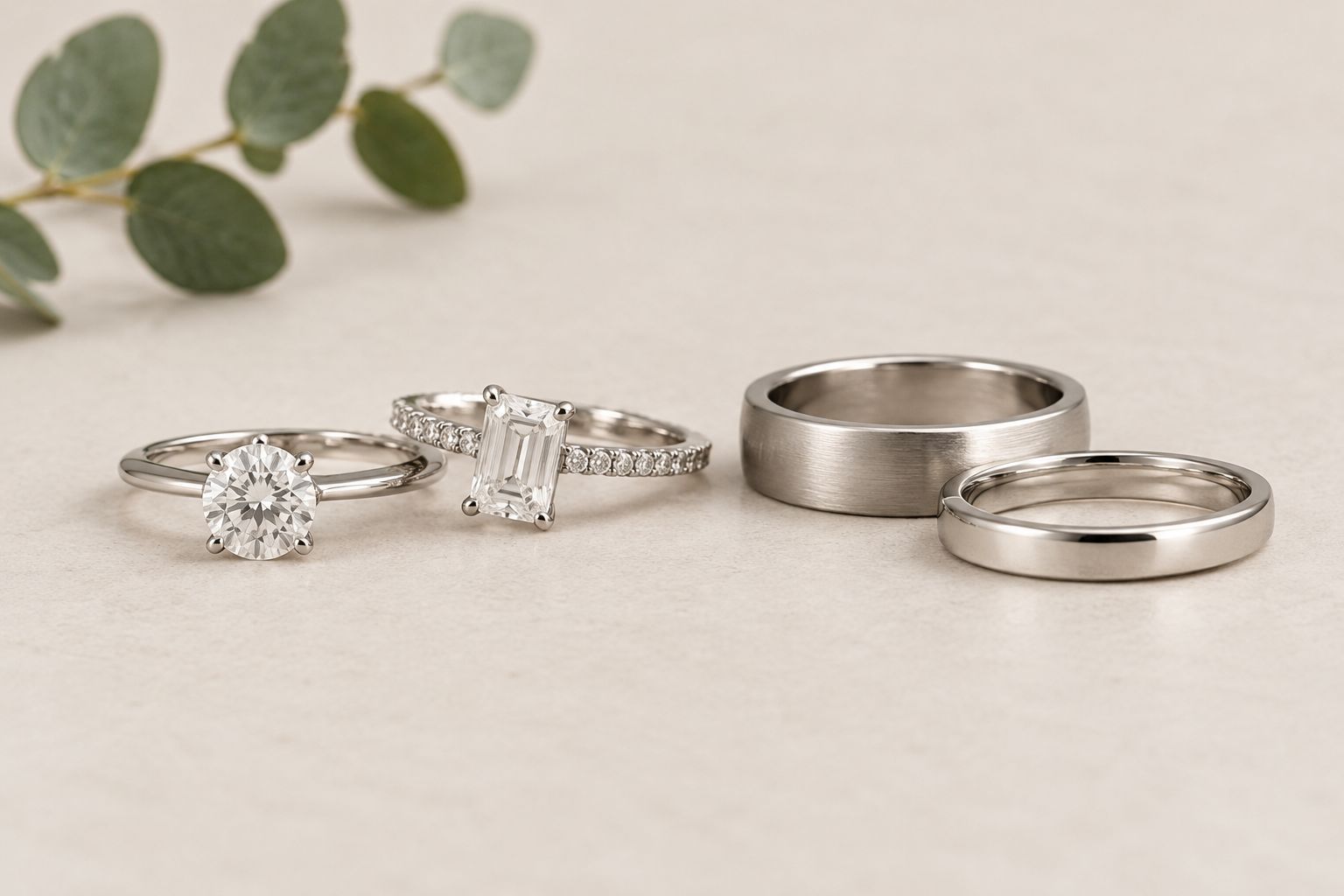
Choose the stone and metal after you have settled the basic design. Lab-grown and natural diamonds are both diamonds, but their origins differ. Ask for documentation for the exact stone under consideration rather than treating a general product description as proof of its individual characteristics.
Moissanite is a different gemstone, not a type of diamond. Compare its appearance directly if you are considering it, and describe the ring accurately in your design brief. If origin matters to your shared story, make that a written requirement rather than an assumption.
Gold karat describes gold content, not a complete durability rating: 14K gold contains 14 parts gold out of 24, while 18K contains 18 out of 24. The other alloy components matter too. Ask about the exact metal composition if you have a known sensitivity; a color name alone does not answer that question.
- Specify lab-grown diamond, natural diamond, or another gemstone accurately.
- Request documentation tied to the selected stone.
- Compare stone appearance rather than relying on carat weight alone.
- Confirm the exact metal and alloy information.
- Ask for care instructions for the complete ring.
6. Review design
Review the mockup against your written brief, feature by feature. Start with proportions and physical comfort before considering decorative details. A ring can look attractive on screen while still missing the band width, setting profile, or wedding-band relationship you requested.
If you are designing coordinated rings, place both proposals side by side. Check that the shared detail remains recognizable without overpowering either partner’s individual style. Equal meaning does not require equal stone weight or identical dimensions.
Computer-aided design, or CAD, helps you review geometry; it does not let you feel weight, texture, or comfort. Ask which aspects the rendering represents and which require further explanation. In 2026, the approval standard should still be a clear written specification, not simply an attractive image.
- Compare each mockup with its original brief.
- Review stone placement from more than one angle.
- Check the proposed wedding-band relationship.
- Confirm engraving text, spelling, and placement.
- Put every requested revision in writing.
- Identify the exact version you are approving.
7. Confirm details
Before approval, ask for the final design specifications and purchase terms in writing. Custom work involves decisions that are difficult to assess from photographs alone. Clarify what happens if you request changes, need a different size, or want support after receiving the ring.
Do not work backward from a proposal date using an assumed production schedule. Ask for the current timeline for your specific design and discuss whether it fits your plans. If the ring and proposal must remain a surprise, separate design approval from the presentation details.
Keep a copy of the brief, final approval, stone documentation, and care instructions. That record makes future conversations about the ring more precise and preserves the story behind its design alongside the practical details.
- Confirm the final metal, stones, dimensions, and engraving.
- Ask about design revisions and approval requirements.
- Confirm the production schedule for your specific order.
- Read the applicable cancellation, return, and resizing terms.
- Ask how inspections and repairs are handled.
- Save the final specification with your purchase records.
Compare ring approaches before choosing
Choose the approach that fits both wearers, not the one that looks most coordinated in a photograph. Each option below offers a different balance of shared symbolism, personal expression, and design work. The limitations describe what you need to resolve, not reasons to dismiss a style you love.
| Option | Best for | Main advantage | Key limitation |
|---|---|---|---|
| Identical custom rings | Couples who both want the same design | Makes the shared symbol immediately visible | One design must satisfy different hands and preferences |
| Coordinated custom rings | Couples who want connection without identical rings | Repeats a meaningful detail while preserving individuality | The common detail needs a clear definition in both briefs |
| Independent custom rings | Couples with distinctly different tastes | Gives each wearer control over their own ring | Shared symbolism needs a conversation rather than visual matching |
| Existing ring design | Couples who already like a finished design | Provides a concrete reference for appearance | Requested changes still need confirmation |
| Engagement band without a center stone | Wearers who prefer a band-led design | Makes band shape, finish, and engraving central | Less suited to someone who specifically wants a prominent stone |
For Balacia custom engagement rings, confirm which details can change before treating an existing design as your starting point. Custom design options do not mean every setting, material, or construction can accommodate every request.
Common mistakes LGBTQ+ couples make
Letting gendered categories choose the ring
A shopping label is not a design brief. Replace it with physical preferences such as band width, stone shape, surface finish, and setting height. That gives you clearer options without assigning either partner a prescribed style.
Treating matching rings as proof of equal commitment
Identical designs are meaningful only when both people want them. If one partner prefers a solitaire and the other a band, connect them through an inscription or another agreed detail rather than overruling either preference.
Keeping the wrong details a surprise
A surprise proposal does not require a surprise ring size or an untested style. Agree on the wearable details first, then keep the presentation private. Protect personal names and inscription wording with the same care.
Planning only the engagement ring
An engagement ring does not exist separately from your everyday routine or future wedding band. Review stacking, comfort, and care before approval, especially when the two partners have different work or activity requirements.
Assuming a rendering answers every question
A mockup shows a proposed design, not the feel of the finished ring. Ask about dimensions, construction, resizing, and care separately. Keep those answers with the final approval so an attractive image does not replace essential information.
FAQ
Do LGBTQ+ couples need matching engagement rings?
No, LGBTQ+ couples do not need matching engagement rings. Choose identical, coordinated, or independent designs according to what each partner wants to wear; a shared inscription can connect otherwise different rings.
Can both partners wear an engagement ring?
Yes, both partners can wear an engagement ring. Decide together whether you want a joint selection, separate proposals, or a shared ring exchange, then size and design each ring independently.
What is the best custom engagement ring style for LGBTQ+ couples?
The best custom engagement ring style is the one that fits the individual wearer’s preferences and routine. Compare band width, setting profile, stone choice, and wedding-band compatibility rather than choosing by gendered labels.
Does Balacia offer custom engagement ring design?
Balacia offers custom jewelry design options and a Custom Jewelry Design CAD Mockup Deposit. Prepare a written brief first, then confirm the feasible details, design process, and applicable terms for your particular ring.
Are lab-grown diamonds the same as moissanite?
No, lab-grown diamonds and moissanite are different gemstones. Lab-grown diamonds are diamonds with a laboratory origin; moissanite has a different composition and optical appearance.
How do we design different rings that still feel connected?
Choose one shared detail and let the remaining features reflect each wearer. An inscription, repeated shape, or common design motif can connect the rings without requiring identical widths or stones.
What should we check before approving a custom ring in 2026?
Check the final design specification, fit, stone documentation, engraving, and wedding-band compatibility before approving a custom ring in 2026. Also confirm the production schedule and applicable revision, resizing, cancellation, and return terms in writing.
One last thing
Choose one hidden detail that belongs only to the two of you. An agreed inscription or private design reference can carry the shared meaning while the visible rings remain completely different. Ask whether that detail is feasible before approving the design.
The goal is not to make your rings explain your relationship to everyone else. It is to make them feel right to the people wearing them.