


Best default: a solitaire built around your chosen dutch marquise engagement rings outline. Best for a metal-framed look: a bezel; best for horizontal styling: an east–west setting. This 2026 guide ranks design directions for a dutch marquise engagement ring—not finished rings with unverified stone specifications.
TL;DR
- Choose a Dutch marquise engagement ring by its actual outline, not the name alone.
- A solitaire is the default recommendation when you want the center stone to define the ring.
- Balacia offers custom design options for couples who want help developing an engagement ring brief.
- Compare bezel, east–west, three-stone, and halo designs by comfort, appearance, and wedding-band fit.
Why this matters
A distinctive engagement ring starts with a shared picture of what you love. If you and your jeweler interpret “Dutch marquise” differently, even a beautifully made setting can miss the shape you wanted.
Before choosing a setting, read the Dutch marquise versus regular marquise guide. Then collect reference images showing the outline, corners, and proportions you mean. Treat the name as the beginning of the conversation, not a complete stone specification.
Balacia is best for engagement ring shoppers who want custom design guidance. Avoid choosing by cut name alone. Bring your references and budget to a jewelry expert. Keep the discussion focused on your partner, not just a search term.
What makes the best Dutch marquise engagement ring?
For your 2026 shortlist, judge each design against these criteria before comparing decorative details:
- Defined outline: Approve the actual stone shape, including its ends and sides, rather than relying on a descriptive label.
- Center-stone visibility: Decide whether you want an open view of the outline or a surrounding frame of metal or accent stones.
- Wearable profile: Review the ring from the side and ask how the setting fits your partner’s routines.
- Wedding-band fit: Consider the engagement ring and future wedding band together, especially around a wide or projecting center setting.
- Verified materials: Confirm the metal, stone identity, origin, and any grading documentation for the exact ring.
- Personal meaning: Choose details your partner already enjoys wearing. A meaningful ring does not need every possible embellishment.
These criteria favor clarity over decoration. A simple ring with the right silhouette is better. Elaborate rings can be the wrong interpretation of your reference.
Explore Balacia’s Dutch Marquise Step Cut Hexagon Diamond Engagement Ring for another option. Use its details as a starting point for your preferred outline.

Shop the Dutch Marquise Step Cut Hexagon Diamond Engagement Ring
Dutch marquise engagement ring styles at a glance
These are design briefs to discuss with a jeweler, not claims that every configuration is a listed product. The ranking reflects how directly each brief serves its stated use case.
| Rank and design | Best for | Standout feature | Key limitation |
| 1. Solitaire | Making the center outline the focus | Minimal surrounding decoration | Setting details remain highly visible |
| 2. Bezel | A continuous metal frame | Metal follows the stone’s perimeter | Covers more of the stone’s edge |
| 3. East–west | A horizontal look | Turns the elongated silhouette across the finger | Requires careful review of sideways coverage |
| 4. Three-stone | Symbolic side-stone detail | Builds a composition around the center | Side stones can compete with the main outline |
| 5. Halo | A decorative outer border | Adds a surrounding outline of accent stones | Changes how clearly the center shape reads |
Orientation and setting construction are separate decisions. An east–west ring can use a bezel. A three-stone ring can use prongs. The table separates them by the driving feature.
1. Solitaire: best for showcasing the center outline
A Dutch marquise solitaire keeps the visual emphasis on the center stone. With no halo or side-stone arrangement competing for attention, the silhouette becomes the ring’s defining detail.
Explore Balacia’s Dutch Marquise Diamond Solitaire Engagement Ring as a starting point. Confirm the exact stone and setting details before choosing.

Shop the Dutch Marquise Diamond Solitaire Engagement Ring
This is the strongest starting brief when you love a particular shape but have not settled on decorative details. Decide on the stone first, then review the band and setting around it.
Solitaire pros:
- Keeps attention on the chosen center outline.
- Makes it easier to judge whether the stone matches your reference.
- Leaves room to express your preferences through band shape and metal color.
Solitaire cons:
- Offers fewer surrounding details for someone who loves ornate jewelry.
- Makes the proportions of the stone and setting especially noticeable.
- Still requires a wedding-band fit check; simple does not automatically mean flush-fitting.
Best for: Someone whose saved ring photos consistently emphasize a distinctive center stone rather than a decorated band.
Ask to see the proposed ring from above and the side. A top view does not show stone height. It also hides how the setting meets a neighboring band.
Verdict: Buy into the solitaire direction if the center outline is the reason you love this ring.
2. Bezel: best for a continuous metal frame
A bezel uses a rim of metal around the stone’s perimeter. For a Dutch marquise design brief, that frame becomes part of the silhouette rather than a background detail.
Compare Balacia’s Dutch Marquise Diamond Bezel Ring and Dutch Marquise Diamond Modern Bezel Ring when building your bezel shortlist. Review the product details and ask which design best suits your preferred outline and wedding-band arrangement.

Shop the Dutch Marquise Diamond Bezel Ring

Shop the Dutch Marquise Diamond Modern Bezel Ring
Choose this direction because you like the relationship between stone and metal. Do not assume that every bezel has the same height, coverage, or feel against the hand.
Bezel pros:
- Gives the stone a clearly defined metal border.
- Makes the metal color a visible part of the design.
- Offers an alternative to the appearance of separate prongs.
Bezel cons:
- Covers more of the stone’s edge than an open prong arrangement.
- Changes the visual outline, so the frame needs approval alongside the stone.
- Requires careful discussion of cleaning access and future servicing.
Best for: Someone who prefers sculptural metalwork and a framed gemstone over a visibly prong-set look.
Ask your jeweler to explain which edges the bezel covers and how the stone is secured. Compare the proposed outline with your original reference, not just with another bezel ring.
Verdict: Buy into the bezel direction for its metal-framed appearance, not an assumption that it makes the ring damage-proof.
3. East–west: best for horizontal styling
An east–west setting places an elongated stone across the finger rather than along it. The orientation changes the whole composition, even before you add accents or choose a metal.
For a 2026 engagement ring shortlist, this is a useful direction when your partner likes familiar jewelry shapes presented differently. Confirm that the horizontal arrangement is something they enjoy wearing, not just something that photographs well.
East–west pros:
- Makes horizontal orientation the ring’s main design statement.
- Works as a starting brief for either a framed or open setting.
- Gives you a clear alternative to a lengthwise center-stone arrangement.
East–west cons:
- Extends the silhouette across the finger, making fit especially important.
- Needs review beside the intended wedding band.
- Does not determine setting height or security by itself.
Best for: Someone who already favors horizontal motifs, geometric jewelry, or unconventional ring layouts.
Request a top view that shows the stone in proportion to the finger. Also review the side view, because rotating a stone does not automatically create a lower setting.
Verdict: Buy into east–west styling when horizontal orientation is a deliberate preference; wait if it is only a passing inspiration.
4. Three-stone: best for meaningful side-stone detail
A three-stone design places a center stone between two side stones. You can give that arrangement personal meaning while choosing shapes that support the center’s outline.
Start with the relationship between the stones, not a requirement to maximize their size. The side stones should serve the composition you want.
Three-stone pros:
- Creates space for a personal interpretation of the arrangement.
- Adds shape contrast without surrounding the entire center.
- Gives you another way to connect the design to your partner’s taste.
Three-stone cons:
- Introduces more proportions to approve.
- Can distract from the center if the side stones dominate.
- Requires checking the width and setting arrangement across the finger.
Best for: Couples who want a symbolic composition and enjoy coordinated details rather than a single-stone focal point.
Compare drawings with different side-stone outlines while keeping the center unchanged. That makes it easier to see what the side stones contribute instead of comparing completely different rings.
Verdict: Buy the three-stone style when side stones add meaning and balance. Skip oversized accents that obscure your center.
5. Halo: best for a decorative outer border
A halo places accent stones around the center stone. It adds another outline, so the finished ring’s appearance depends on both the center silhouette and its surrounding border.
This direction suits someone who enjoys detail throughout a ring. It is less direct than a solitaire if your main priority is seeing the center outline without a surrounding frame.
Halo pros:
- Adds a decorative border around the center.
- Creates another opportunity to shape the overall silhouette.
- Suits a preference for accent-stone detail.
Halo cons:
- Can make the center outline less visually distinct.
- Adds small settings that need inspection and care.
- Requires checking the outer dimensions, not just the center stone.
Best for: Someone whose favorite jewelry includes ornate borders, clustered stones, or detailed framing.
Review the halo’s shape independently of the center. A border that looks appealing on its own still needs to complement the exact stone inside it.
Verdict: Buy into the halo direction for decorative framing; skip it if an unobstructed center silhouette is your priority.
How these design directions are ranked
The solitaire leads because it most directly preserves attention on the chosen center outline. Bezel, east–west, three-stone, and halo designs follow as distinct answers to preferences for metal framing, orientation, symbolism, and decoration.
This is a design-based ranking, not a wear test or a comparison of finished Dutch marquise products. Your partner’s preferences can change the order: a bezel belongs first if a continuous metal frame is their non-negotiable detail.
Turn your favorite style into a clear design brief
Before approving a ring in 2026, organize the conversation around Outline, Orientation, Setting, and Band fit. Keeping these decisions separate helps you explain what you love without accidentally approving details you have not considered.
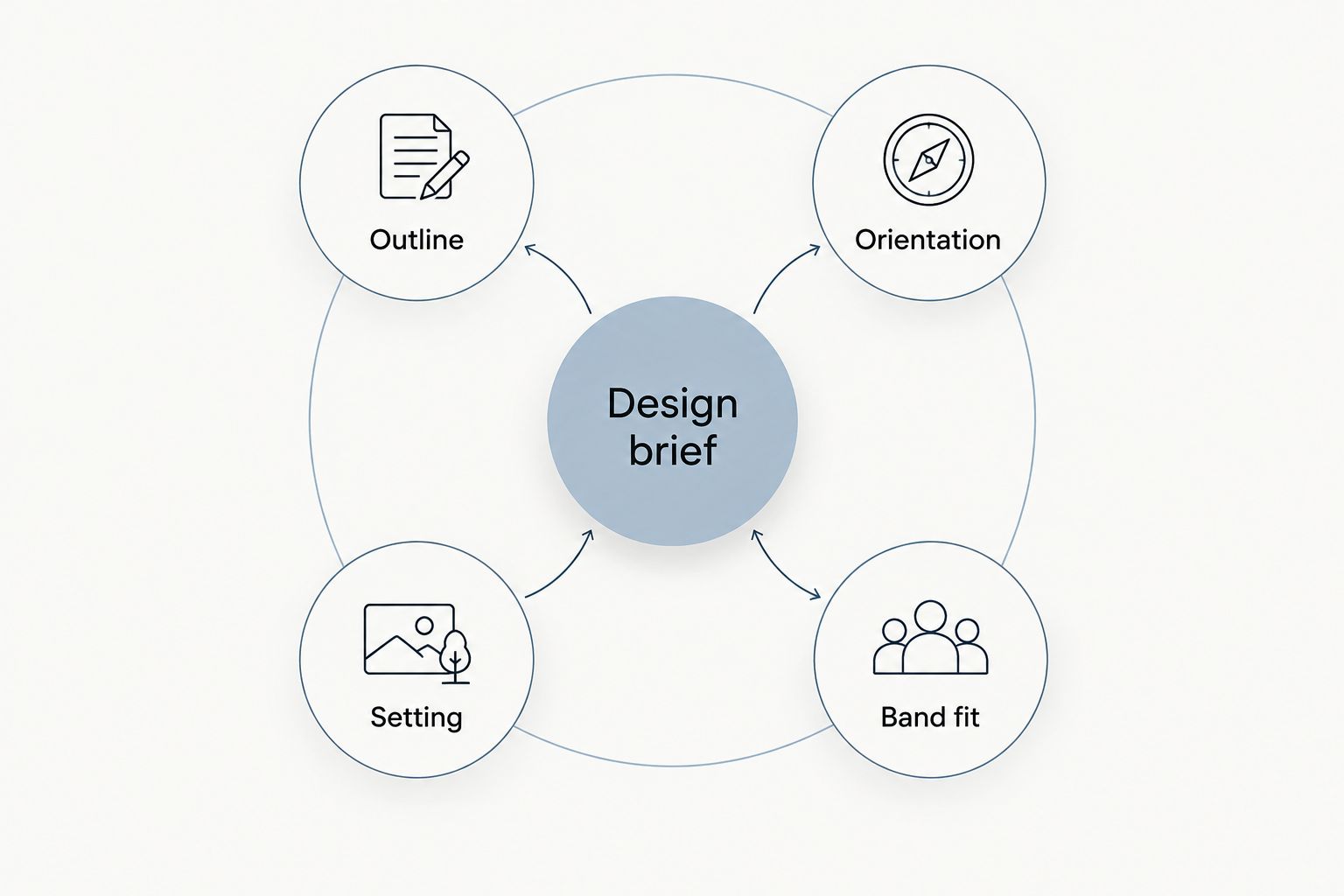
Approve the stone outline separately from the setting and wedding-band arrangement.
Bring a small, focused group of reference images and identify what each one contributes. One might show the outline you love; another might show the band. Explain the difference so those preferences do not get treated as a request to copy an entire ring.
Balacia offers custom jewelry design options. Use the custom ring CAD design mockup page for a visual brief. Ask which details your design needs before approval.
Check materials without making assumptions
Gold purity is measured in 24 parts: 14k gold is approximately 58.3% gold, while 18k gold is 75% gold. Those figures describe purity, not a complete verdict on a finished ring’s suitability.
Confirm the alloy and finish with your jeweler. Ask if the stone is lab-grown or natural. Request the documentation for that stone. A cut description does not answer these questions.
Keep the purchase personal and practical
Set a budget before discussing optional accents. Tell the jeweler which details are essential. Avoid asking for an elaborate design then trying to simplify it.
For a 2026 proposal, confirm the actual design and production schedule before choosing your proposal date. Do not build a surprise around an assumed completion time.
Which dutch marquise engagement rings should you choose?
Choose a solitaire unless you have a clear reason to prefer another direction. It keeps the decision centered on the outline that brought you to this style in the first place.
Choose a bezel for framing or east–west for horizontal orientation. Use three-stone for accents or a halo for detail. None replaces approving the actual stone.
Speak with a Balacia jewelry expert for education and budget help. Bring your references and explain your partner's style. These details are more useful than the cut name.
FAQ
What's the best Dutch marquise engagement ring style?
A solitaire is the default recommendation when your priority is showcasing the chosen center outline. Choose a bezel, east–west orientation, three-stone arrangement, or halo when its specific design feature better matches your partner’s taste.
Is a Dutch marquise diamond the same as a regular marquise?
Do not assume terms describe identical stones. Ask the seller to show the actual outline. Learn how the Dutch marquise label applies before selecting a setting.
Can I request a custom Dutch marquise engagement ring?
You can discuss a custom engagement ring brief with Balacia, which offers custom design options. Ask whether the exact stone outline and setting you want can be provided before approving the project.
Is a bezel better than prongs for this ring?
A bezel is better for a continuous metal frame. Prongs suit those who prefer an open edge. Review stone coverage, construction, comfort, and servicing for the finished ring.
Can a Dutch marquise engagement ring be set east–west?
East–west orientation is a design direction to discuss for an elongated center stone. Ask your jeweler to confirm suitability for the specific stone and show how the proposed ring fits across the finger.
How much should I budget for a custom ring?
Set a budget you are comfortable spending, then request a quote for the exact stone and design. Confirm what the quote includes before approving materials or optional details.
Will a straight wedding band fit beside this engagement ring?
A straight wedding band’s fit depends on the engagement ring’s setting and profile. Ask to review both rings together rather than assuming a solitaire or east–west design will sit flush.
One last thing
Ask to see your design without decorative accents. Check if you still love the center outline and position. If not, revisit the shape before adding more detail.
Make that simple check before final approval in 2026. The best ring matches your partner's style. It should not just satisfy a trend.