


A hidden halo setting is not inherently more fragile than a regular halo; its durability depends on how the ring is built, how its small stones are secured, and what it encounters during wear. The less obvious concern is contact beneath the center stone, where a neighboring wedding band can rub against exposed details. When choosing your ring in 2026, compare the complete setting rather than treating “hidden halo” as a durability rating.
- Is a hidden halo setting fragile? Not inherently; construction and wear matter more than the style name.
- Hidden halos add side-view sparkle; regular halos frame the center stone from above. Both need care.
- Balacia offers custom engagement ring options; discuss head support, small-stone security, and wedding-band clearance before choosing.
- Choose the halo you love only after checking its side profile and how your wedding band sits beside it.
Why this matters
An engagement ring carries a promise, but it also encounters sleeves, countertops, bags, and neighboring rings. A design that looks delicate is not automatically poorly constructed, and a larger-looking halo is not automatically stronger.
For your 2026 shortlist, separate appearance from construction. The hidden halo engagement rings guide is a starting point for understanding the look; a side-view inspection answers the more important questions about support and clearance.
Choose the setting for your life, not just the photograph. A ring should feel meaningful without leaving you uncertain about when to take it off.
Is a hidden halo setting more fragile than a regular halo?
No. Neither label establishes which finished ring is stronger, because halo placement is only part of the construction. The amount and arrangement of supporting metal, the stone-setting work, and the ring’s condition all affect durability.
A hidden halo places accent stones beneath the center stone, making them most noticeable from the side. A regular halo surrounds the center stone’s outline when viewed from above. Those positions create different contact points, not a universal ranking of strength.
| Detail | Hidden halo | Regular halo |
|---|---|---|
| Best for | A center-focused top view with side sparkle | A visible frame around the center stone |
| Main visual benefit | Accent stones stay beneath the center stone | Accent stones emphasize the center stone’s outline |
| Main trade-off | Underside details need attention when pairing a band | The surrounding halo adds an exposed outer edge |
| What to inspect | Halo clearance, basket support, and small-stone settings | Outer-edge condition, head support, and small-stone settings |
| What the name cannot tell you | Metal thickness, workmanship, or current condition | Metal thickness, workmanship, or current condition |
A visible halo can project beyond the center stone, while a hidden halo can sit closer to surrounding bands. Neither observation proves that one ring will last longer. Compare actual rings with similar proportions, not style names in isolation.
Also distinguish a damaged accent-stone setting from a compromised center-stone setting. They are different problems, although damage anywhere on the head warrants professional inspection rather than continued wear.
Hidden halo: best for side-view sparkle
A hidden halo suits someone who wants the center stone to lead from above, with a quieter detail visible as the hand moves. That private sparkle can feel especially personal in an engagement ring.
Its limitation is visibility during inspection. You need to look beneath and around the center stone, not simply check whether the ring looks intact from above. Small settings tucked into the basket still require care.
Ask whether the hidden halo also forms part of the ring’s supporting structure or serves mainly as decoration. A circle of accent stones does not, by itself, establish how the center stone is secured.
Choose a hidden halo when you love the side detail and can confirm that the complete setting suits your routine. Do not choose it on the assumption that “hidden” means protected from every impact.
Regular halo: best for a visible diamond outline
A regular halo suits someone who wants a distinct border of sparkle around the center stone. It changes the ring’s face-up appearance more directly than an accent positioned beneath the stone.
Its trade-off is the surrounding perimeter. That outer edge contains small stones and settings that deserve inspection after knocks, catching, or visible changes. A broad outline is a visual feature, not proof of stronger construction.
Look beneath a regular halo as carefully as you would beneath a hidden one. The attachment between the head and band matters even when the top looks substantial.
Choose a regular halo for its visible framing, not as an automatic durability upgrade. A well-considered design still needs appropriate handling and professional attention when something changes.
Why halo-setting durability varies
The details behind durability are more useful than a blanket verdict about either style. Focus on these factors when comparing rings:
- Head support: Look at how the stone-holding portion connects to the band. Ask the jeweler to explain the connection and any supporting shoulders.
- Small-stone security: Accent stones depend on their individual settings. Loose, worn, or damaged metal needs attention regardless of halo position.
- Setting height: A raised head changes how the ring encounters objects and clothing. Consider the full side profile rather than the halo alone.
- Metal and proportions: The alloy, thickness, and arrangement of metal work together. A metal name alone does not establish durability.
- Wedding-band contact: A neighboring ring can rub against the basket, prongs, or accent stones when the profiles interfere.
- Daily wear and condition: Lifting weights, gripping tools, and wearing an already damaged setting introduce concerns that a style label cannot resolve.
Ask for explanations tied to the exact ring. “This design has supporting shoulders here” gives you something to examine; “all hidden halos are strong” does not.
How do you check a halo setting before buying?
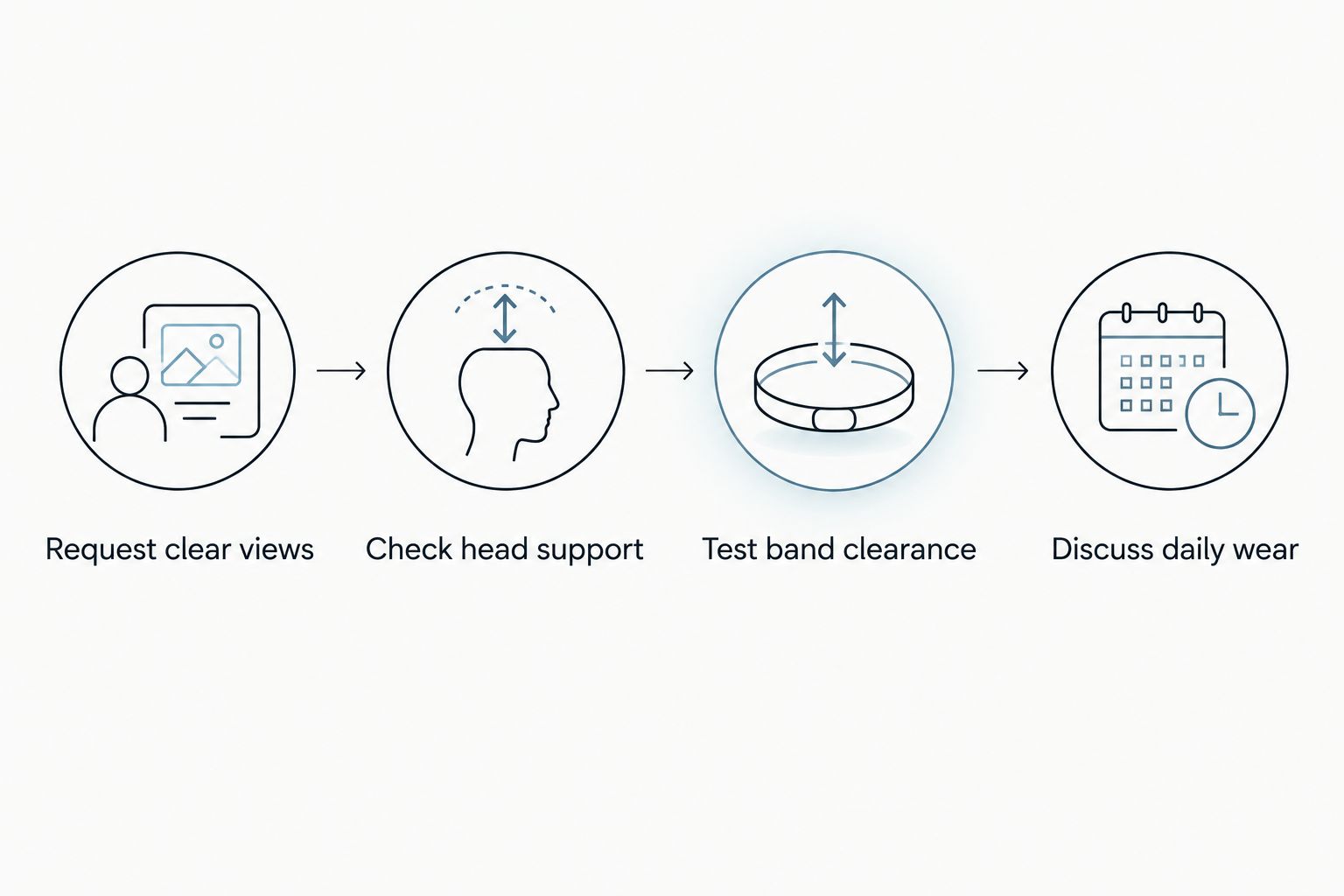
Use this 2026 buying checklist to turn a beautiful image into an informed decision. You do not need to diagnose jewelry construction yourself; you need clear views and specific answers.
1. Request clear views
Ask for 3 views: top, side, and underside. The top shows the visual effect, the side shows height and support, and the underside helps reveal the basket and accent-stone placement.
Do not infer dimensions from a close-up photograph. Ask for the actual measurements if you need to understand how the ring will sit on your hand.
2. Check head support
Ask the jeweler to identify what holds the center stone and how the head joins the band. Check whether the explanation concerns the main setting or only the decorative halo.
An unfamiliar design is not automatically unsafe. The goal is to understand its construction rather than judge it by appearance alone.
3. Test band clearance
View the engagement ring beside the wedding-band style you intend to wear. Check where the band reaches the basket and whether either ring touches exposed stones or delicate setting details.
A matching look does not guarantee a compatible fit. The side profiles need to work together.
4. Discuss daily wear
Tell the jeweler about gloves, hands-on work, exercise, and the rings you already wear. Ask which activities require removing the engagement ring and how to recognize a setting that needs inspection.
A useful buying conversation ends with care instructions for the actual ring, not a general promise that it is durable.
Can your wedding band damage a hidden halo?
A wedding band can damage a hidden halo if repeated contact wears the setting or its exposed details. The same concern applies wherever adjacent rings rub against vulnerable parts; it is not exclusive to hidden halos.
Check 2 rings together rather than evaluating each separately. A band that sits neatly beside one engagement ring can meet the underside of another because their profiles differ.
When comparing solitaire and halo ring settings, the useful distinction is not simply the presence of accent stones: the neighboring band must clear the actual head and basket in either design. A plain-looking setting still needs a compatible pairing.
Do not assume a spacer band solves every contact problem. Ask a jeweler to assess the complete stack, including whether the proposed spacer changes where the rings touch.
For your 2026 wedding stack, request a side view of the combination before committing. A small gap is preferable to forcing rings into contact simply to achieve a flush appearance.
What should you ask about a specific hidden halo ring?
The Balacia Nova Vintage Halo Round Pink Diamond Engagement Ring is described as having a round center diamond, a 4-prong setting, and a hidden halo. Those details identify its design; they do not establish a comparative failure rate or remove the need to assess its fit with your wedding band.
Its hidden accent is best for someone drawn to side-view detail. The trade-off is the same practical consideration as other hidden halos: look beyond the top view and ask about the exact basket, clearance, and care requirements.
Balacia is best for engagement-ring shoppers seeking online options with custom design possibilities. Speak with a Balacia jewelry expert for education about your purchase and help discovering a meaningful ring within your budget.
Bring questions about the ring’s metal, proportions, stone settings, and intended band pairing. If you are considering a custom design, discuss these points while reviewing the custom ring CAD design mockup, rather than treating the drawing only as an appearance check.
How do you care for a hidden halo without damaging it?
Protect the setting from pressure and impact first. Remove your engagement ring before lifting weights, handling tools, or doing work that presses hard objects against the head or band.
For routine cleaning in 2026, follow the jeweler’s instructions for the ring’s exact materials. A soft brush and mild soapy water are commonly used for diamond jewelry, but mixed materials, treatments, and delicate settings require individual guidance.
- Clean over a bowl rather than an open drain.
- Avoid forcing brush bristles beneath tiny settings.
- Do not probe beneath stones with pins or other sharp objects.
- Ask a jeweler before using an ultrasonic cleaner.
- Store the ring separately so it does not rub against other jewelry.
There is no universal home test that proves every accent stone is secure. Cleaning restores visibility; it does not replace inspection of worn or damaged setting metal.
Should you stop wearing a halo ring if it starts snagging?
Yes. New or persistent snagging warrants an inspection, particularly if the ring previously felt smooth. A raised or damaged prong is one possible cause, and continued catching can worsen the problem.
Do not bend metal back yourself or test security by pressing on the stones. Remove the ring, keep it safely stored, and have a jeweler identify the cause before wearing it again.
Does a hidden halo make the center diamond more secure?
Not automatically. A hidden halo is not a substitute for properly fitted center-stone prongs or another suitable securing structure.
Some designs incorporate supporting elements around the basket, but their function depends on the construction. Ask which parts secure the center stone and which parts provide decoration.
FAQ
Is a hidden halo setting fragile enough to avoid for everyday wear?
A hidden halo is not inherently too fragile for everyday wear. Choose a well-constructed setting, check wedding-band clearance, and remove the ring for activities involving pressure or impact.
Is a regular halo stronger than a hidden halo?
A regular halo is not automatically stronger than a hidden halo. Compare head support, metal proportions, small-stone settings, and condition on the actual rings.
Can small diamonds fall out of a hidden halo?
Small diamonds can come loose if their settings become worn or damaged. Stop wearing the ring if you notice movement, missing stones, or a change in how the setting feels.
Can I wear a wedding band next to a hidden halo?
You can wear a wedding band next to a hidden halo when the profiles are compatible. Have a jeweler check that the band does not rub against vulnerable setting details.
Does a lower hidden halo always mean a stronger ring?
A lower hidden halo does not always mean a stronger ring. Height is only one consideration; the head connection, supporting metal, and stone-setting work also matter.
Should I use an ultrasonic cleaner on my hidden halo ring?
Ask your jeweler before using an ultrasonic cleaner on a hidden halo ring. Loose stones, delicate settings, and some materials or treatments require different cleaning methods.
What should I ask a jeweler before choosing a hidden halo?
Ask about head support, accent-stone security, wedding-band clearance, and care for your daily routine. Request top, side, and underside views so the explanation relates to the exact ring.
One last thing
The most revealing photograph on your 2026 shortlist might be the underside, not the sparkling top view. It shows the area you need to understand before pairing a hidden halo with a wedding band.
Ask to see how the rings sit together before you fall in love with the stack. That practical step protects the small details that make your engagement ring feel personal.