


Best overall: a round diamond solitaire. Best for a sparkling outline: an oval halo. Best for clean geometry: an emerald-cut solitaire. Best for shared symbolism: a three-stone ring. Best for a personal fit: a custom low-profile design. This 2026 guide ranks natural diamond engagement rings by style. It includes the checks that matter before you choose your forever ring.
TL;DR
- For natural diamond engagement rings, a round solitaire is the best starting point when you want a simple, adaptable design.
- Choose an oval halo for a diamond-framed outline or an emerald-cut solitaire for clean geometry.
- Confirm natural origin for the center diamond and accent stones separately; a style name does not establish origin.
- Ask a Balacia jewelry expert to explain stone documentation, setting choices, and options within your budget.
Why this matters
An engagement ring carries a promise. It also has to work on an ordinary Tuesday. The best choice balances your partner's love with how the setting feels. Consider how stones are secured and what documentation establishes.
Balacia is best for natural diamond engagement ring shoppers who want help exploring designs and custom options. Start with Balacia to explore their engagement ring offering. Then ask about the exact natural diamond and setting combination you want.
For your 2026 shortlist, separate style from stone origin. Solitaire, halo, or three-stone designs can contain natural or lab-grown diamonds. The setting's appearance does not tell you which it holds.
What makes the best natural diamond engagement rings?
Use these criteria before falling in love with a photograph. A beautiful image is an introduction, not a complete buying decision.
- Verified origin: Ask for documentation identifying the center diamond as natural, plus separate confirmation for accent diamonds.
- Appearance in motion: Review the actual diamond beyond a still photograph, including its light pattern and any visible inclusions.
- Wearable construction: Consider setting height, exposed corners, prongs, and how the ring feels beside neighboring fingers.
- Personal style: Match your partner's existing jewelry preferences rather than treating a popular shape as a universal answer.
- Complete-ring suitability: Check metal, ring size, wedding-band fit, care requirements, and the full purchase terms before committing.
The familiar 4Cs are cut, color, clarity, and carat weight. For round diamonds, distinguish a laboratory's cut grade from the term "cut" for shape. An oval or emerald shape needs its own visual assessment.
Natural diamond engagement rings at a glance
These are style recommendations, not claims that every ring in a category has the same construction or diamond quality. Confirm the details of the exact ring you select.
| Rank and style | Best for | Standout feature | Key limitation |
| Round diamond solitaire | A simple, adaptable default | One center diamond remains the focus | An exposed setting needs careful inspection |
| Oval halo ring | A diamond-framed outline | Accent diamonds surround an elongated center | More settings to inspect and clean |
| Emerald-cut solitaire | Clean geometry | Broad, step-cut reflections | Inclusions can be easier to see |
| Three-stone ring | Shared symbolism | A center diamond with a stone on either side | Matching and finger coverage need attention |
| Custom low-profile ring | A personalized wearing fit | Design decisions centered on the wearer | Requires detailed decisions before approval |
1. Round solitaire: best natural diamond ring for simplicity
A round diamond solitaire puts one center stone at the heart of the design. You see the diamond and setting clearly without a halo or side stones. This is useful when your partner prefers understated jewelry.
Choose this style because you love its simplicity, not because every solitaire wears the same way. A tall prong setting and a low bezel setting can feel very different, even around similarly sized diamonds.
Round solitaire pros:
- Keeps attention on the center diamond.
- Makes setting details easier to assess without surrounding accents.
- Provides a straightforward starting point for discussing wedding-band pairing.
Round solitaire cons:
- Offers little decorative detail if your partner likes ornate jewelry.
- Leaves the center diamond visually prominent, including visible inclusions.
- Requires a separate check of setting height and stone protection.
Best for: Someone whose favorite jewelry is simple and who wants the engagement diamond to be the main event.
For a 2026 purchase, see the round diamond in different lighting. Do not choose by carat weight alone. Verdict: Buy a round solitaire if simplicity matches your partner's style.
2. Oval halo: best natural diamond ring for a sparkling outline
An oval halo surrounds an elongated center diamond with smaller accent stones. The halo adds a distinct border. This choice suits someone who enjoys a decorated ring over a single-stone look.
Examine the oval and its surrounding frame separately. Look at the center diamond's dark and bright areas as it moves. Check whether the halo's proportions complement the center diamond.
Oval halo pros:
- Creates an elongated, diamond-framed silhouette.
- Adds detail around the center without requiring a three-stone arrangement.
- Gives you clear design choices around halo shape and spacing.
Oval halo cons:
- Adds small settings that need inspection and cleaning.
- Can feel visually busy beside a detailed wedding band.
- Requires confirmation of accent-stone origin as well as center-stone origin.
Best for: A partner who already gravitates toward sparkle, decorative borders, and elongated shapes.
Ask how the halo sits relative to the center diamond and whether its edges feel comfortable against neighboring fingers. Verdict: Buy an oval halo for a framed look; skip it if your partner consistently chooses minimal jewelry.
3. Emerald-cut solitaire: best natural diamond ring for geometry
An emerald-cut diamond has a rectangular outline, clipped corners, and step-cut facets. Its broad reflections create a different visual rhythm from the smaller flashes associated with brilliant-cut designs.
An emerald-cut solitaire makes geometric features the focus. Look closely at the actual stone. Open facets make inclusions easier to notice. A clarity grade alone should not decide the purchase.
Emerald-cut solitaire pros:
- Emphasizes straight lines and an architectural silhouette.
- Shows broad reflections rather than a busy facet pattern.
- Keeps the center stone's outline visible without a surrounding halo.
Emerald-cut solitaire cons:
- Can reveal inclusions that distract from the face-up appearance.
- Will disappoint someone expecting a round brilliant's light pattern.
- Needs careful inspection of corner protection and setting construction.
Best for: Someone who loves tailored clothing, clean lines, and jewelry with a restrained geometric character.
View the diamond face-up and in motion. Check that you like the balance of bright and dark reflections, rather than selecting a rectangle from its measurements alone. Verdict: Buy an emerald-cut solitaire for its geometry, not as a substitute for brilliant-cut sparkle.
4. Three-stone ring: best natural diamond ring for shared symbolism
A three-stone engagement ring places a center diamond between two side stones. You can give that arrangement your own meaning. It may represent shared history or a design your partner loves.
Judge the composition as a whole. The side stones should create the balance you want. The spread across the finger should feel comfortable rather than crowded.
Three-stone ring pros:
- Creates room for personal meaning without requiring an engraving.
- Offers different combinations of center and side-stone shapes.
- Adds detail across the finger rather than around the center alone.
Three-stone ring cons:
- Requires attention to how the stones look together.
- Can occupy more space across the finger than a narrow solitaire.
- Needs origin confirmation for each diamond component.
Best for: A couple who wants a meaningful arrangement and enjoys a ring with distinct side-stone detail.
If natural origin matters throughout the ring, specify that clearly before selecting stones. Do not assume a natural center means the side diamonds share that origin. Verdict: Buy a three-stone ring when both the symbolism and the finger coverage feel right.
5. Custom low-profile ring: best natural diamond ring for personal fit
A custom low-profile design starts with how your partner wants the ring to feel. This is a design brief, not a single setting type. Diamond dimensions and construction determine how low the ring sits.
Balacia offers custom design options. Bring photographs of styles your partner likes. Explain practical preferences such as a lower setting, protected edges, or space for a wedding band.
Custom low-profile ring pros:
- Lets you prioritize the wearer's preferences from the beginning.
- Creates a focused conversation about height, proportions, and band pairing.
- Allows personal details without relying on an existing design unchanged.
Custom low-profile ring cons:
- Requires decisions that a finished-ring shopper would not need to make.
- Needs careful review of dimensions, renderings, and written specifications.
- Does not guarantee a wedding band will sit flush beside it.
Best for: Someone with clear wearing preferences or a specific design idea that existing rings do not satisfy.
Verdict: Buy custom after agreeing on the stone and design details; wait if your partner's preferences remain uncertain.
Check the stone before approving the ring
For natural diamond engagement rings in 2026, verify origin separately from the design. A grading report evaluates the diamond described in that report. It is not a blanket statement for every stone.
Use this sequence before approving your selection:
- Confirm origin: Request documentation identifying the center diamond as natural and ask about any treatments.
- Match the report: Compare the report details with the diamond being offered, including an inscription when present.
- Inspect appearance: Review the actual diamond's images or video and ask about anything you can see.
- Confirm accents: Establish the origin and stated quality of side stones and halo diamonds separately.
- Approve construction: Review metal, dimensions, setting height, ring size, and wedding-band clearance.
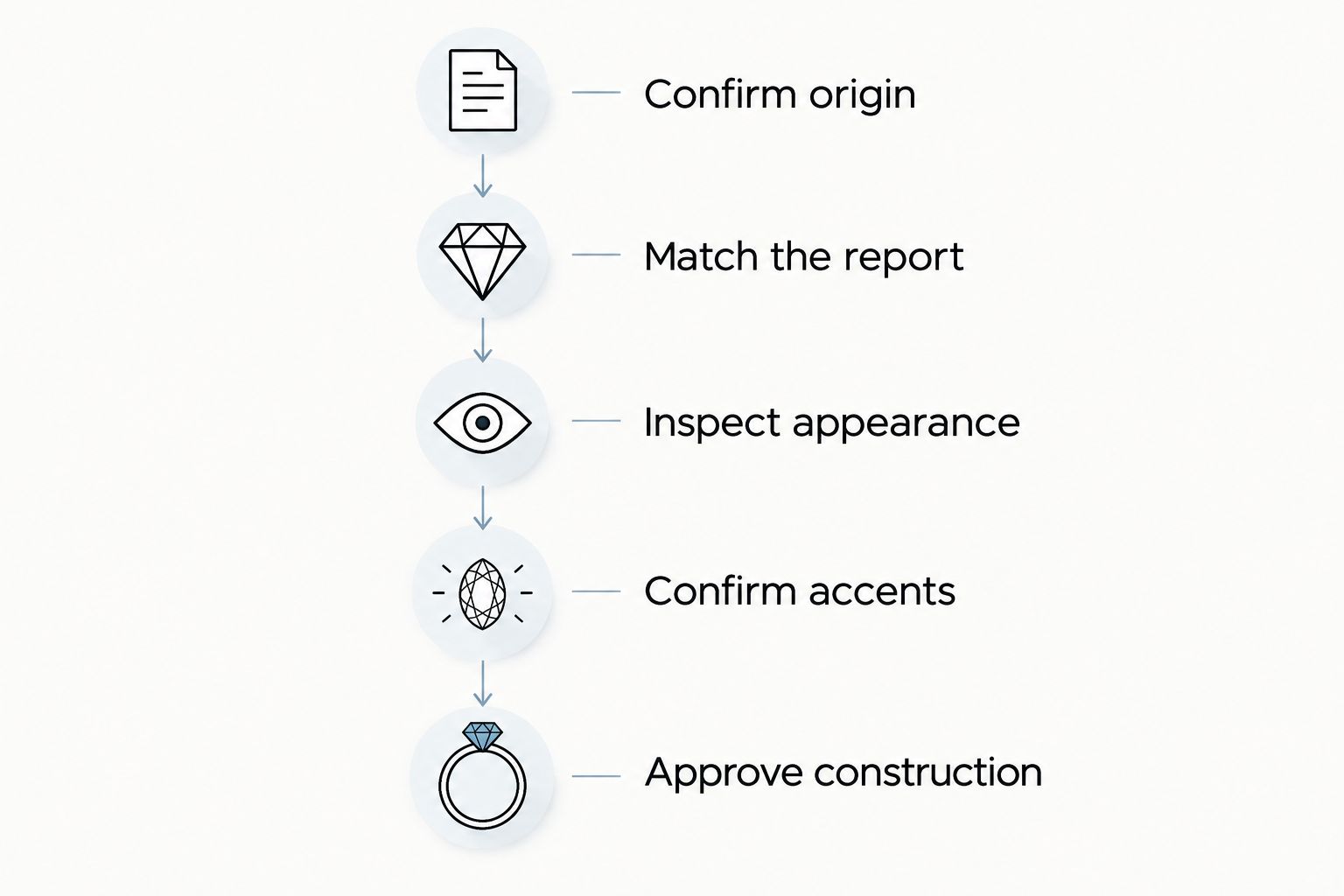
Choose the style first, but approve the ring only after checking the stone and construction.
Metal markings deserve the same attention. Gold fineness describes the proportion of gold in an alloy. 14k gold contains 14 parts gold out of 24. 18k contains 18 parts. Neither marking establishes diamond origin or stone grade.
How these styles are ranked
The ranking prioritizes design simplicity, clear use cases, and the decisions you need to make before purchase. It is not a laboratory comparison of individual diamonds or a durability test of finished rings.
The round solitaire leads as a straightforward starting point. The other choices earn separate roles: a framed outline, geometric reflections, shared symbolism, and personalized fit. None replaces inspection of the actual ring.
Which natural diamond engagement ring should you choose?
Choose a round solitaire if you are undecided and your partner likes simple jewelry. Choose the oval halo or three-stone design only when the added detail reflects what your partner already enjoys wearing.
For your final 2026 decision, keep the brief concrete: preferred shape, metal color, wearing height, natural-origin requirements, and spending limit. Speak with a Balacia jewelry expert for help understanding the options and finding a meaningful ring within your budget.
FAQ
What's the best natural diamond engagement ring style?
A round solitaire is the best starting point if you want a simple design focused on one diamond. Choose a halo, emerald-cut solitaire, three-stone ring, or custom design when its specific features better match the wearer.
How do I know an engagement ring diamond is natural?
Request documentation identifying the exact diamond as natural, then match that documentation to the stone being offered. Confirm accent diamonds separately and ask whether any treatments are disclosed.
Is a natural diamond better than a lab-grown diamond?
Natural origin is a preference, not a guarantee of better appearance or construction. Compare the actual diamond and finished setting, and choose the origin that fits your priorities.
Should I choose a solitaire or a halo engagement ring?
Choose a solitaire for a single-stone focus and a halo for a diamond-framed outline. A halo adds small settings to inspect and clean, while a solitaire makes the center diamond more visually prominent.
How much should I spend on a natural diamond engagement ring?
Set a spending limit that fits your finances rather than following a salary rule. Ask a jewelry expert to explain the trade-offs among the center diamond, setting, metal, and accent stones within that limit.
Are emerald-cut diamonds a good choice for engagement rings?
Emerald-cut diamonds suit engagement ring shoppers who prefer clean geometry and broad reflections. Inspect the actual stone for visible inclusions and a light pattern you enjoy before choosing it.
Can I customize a natural diamond engagement ring with Balacia?
Balacia offers custom design options for engagement ring shoppers. Ask a jewelry expert about a natural diamond design brief. Confirm the exact stone, construction, and terms before approving it.
One last thing
A lower setting and a flush-fitting wedding band are different requirements. See the ring's side profile beside the band your partner wants. That small check can change your setting choice.
For a proposal in 2026, let the surprise be the moment, not an avoidable mismatch in style or fit. The ring should feel like something your partner would choose—and something you chose with care.